Solar installation on Austria's Patscherkofel mountain above Innsbruck powers facilities at 6,500 feet
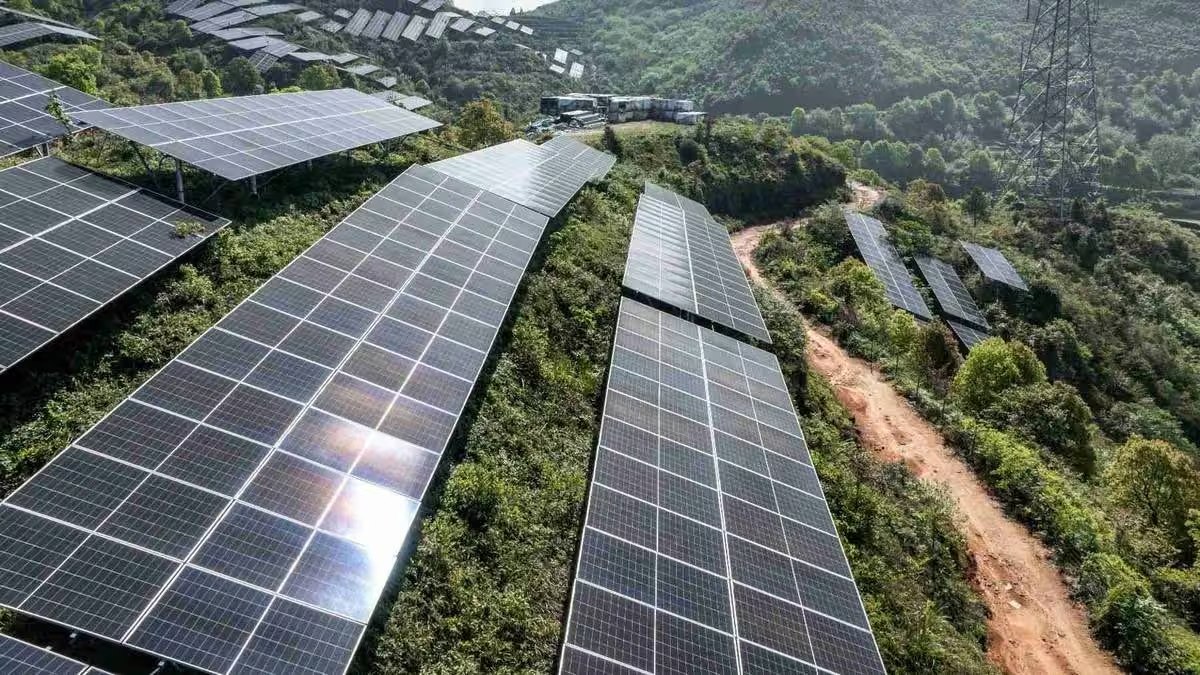
The short answer
IKB Sonnenstrom commissioned a 500 kWp photovoltaic system on Patscherkofel in September 2025, integrating power to cable car stations and summit facilities. The project demonstrates viable high-altitude solar deployment, using specialized mounting systems to withstand extreme alpine weather conditions.
Key facts
- Capacity
- 500 kWp total across three stations
- Stage
- Commissioned
- EPC or contractor
- Aerocompact
- Owner or developer
- IKB Sonnenstrom GmbH
- COD
- September 2025
- Location
- Patscherkofel, Innsbruck, Austria
Solar installations are typically associated with sun-drenched rooftops or quiet agricultural fields.
A windswept alpine peak in the dead of winter presents a starkly different environment.
High above the Austrian city of Innsbruck, photovoltaic arrays now operate at nearly 2,000 meters on the slopes of Patscherkofel, positioned adjacent to a cable car line.
The engineering challenge lies in ensuring these systems endure such severe climatic conditions.
A solar plant on a mountain above Innsbruck
Patscherkofel, a prominent local landmark, rises approximately 2,000 meters above the city of Innsbruck.
The mountain functions as a year-round recreational destination, offering skiing in the winter months and mountain biking during the summer.
A cable car system ascends the peak, with stations distributed along the route.
These facilities serve purposes beyond those of sports enthusiasts.
In September 2025, a photovoltaic facility was officially commissioned, integrating the cable car infrastructure and its stations.
The project represents one of the largest undertakings by IKB Sonnenstrom GmbH.
Following an intensive period of planning and construction, the system is now capable of providing sustainable solar power to the ski resort.
Aerocompact and IKB report that the installation comprises 1,143 modules with a total capacity of approximately 500 kWp.
Achieving this scale at such an altitude is a significant engineering accomplishment.
The summit station sits at an elevation of 1,965 metres, or roughly 6,450 feet.
At such altitudes, the infrastructure must withstand daily exposure to strong winds, heavy snowfall, and extreme cold.
The photovoltaic array on Patscherkofel is not a single contiguous field. Instead, it comprises three distinct stations, each contributing to the total output.
Each facility features a tailored configuration designed to handle its specific local weather conditions.
Three solar stations along the mountain
Innsbrucker Kommunalbetriebe reports that the valley station is equipped with 207.9 kWp of capacity, the intermediate station with 204.68 kWp, and the mountain station with 90.05 kWp.
The system directs electricity to where it is required. At the valley level, the primary objective is to provide a steady power supply for lift operations and related infrastructure.
Up at the mountain station, the solar panels power the restaurant and the surrounding facilities.
Consequently, skiers sipping hot chocolate at the summit are benefiting in part from this renewable energy source.
While the high altitude necessitates robust construction, it also offers the advantage of more intense solar radiation, which boosts energy production.
Each photovoltaic module must remain securely fastened during severe storms and under significant snow accumulation.
How the panels stay in place in rough weather conditions
The mounting infrastructure is the critical component of this installation.
Aerocompact, the developer responsible for the project, deployed its COMPACTFLAT SN 2 system across all three solar stations on the mountain.
While the valley-level station requires a straightforward installation, the facilities located higher up the slopes present more complex engineering challenges.
The intermediate station faces storm and snow loads that pose significant risks. To address this, Aerocompact’s solution there integrates an aerodynamic profile with ballast-optimized fixation.
This approach utilizes a weighted base to secure the system. In this context, the weight anchors the panels firmly without causing damage to the underlying roof structure.
The mountain station demands an even higher level of engineering complexity.
At an elevation of nearly 2,000 metres, wind conditions are extreme, prompting the company to develop a specialized variant of its system.
Whereas the standard configuration relies on two attachment points, this high-altitude version employs a reinforced clamping mechanism featuring three support feet.
The additional foot provides essential stabilization against the intense winds encountered at that altitude.
Aerocompact’s design aims to demonstrate that sustainable energy solutions are viable even in the most demanding alpine environments. However, annual performance reports have not yet been released. While the solar panels are engineered to withstand extreme weather conditions, long-term validation will require further evidence. If the mounting systems prove durable, other mountain stations may adopt similar installations. Aerocompact contends that ski resorts could then meet their energy demands efficiently.
Get the week's signal, not the noise
Our sharpest reporting on energy, climate and nature — free, once a week.
Pvola take
This installation proves that utility-scale solar is viable in extreme alpine environments, not just flat agricultural land. The engineering focus on wind and snow load resistance offers a critical template for developers targeting high-elevation sites where traditional mounting fails.
Frequently asked questions
What is the operational status of the solar plant on Patscherkofel mountain above Innsbruck?
The photovoltaic facility was officially commissioned in September 2025. It is now operational, providing power to cable car stations and mountain facilities at nearly 2,000 meters elevation.
How does the Patscherkofel solar project support the cable car infrastructure and mountain stations?
The system provides a steady power supply for lift operations at the valley level. At the mountain station, solar panels power the restaurant and surrounding facilities, reducing reliance on external grid power.
What engineering challenges does the Patscherkofel solar installation face due to its high-altitude location?
The systems must endure severe alpine climatic conditions, including extreme weather and winter winds. Long-term validation of mounting system durability is required to confirm viability for broader adoption in ski resorts.