Brazil: Neoenergia launches R$60 million tender to fund solar, battery, and grid modernization projects in Bahia
The short answer
Neoenergia Coelba has opened a 60 million reais funding call in Bahia for energy efficiency projects, including solar and battery storage, with a submission deadline of January 14, 2027. Developers and facility owners can access capital to reduce peak consumption and modernize electrical infrastructure through this competitive selection process.
Key facts
- Jurisdiction
- Bahia, Brazil
- Instrument
- Public tender for energy efficiency projects
- Status
- Open for proposals
- Effective date
- January 14, 2027
- Scope
- Industrial, commercial, public, and residential sectors
- Rate or target
- 60 million reais total allocation
Neoenergia Coelba has launched a new funding opportunity for businesses, public institutions, and residential complexes in Bahia seeking to upgrade their electrical infrastructure and cut energy costs. The utility has allocated 60 million reais to select energy efficiency projects, which may include solar power generation and battery storage systems.
Proposals must be submitted by January 14, 2027. However, a mere interest in installing solar panels or replacing outdated equipment is insufficient; applicants are required to demonstrate the technical and economic feasibility of the proposed improvements.
Industrial sector to receive the largest share of the 60 million reais
Although the public call covers various sectors, the majority of the available funds has been earmarked for the industrial and productive rural sectors.
China connects 600 MWh plant to grid, converting air to liquid at −194 °C to store solar and wind energy and generate power for 10 hours
Brazil leaves over 36 billion kWh of solar and wind energy unused in 2026, despite billions invested in renewable power plants
Researchers at the University of São Paulo (USP) and the University of York have simulated a silicon structure that requires less than half the surface area of conventional black silicon, while maintaining similar optical properties for solar research applications.
The initiative allocates 25 million reais to this specific category, which is eligible to submit proposals for modernizing equipment, optimizing electrical processes, and integrating energy efficiency solutions.
The public tender also sets aside 8 million reais for government entities, 8 million reais for the commercial and services sector, and another 8 million reais for public services. Street lighting projects will receive 6 million reais, while residential condominiums are allocated a share of 5 million reais.
This distribution underscores the scale of the program, which extends beyond the installation of photovoltaic power plants. Hospitals, commercial establishments, administrative buildings, and lighting systems are all eligible to propose measures for reducing energy consumption.
For productive agricultural activities, specific conditions apply: such projects compete for funds within the industrial category but will only be funded if there is a remaining balance after the selection of approved industrial projects.
Funds will not be allocated automatically. Each proposal must meet the tender's requirements and undergo an evaluation that considers, among other factors, the projected energy savings relative to the required investment.
Solar power and batteries could reshape consumption at large facilities
One of the most compelling aspects of the selection process is the potential to combine electricity generation with technologies that enable smarter utilization.
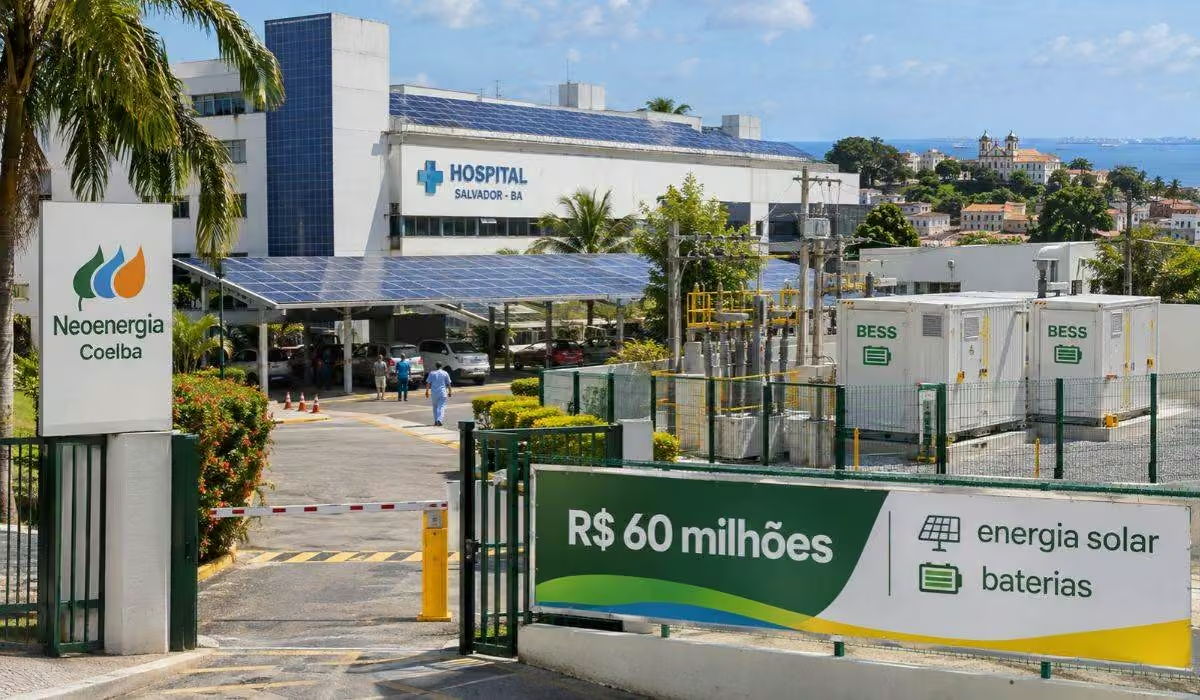
Projects may include photovoltaic solar panels, upgrades to electrical infrastructure, replacement of inefficient equipment, and battery storage systems, known as BESS.
Consider a hospital that consumes significant amounts of electricity during the day and faces higher rates at certain times. In addition to generating part of its own power through solar panels, the facility could use batteries to shift grid consumption to more cost-effective periods.
The combination of these technologies is already operational in Bahia. In Salvador, the Hospital Santo Antônio, part of the Obras Sociais Irmã Dulce network, previously received an 800 kilowatt-peak (kWp) solar power plant and an energy storage system, a project implemented in partnership with Neoenergia Coelba.
According to the distributor, the system installed in 2024 enables the displacement of approximately 1,800 kWh of consumption from peak hours on a daily basis. The facility has also undergone various other energy efficiency improvements over the years.
This case illustrates the potential of such technologies in high-consumption facilities, although it is a prior project and is not included in the new R$ 60 million call.
However, participation in the current tender requires more than simply proposing the installation of a standalone solar plant. The documentation mandates demonstrating that other economically viable energy efficiency measures have already been adopted or will be implemented concurrently.
This requirement aims to prevent establishments from installing new generation equipment while continuing to waste electricity in lighting, air conditioning, or processes that could be modernized.
Who can participate and what is the maximum funding per project?
The call for proposals is open to eligible consumers served by Neoenergia Coelba in Bahia, a group that includes industrial facilities, commercial establishments, public agencies, service providers, and residential condominiums.
Participating consumer units must be connected to the distributor's grid and be in good standing regarding their contractual obligations. The tender also imposes restrictions on properties that are occupied under lease agreements.
Each project is generally required to request funding from the Energy Efficiency Program within a range of 600,000 to 3 million reais. For industrial proposals, the maximum allowable amount increases to 5.5 million reais.
These figures represent the resources allocated for each initiative, rather than a guaranteed sum for participants. Projects that include financial co-investments may present a higher total investment, provided they remain within the program's established limits.
A critical aspect of the financing conditions involves the structure of returns. For-profit companies and residential condominiums are required to enter into energy performance contracts, where the return of funds is tied to the actual energy savings achieved.
Non-profit organizations may qualify under different terms, provided they verify their eligibility and meet the requirements set out in the public call.
Neoenergia also requires that the studies be prepared by a technically qualified applicant. This means interested parties must provide concrete details regarding their energy consumption, existing equipment, and the anticipated benefits of the modernization.
How to submit a project and participate in the selection process until January 2027
Interested parties must access the Project Public Calls page on Neoenergia’s official website, locate the 2026 edition, and review the tender document, its annexes, and any subsequent updates.
Registration is conducted through the Project Public Call Portal, the electronic platform used to receive technical and commercial documentation. Applicants are required to register their responsible parties and prepare the preliminary energy diagnosis mandated for the first phase.
This document must outline information on the consumer unit, consumption history for the past 12 months, intended improvements, estimated costs, and the expected energy savings.
The scope of required studies varies by project type. Photovoltaic systems, for instance, demand detailed data on the installation site, shading conditions, and the structural integrity of the surface intended to support the panels.
Prospective applicants bear the full cost of preparing the preliminary diagnostic, which Neoenergia will not reimburse. Submitting the document does not guarantee project approval or subsequent execution.
Queries regarding the process can be submitted through the company’s portal until January 7, 2027. The preliminary diagnostic must be delivered by 11:59 p.m. Brasília time on January 14, 2027.
According to the tender’s schedule, the partial results of the first phase are expected to be released by March 1, 2027. Selected projects will then undergo a second round of diagnostic and evaluation before any potential contract is awarded.
Pvola take
This tender shifts the focus from pure generation to integrated efficiency, rewarding projects that demonstrably reduce peak load. The strict feasibility requirement ensures funds go to viable upgrades rather than speculative installations, setting a benchmark for technical rigor in Brazilian distributed energy projects.
Frequently asked questions
How much funding has Neoenergia Coelba allocated for the new energy efficiency tender in Bahia?
Neoenergia Coelba has allocated 60 million reais for the tender. The funds are intended for projects that include solar power generation and battery storage systems.
What are the submission deadlines for the Neoenergia Coelba energy efficiency tender in Bahia?
Proposals must be submitted by January 14, 2027. Applicants must also deliver a preliminary diagnostic by 11:59 p.m. Brasília time on that date.
Which sectors are prioritized for funding in the Neoenergia Coelba 60 million reais tender?
The industrial and productive rural sectors are earmarked for the majority of the available funds. Applicants must demonstrate technical and economic feasibility for their proposed improvements.