Smart Energy Signs 1.5 MWc Solar EPC+F Contract in Cote d'Ivoire
The short answer
Smart Energy and CTCI executed an EPC+F agreement on Nov 20, 2026, for a 1.5 MWc solar plant with 2 MWh storage in Alepe. The project targets grid instability by replacing expensive diesel generation, securing industrial continuity for the rubber processor.
Key facts
- Capacity
- 1.5 MWc solar panels and 2 MWh battery storage
- Stage
- EPC+F contract signed
- EPC or contractor
- Smart Energy
- Owner or developer
- CTCI (Ivorian Rubber Processing Company)
- Location
- Alepe, Cote d'Ivoire
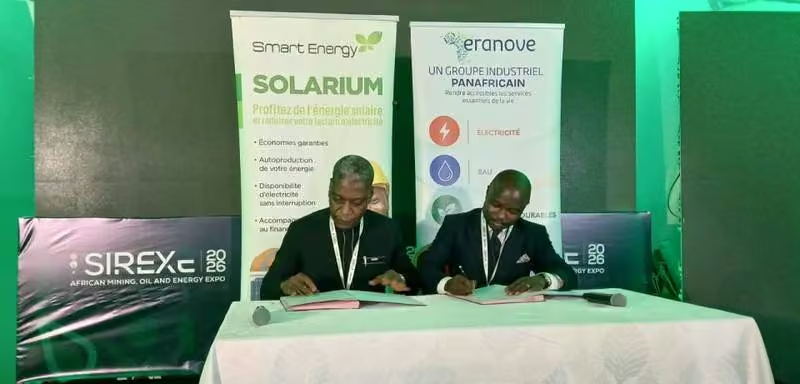
Abidjan, Nov 20, 2026 (AIP) – Smart Energy and the Ivorian Rubber Processing Company (CTCI) executed an EPC+F agreement on Friday, Nov. 20, 2026, in Abidjan. The signing took place on the sidelines of the second International Exhibition of Extractive Resources and Energy (SIREXE). The contract covers the construction of a solar power plant equipped with energy storage systems.
Smart Energy Chief Executive Officer Kpan Refus stated that the project involves the installation of approximately 1.5 megawatt-peak (MWc) of solar panels and 2 megawatt-hours (MWh) of battery storage. He emphasized that the initiative reflects a shared goal of leveraging energy performance to enhance industrial competitiveness.
“Since Smart Energy began supporting commercial and industrial enterprises in Côte d’Ivoire, our consistent message has been that energy efficiency and the self-generation of renewable energy are not merely issues of sustainability but also critical factors in industrial competitiveness,” Kpan said.
For a processing company like CTCI, where energy underpins every stage of production, the cost, quality and availability of power directly shape the performance of its industrial assets, the executive noted.
Through its EPC+F offering, Smart Energy bundles engineering, procurement, construction and financing structuring to deliver reliable energy with predictable costs over a 20- to 25-year horizon, allowing clients to concentrate on their core business.
“Signing today commits us to the results of tomorrow,” he stated, praising the teams at both companies that prepared the project.
CTCI Chief Executive Officer Karim Diarra thanked Smart Energy for its persistence, admitting he had been skeptical at first following a previous unsuccessful experience with another firm.
“Smart Energy understood our needs and our vision,” he said, noting that CTCI, an active member of the Association of Natural Rubber Professionals of Côte d’Ivoire (APROMAC), pursues a sustainability vision aimed at green production.
The initiative addresses a critical operational challenge. CTCI’s facility in Alépé, located at the end of the transmission line, has been plagued by power outages and voltage drops, forcing the company to rely on expensive gas-powered generators, according to Mr. Diarra.
“By replacing or reducing our dependence on diesel generators with green energy, we can lower our production costs, gain better control over our operational chain, and ensure business continuity,” he stated.
The project will also help reduce the company’s carbon footprint and better meet customer demands, while being financed by Smart Energy based on its performance metrics.
“The biggest risk is yours. It is the savings or the output of your production that will fund the solution,” emphasized the CEO of CTCI, who thanked Smart Energy and the Eranove group for their confidence. On-site deployment is scheduled for Monday.
Pvola take
This deal validates the EPC+F model for industrial sites facing grid instability, shifting risk to the provider while locking in predictable energy costs. For developers, it demonstrates that performance-based financing can unlock projects in underserved regions where traditional grid connections are unreliable.
Frequently asked questions
What are the capacity specifications of the solar plant Smart Energy is building for CTCI in Côte d’Ivoire?
The project includes 1.5 MWc of solar panels and 2 MWh of battery storage. This hybrid system is designed to enhance industrial competitiveness by ensuring reliable and cost-predictable energy supply.
How does the EPC+F contract structure the financial risk for CTCI in this solar project?
Smart Energy finances the solution based on performance metrics, shifting the primary risk to the savings generated. This model allows CTCI to focus on core business while reducing its carbon footprint.
What is the expected operational horizon for the energy solution provided to CTCI by Smart Energy?
The contract covers a 20- to 25-year horizon for reliable energy delivery. This long-term structure enables CTCI to plan production with predictable energy costs and improved asset performance.