Balcony Solar Study Shows Winter Grid Draw Exceeds Panel Output
The short answer
A 365-day Italian study found that a 1.38 kWp balcony solar system drew 56 kWh more from the grid than it produced between November and January. This reveals that small distributed systems with oversized inverters can become net energy consumers during low-sun periods, undermining self-consumption goals.
Key facts
- Application
- Balcony-mounted photovoltaic system with battery storage
- Scale
- 1.38 kWp array, 2.56 kWh battery, 6 kW hybrid inverter
- Performance metric
- 56 kWh excess grid draw in winter; -10.6% self-sufficiency index
- Segment
- Residential households seeking bill reduction via self-consumption
- Economics
- 16.80 euros additional cost over winter quarter at 30 cents per kWh
- Location
- Parma, Italy, Po Valley region
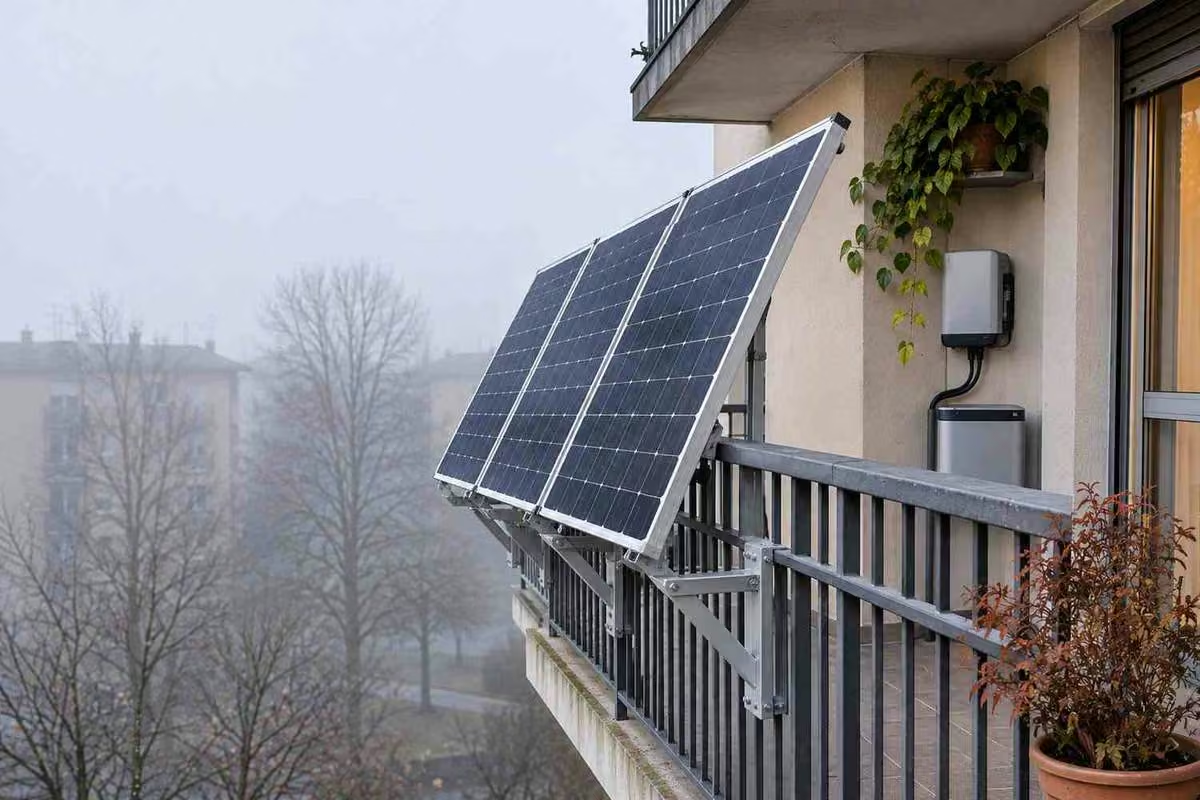
Three solar panels mounted on a balcony, a battery for energy storage, and a device intended to lower utility bills. Yet, between November 2025 and January 2026, an experimental photovoltaic system in Parma recorded 56 kWh of electricity drawn from the grid in excess of the monitored household consumption. While the panels generated power, the system ultimately required more energy to operate than it produced. This presents a significant contradiction for a technology specifically designed to reduce electrical consumption.
An Italian study published in Sustainability documented this behavior. The research was conducted by scientists from the National Research Council (CNR), the University of Catania, and the University of Florence. Over a 365-day period, the team monitored a balcony-mounted photovoltaic system with storage capabilities, identifying a phenomenon they termed the Appliance Paradox. Under specific conditions, the system intended to save electricity can function like an always-on appliance, consuming more energy than it saves.
Why balcony solar panels can consume energy in winter
The experiment ran from May 8, 2025, to May 7, 2026, on a balcony in the Po Valley, positioned approximately five meters above ground level. Researchers installed three 460-watt photovoltaic modules, totaling 1.38 kWp of capacity, alongside a 2.56 kWh lithium iron phosphate battery and a hybrid inverter rated at roughly 6 kW. This inverter serves as the central component that converts the electricity generated by the panels and manages the flow of energy among the system, the battery, household appliances, and the public grid.
The panels were tilted at a 60-degree angle and oriented slightly west of south, a configuration designed to capture the lower winter sun. The system operated in zero feed-in mode, meaning generated power could be used immediately or stored in the battery, but any surplus was not exported to the public grid. While this setup allows for the management of self-consumption, it also introduces constraints when the electricity produced exceeds immediate demand.
The core issue, however, lay within the inverter. According to the manufacturer’s specifications, the model in question draws 50 watts even when it is not powering any connected devices. While this figure may seem negligible in isolation, it accumulates to 1.2 kWh per day over a 24-hour period. This baseline consumption is further compounded by energy losses associated with current conversion and battery operation. Consequently, the inverter continues to require electrical input even during periods of zero solar irradiance.
During the winter months, which are marked by the fog and limited sunlight typical of the Po Valley, panel output dropped sharply. In certain intervals, the energy harvested was insufficient to offset the system’s own demand. The inverter was also significantly oversized for the three-panel array; its 6 kW nominal capacity far exceeded the installation’s requirements, leading to efficiency losses when operating at very low loads.
The data clearly illustrates the outcome. Between November and January, the panels generated approximately 131 kWh of electricity, yet total losses exceeded the energy produced. Consequently, grid consumption rose by 56 kWh compared to the amount required solely to power the monitored appliances. This resulted in an estimated additional cost of 16.80 euros, based on a tariff of 30 cents per kWh. The quarterly energy self-sufficiency index dropped to -10.6%. The negative figure signifies that more electricity was required to keep the system operational than was saved through generation.
In summer, panels covered more than half of consumption
Conditions shifted significantly during the sunniest months. Over the full year of monitoring, the three panels produced 1,477 kWh of electricity, enabling an average coverage of 32.3% of the demand from connected devices. In summer, this percentage climbed to 55.8%, reaching as high as 84.7% on the most productive day. The battery contributed to this result by storing electricity generated during midday hours and making it available in the evening.
The experiment also revealed a second constraint. When the battery reached full capacity and connected devices drew minimal power, the inverter curtailed panel output to prevent surplus energy from being fed into the public grid. Researchers calculated that approximately 289 kWh of potential solar generation went unused over the course of the year, representing 16.4% of the theoretically available energy.
Despite these losses, the system’s annual economic balance remained positive. The installation avoided electricity purchases from the grid worth roughly 224 euros over twelve months, with savings particularly pronounced during the summer months. In August alone, for instance, the reduction in electricity costs was estimated at 33.50 euros, slightly more than half of what the household would have spent without the photovoltaic system.
To replicate the energy profile of a typical household, the research team employed actual appliances controlled by programmable power outlets, distributing domestic tasks across the day. Certain activities were deliberately scheduled during peak solar generation hours to maximize the utilization of available renewable energy. This setup effectively models a residence where consumption is optimized to support self-consumption, a strategy that offers significant benefits for homeowners capable of scheduling laundry and other appliance usage during daylight hours.
Shutting down the system in winter could yield greater savings
To prevent the photovoltaic installation from becoming a net energy consumer, the researchers developed a metric known as the Energy Advantage Index (EAI). This index compares the energy savings generated by the system against the power losses inherent in its operation. A negative value indicates that the system is drawing more electricity from the grid than would be required in the absence of the photovoltaic setup. In the experimental data, this condition was observed predominantly during the coldest months of the year.
The researchers modeled a straightforward intervention: shutting down the balcony solar system entirely from November through January to eliminate inverter power consumption during the least productive months. Their calculations indicated that this measure would increase annual savings from approximately 224 euros to 241 euros. Furthermore, the payback period for the initial investment, estimated at roughly 1,100 euros for the components, would shorten from 4.6 years to 4.3 years.
This seasonal shutdown scenario was evaluated using a simulation based on data collected over the course of the year, rather than through direct experimental testing. The findings nonetheless suggest that operating a balcony solar system with battery storage for twelve consecutive months is not necessarily the most cost-effective approach, particularly when the inverter has high idle power consumption and winter energy generation is minimal.
The detail to check before buying a balcony solar system
The study also points to an alternative approach: selecting an inverter that is appropriately sized for the panel capacity and operates with significantly lower standby power consumption. The researchers compared various levels of energy draw and found that if the inverter’s consumption had remained below 10 watts, there would have been no days during the monitored winter period where the energy required just to keep the device running exceeded the panels’ output. While other system losses naturally persist, the comparison highlights the substantial impact that device selection can have on overall performance.
A critical distinction must be made: the experimental setup differed from standard plug-and-play balcony solar kits. It featured a battery, three panels with a combined capacity of 1.38 kWp, and a hybrid inverter of approximately 6 kW, chosen specifically to manage energy storage and prevent feed-in to the grid. These results apply strictly to this specific configuration, which was installed in Parma and monitored for a single year, and do not imply that all balcony solar panels exhibit identical behavior.
The study offers a practical guideline for homeowners considering the installation of a small-scale solar array. To accurately estimate potential savings, it is not enough to examine the cost of the panels and the battery capacity; one must also account for the power consumption of the inverter during periods of low activity or when it remains active without generating usable energy. This factor can have a significant impact, particularly during the winter months. When sunlight is scarce, panel output drops to zero, yet the inverter may continue to draw power, adding to the household's electricity bill.
Green news of the week, in 5 minutes.

Choose a Christmas gift with a story to tell

Seychelles, beyond the beaches: discover the extraordinary animals that inhabit them

4 Green Spain destinations to visit in autumn (and 118 experiences to truly live them)
4 Green Spain destinations to visit in autumn (and 118 experiences to truly live them)
Pvola take
The Appliance Paradox highlights a critical design flaw in small-scale distributed solar: oversized inverters create baseline loads that exceed generation in low-irradiance conditions. Installers must match inverter capacity to array size to prevent systems from becoming net consumers rather than savings tools.
Frequently asked questions
What did the Italian study find about balcony solar systems in winter?
The study found that the system drew 56 kWh from the grid in excess of household consumption between November and January. This occurred despite the panels generating power, highlighting a significant operational contradiction for the technology.
How much potential solar generation was unused in the Parma experiment?
Approximately 289 kWh of potential solar generation went unused over the year, representing 16.4% of theoretically available energy. The system's annual economic balance remained positive, avoiding roughly 224 euros in electricity purchases.
What are the implications for installers of balcony solar systems?
Installers must account for the Appliance Paradox, where the system can consume more energy than it saves in winter. This requires careful design to ensure the system does not function as an always-on appliance that increases utility bills.