Netherlands: Housing corporations install far fewer solar panels: only 49,400 new PV installations, while insulation gains priority
The short answer
Dutch housing associations installed 49,400 solar panels in 2026, down 20 percent from 2025, as the netting scheme abolition reduced financial appeal. This shift prioritizes insulation, which grew 10 percent, to meet 2028 energy label mandates for social rental stock.
Key facts
- Application
- Rooftop solar PV on social rental housing
- Scale
- 49,400 new installations in 2026
- Performance metric
- 20 percent year-on-year decline in installations
- Segment
- Social housing associations managing 2.26 million units
- Economics
- 12.4 billion euros allocated to maintenance and sustainability in 2025
- Location
- Netherlands
The figures are drawn from the latest Aedes benchmark. The study relied on data provided by 242 housing associations, which collectively manage 2.26 million social rental units and represent 92 percent of all association-owned housing in the country.
Conflicting figures persist
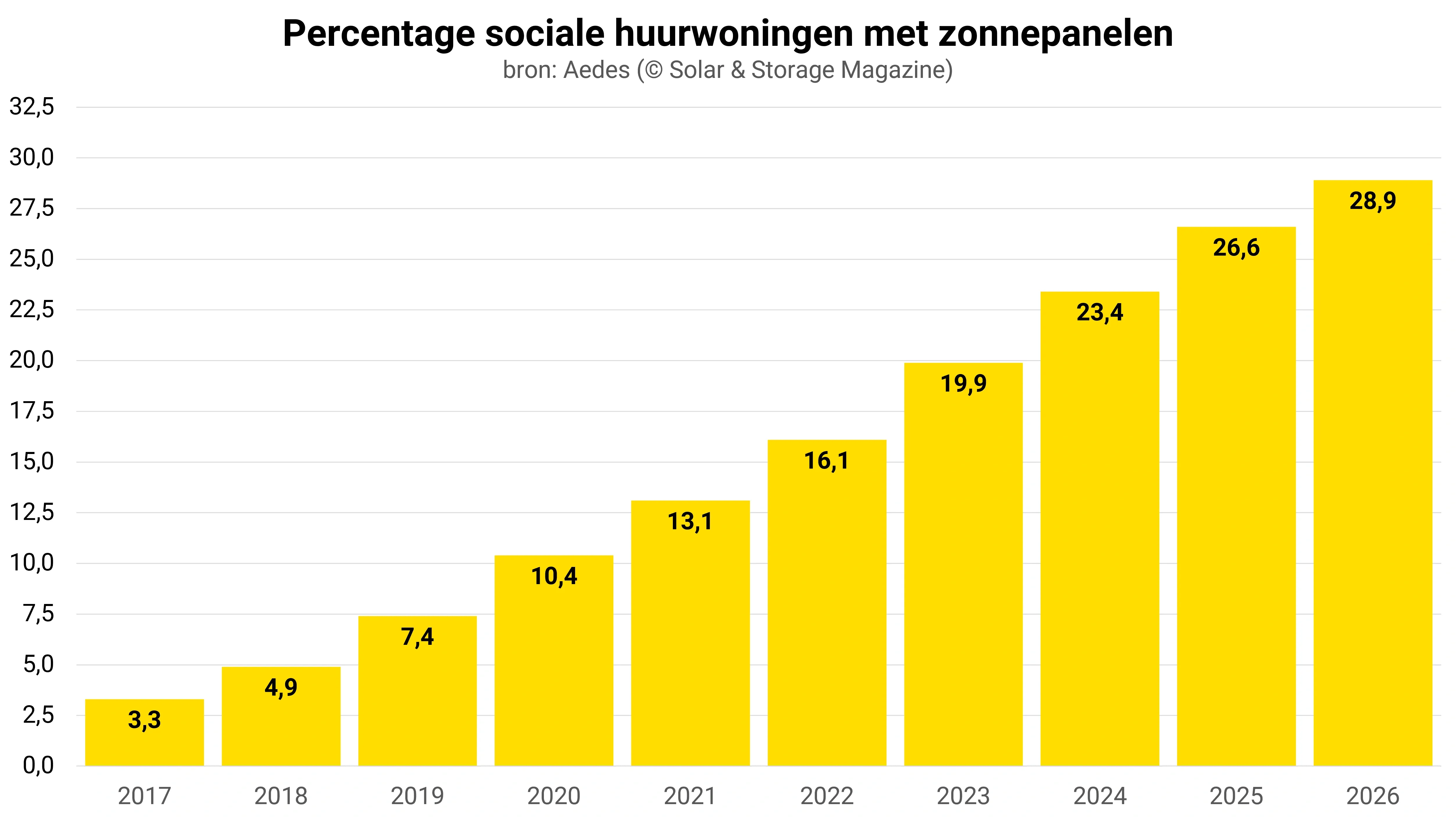
The number of homes receiving solar panel installations from housing associations has declined for the second consecutive year. The count fell from 75,200 units in 2024 to 61,500 in 2025, and further to 49,400 in 2026, marking a drop of nearly 20 percent in the most recent year.
Notably, the 2025 figure of 61,500 installations remains unchanged in this latest benchmark, despite Aedes previously informing Solar & Storage Magazine that the actual number stood at 76,045, a substantial increase over the initially reported total. At the time, Aedes attributed the discrepancy to the fact that not the same housing associations participate in the survey each year, meaning that identical periods can yield different results across various reports. Consequently, year-on-year comparisons must be interpreted with caution, a caveat that also applies to the figures in this latest benchmark.
Insulation takes priority
The decline in solar panel installations is linked, according to the benchmark, to the abolition of the netting scheme effective 1 January 2027, along with feed-in costs and unpredictable feed-in tariffs, which have reduced the financial appeal of solar panels for housing associations.
In contrast to the drop in solar panel activity, there has been a clear acceleration in insulation work. Between mid-2025 and mid-2026, housing associations implemented approximately 3 percent more sustainability measures than in the previous year, driven primarily by insulation. Facade insulation increased by 15 percent, roof insulation by 13 percent, and floor insulation by 10 percent. Window replacement rose by 3 percent. In total, the number of insulation measures grew by nearly 10 percent. The number of measures related to heat generators and tap water systems also increased by 15 percent, a trend associated with the rise in gas-free homes and homes equipped with hybrid heat pumps. Boiler replacements remained largely unchanged, and there was virtually no change in ventilation measures.
Investments have risen significantly
Dutch housing corporations allocated a total of 12.4 billion euros to maintenance, housing improvements, and sustainability measures in 2025, an increase from the 12.1 billion euros spent the previous year. Sustainability projects are increasingly being integrated with planned maintenance schedules. Expenditure per dwelling continues to rise, driven partly by general cost inflation and partly by the fact that the remaining stock requiring intervention often necessitates more complex and expensive measures.
Energy labels continue to improve
The number of social housing units holding an energy label of A or better increased by 73,500 over the past year, reaching a total of 1,112,800 dwellings. Of this figure, 21,277 units are attributable to new construction. Consequently, half of all social housing stock now holds at least an energy label of A. The number of dwellings with poor energy labels E, F, or G declined from 127,500 to 108,200 during the same period, a reduction of 19,300 units or 15.2 percent. The counts for labels B, C, and D also decreased, by 4.1 percent.
Under the National Performance Agreements for 2025-2035, all dwellings rated E, F, or G must undergo energy upgrades by 2028, excluding listed monuments and properties designated for demolition. For large-scale sustainability projects, consent from at least 70 percent of tenants and any relevant owners' associations is required. Of the remaining E, F, and G-rated homes, 8.2 percent, approximately 9,380 units, are classified as monuments, while 14.2 percent, roughly 16,280 units, are part of owners' associations, though the extent of overlap between these two groups remains unclear. It is also not yet determined how many E, F, and G-rated dwellings have been marked for demolition.
Pvola take
The decline in solar adoption signals a strategic pivot toward mandatory efficiency upgrades rather than generation. With half of social housing now holding A-labels, the economic case for new PV is weaker than for insulation. Installers should expect reduced demand for residential PV in this segment as capital flows to envelope improvements.
Frequently asked questions
How many new solar panel installations did Dutch housing associations report in the 2026 Aedes benchmark?
The 2026 Aedes benchmark reports 49,400 new solar panel installations by Dutch housing associations. This figure represents a nearly 20 percent drop from the 61,500 units reported for 2025.
What was the total investment by Dutch housing corporations in sustainability measures in 2025?
Dutch housing corporations allocated 12.4 billion euros to maintenance and sustainability measures in 2025. This amount represents an increase from the 12.1 billion euros spent in the previous year.
Why are housing associations prioritizing insulation over solar panel installations in their recent budgets?
Housing associations are prioritizing insulation and hybrid heat pumps over solar installations in their recent budgets. This shift is evident in the declining number of new PV units installed across the sector.