Longi Hi-MO X10 Module Achieves 25.2% Efficiency in Mass Production
The short answer
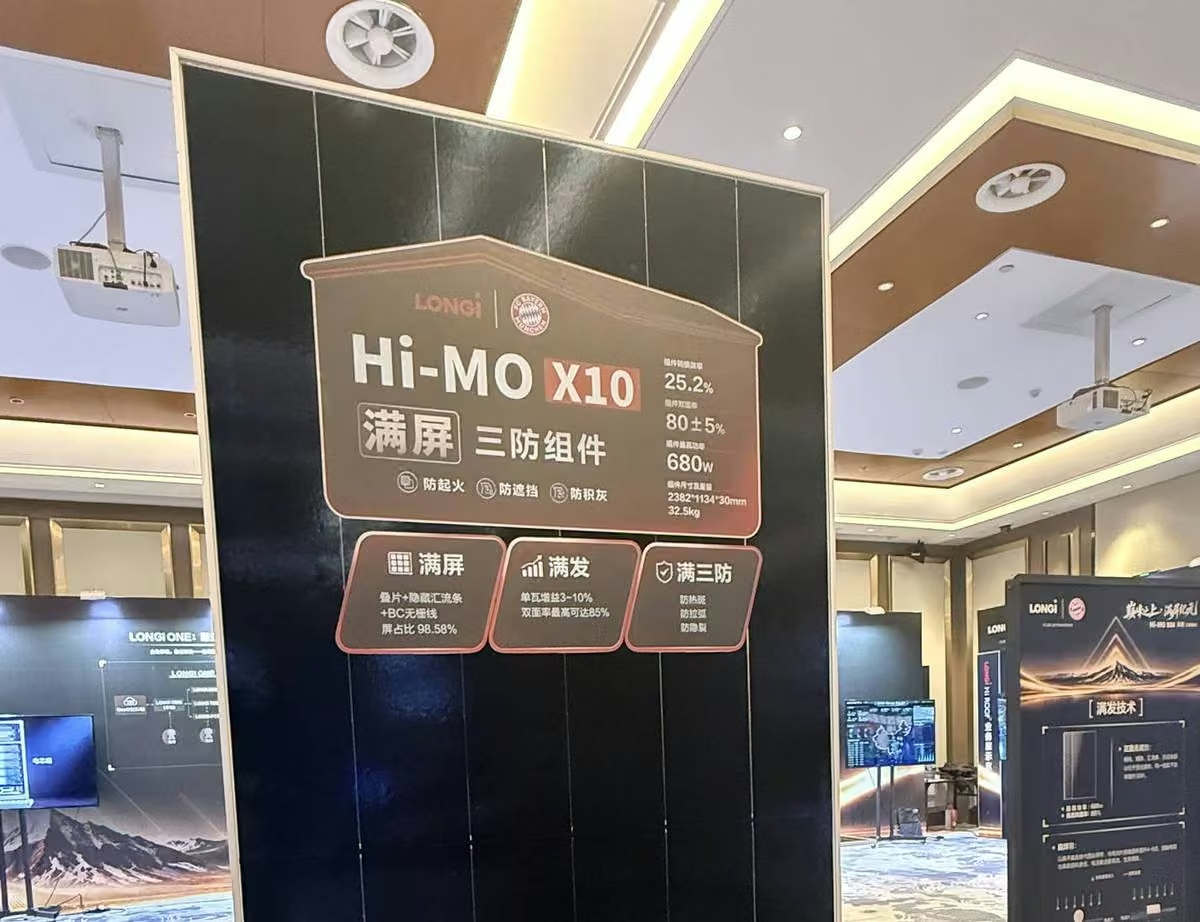
Longi launched its Hi-MO X10 Full-Screen module on Nov. 17, achieving a 25.2% conversion efficiency and 680 W maximum power output in volume production. The design increases light-receiving area by 759.3 cm², targeting reliability challenges in commercial and industrial rooftop installations.
Key facts
- Efficiency
- 25.2% conversion efficiency, 680 W maximum front-side power output
- Area
- 98.58% front-side light-receiving area ratio, 759.3 cm² increase
- Technology
- HPBC 2.0 cells, low-temperature film-welding, triple-protection design
- Status
- Volume production, 1.5 GW shipments in China C&I market in August 2026
- Certification
- TÜV SÜD and TÜV Rheinland under IEC 61215 and IEC 61730
Chinese PV manufacturer Longi launched its Hi-MO X10 Full-Screen Triple-Protection PV module on Nov. 17 at an industry event in Qingdao, China. The module features a front-side light-receiving area ratio of 98.58%, the highest the company has achieved in a commercial product.
The module retains the standard 2,382 mm × 1,134 mm dimensions of Longi’s existing Hi-MO X10 lineup for distributed PV applications, while increasing the light-receiving area by 759.3 cm² through four structural modifications.
Longi said it eliminated 20 white gaps between cells using a low-temperature film-welding process that bonds the cells at ambient temperature before a low-heat lamination step. The process reportedly limits the resulting height difference to 130 micrometers and recovers 178 cm² of light-receiving area.
The company also relocated three front-side busbars to the rear of the module, adding another 294 cm². According to Longi, thinner busbar profiles and staggered positioning help mitigate the risk of microcracks associated with rear-side busbar stacking. The remaining modifications include reducing inter-string spacing from 1.48 mm to 1 mm and cutting the cell-to-frame creepage distance from 12.9 mm to less than 9 mm through the use of upgraded insulation materials.
The module delivers a maximum front-side power output of 680 W and a conversion efficiency of 25.2%. Its standard power rating for volume production is 670 W, which Longi claims is 20 W higher than that of mainstream TOPCon modules of the same size.
To address additional rear-side shading caused by the relocation of the busbars, Longi replaced flat ribbons with round-wire ribbons, introduced precision-insulated sub-busbar break points, and developed an alloy frame profile designed to prevent the frame’s C-shaped section from shading the cells. The company said these changes increase the rear-side light-receiving area by 2.5% and enable a maximum bifaciality of 85%.
The module’s triple-protection design targets three reliability challenges that Longi identifies as particularly significant for commercial and industrial (C&I) rooftop installations: hotspots, electrical arcing, and microcracks.
For hotspot protection, the company integrated additional structures equivalent to bypass diodes within each hybrid passivated back contact (HPBC) 2.0 cell, which it claims can limit hotspot temperatures to below 100 C. To mitigate electrical arcing, Longi uses laser fusion welding in the junction box to eliminate metal-to-metal interface gaps that can contribute to DC arc formation.
Microcrack resistance is addressed through the same low-temperature welding process used in the full-screen design, combined with thinner busbars to reduce mechanical stress during transportation and installation.
The module has received TÜV SÜD and TÜV Rheinland certifications under IEC 61215 and IEC 61730. Longi also reported double-stress potential-induced degradation (PID), light-induced degradation (LID), and light- and elevated-temperature-induced degradation (LeTID) testing, along with level-six salt-mist, ammonia, and dust testing, and hail-impact qualification using 25 mm and 35 mm hailstones.
The product comes with a 15-year materials warranty and a 30-year linear power-output warranty. Longi specifies maximum first-year degradation of 1% and annual linear degradation of no more than 0.35%.
Longi said shipments of its Hi-MO X10 Triple-Protection modules reached 1.5 GW in China’s C&I market in August 2026. The company added that triple-protection variants accounted for more than half of its distributed PV shipments in the first nine months of 2026.
Speaking at the launch, Longi Chairman Zhong Baoshen cited internal laboratory results showing that the company’s hybrid interdigitated back-contact (HIBC) solar cell had achieved a conversion efficiency of 28.29%, approaching the theoretical crystalline silicon efficiency limit of 29.4% cited by the company. He positioned the full-screen module design as a complementary approach to improving power output through structural optimization, alongside further gains in cell conversion efficiency.
Pvola take
The 25.2% efficiency in a standard-sized module addresses the specific reliability pain points of C&I rooftops, where hotspot and microcrack risks are highest. By integrating protection features directly into the cell and module structure, Longi shifts the value proposition from raw efficiency to long-term yield stability for commercial buyers.
Frequently asked questions
What is the front-side light-receiving area ratio of the new Longi Hi-MO X10 module?
The module features a front-side light-receiving area ratio of 98.58%, which is the highest achieved by the company in a commercial product. This increase is accomplished through four specific structural modifications to the existing module design.
How does the low-temperature film-welding process improve the light-receiving area of the Longi module?
The process eliminates 20 white gaps between cells, recovering 178 cm² of light-receiving area. It bonds cells at ambient temperature before lamination, limiting height differences to 130 micrometers to maintain structural integrity.
What specific reliability challenges does the triple-protection design of the Longi module address for C&I installations?
The design targets hotspots, electrical arcing, and microcracks, which are significant risks for commercial and industrial rooftop installations. Longi integrated additional structures and busbar modifications to mitigate these specific failure modes.