Scientists figured out how to use a cheap everyday camera to measure how well solar panels work
The short answer
A University of Stuttgart team demonstrated that a modified consumer camera can measure absolute luminescent quantum efficiency in silicon modules. This method provides quantitative quality data for manufacturing inspection without the cost of industrial calibrated cameras.
Key facts
- Technology
- Silicon modules, electroluminescence imaging
- Status
- Laboratory research, University of Stuttgart
- Partner
- Research Center Jülich, Solarzentrum Stuttgart
- Efficiency
- 1.6 percent reference cell at 738 mV
New digital tools turn massive amounts of complex data into simple, actionable insights to help leaders make better conservation decisions.
Solar panels glow if you run electricity into them in the dark. While photos easily show the bright and dim patches, measuring the exact brightness used to require an expensive, manually calibrated industrial camera.
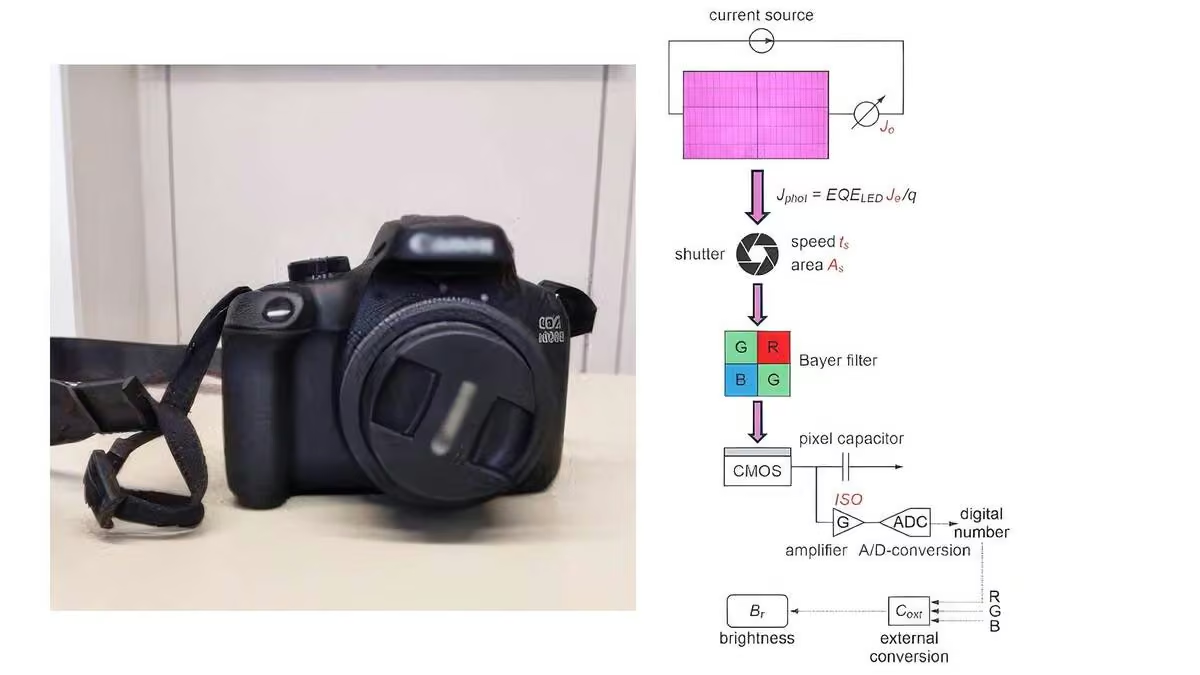
Jürgen Werner and her research team from the University of Stuttgart , the Research Center Jülich , and the German company Solarzentrum Stuttgart got the same kind of number out of a $450 consumer camera, after writing down how its own electronics respond to light.
The camera is the easy part. A model of how it converts light into numbers is what makes the reading possible, and that model still leans on one reference cell with a known quality.
Bright and dark solar cells said little
Push current into a solar cell and it behaves like an LED, giving off light of its own. Silicon cells glow in the infrared range, which the eye can’t see, so the picture has to come from a camera that can.
Engineers already use those pictures to check solar panels for cracked cells and broken connections. What they read is contrast. Bright areas are doing their job, dark ones aren’t.
The brightness itself is a measurement. The fraction of electrons that leave a solar cell as light instead of heat is its luminescent quantum efficiency.
Solar cell’s electroluminescence says more
The cell’s open-circuit voltage – the voltage it holds when nothing draws power from it – determines that fraction. Every tenfold rise adds about 60 mV to that voltage.
“An electroluminescence image contains much more quantitative information than simply showing bright and dark regions,” said Werner, of the Institute for Photovoltaics at the University of Stuttgart.
“With a suitable physical camera model and calibration, it can provide absolute luminescent quantum efficiency and, therefore, information about the local quality of a solar cell or module.”
One filter opened the infrared
Werner worked with Georgette Udo at Forschungszentrum Jülich and Liviu Stoicescu at Solarzentrum Stuttgart , a German company that inspects photovoltaic systems. Their camera was a Canon EOS 4000D, a low-cost model selling for around €400 in 2026.
Most consumer cameras carry a film over the sensor that absorbs infrared light, so the team took that film out. Astronomy hobbyists make the same change to shoot the night sky.
Then they screwed a long-pass filter onto the lens, which blocks the visible light that would otherwise wash out the faint glow.
The researchers took every photograph in the dark. A current source pushed a known current through each module, and the shutter time, the aperture and the ISO setting decided how much glow reached the sensor.
Brightness was then averaged across a whole cell in ImageJ , free image software, by drawing a box over the cell by hand.
Camera electronics stop being linear
Here is the problem that the model had to solve. A camera doesn’t report light honestly all the way up.
Below a certain brightness the number a pixel returns rises in step with the light that hits it, but above it the pixel fills up and the response stops rising.
That is over-exposure, familiar from any photograph taken into the sun.
Werner’s team measured where their own camera crossed over. It stayed linear below a brightness value of 400, and above that it bent toward a ceiling, which for one module sat at 1,177.
Both stretches are usable once the shape of the curve is known, and the saturated one yields a second estimate of the same quantity.
Converting brightness into quantum efficiency needs an anchor. The team took theirs from a cell with an established efficiency – 1.6 percent at 738 mV – and scaled everything else against it.
Panels from 1978 to 2022 were measured
Eight silicon modules went under the camera, picked to span decades of production. The oldest was a Solarex panel built in 1978, with a module efficiency of 5.7 percent. At the other end, a Trina module from 2022 reached 21.1 percent.
A modern cell turns far more of its current into light, and by that measure a better cell is simply a brighter one.
Cells in the old panel averaged 560 mV of open-circuit voltage and a luminescent quantum efficiency of 0.0007 percent. Cells in the newer module ran at 687 mV and 0.23 percent.
Across those 45 years the quantum efficiency climbed by roughly a factor of 300.
The model had to fit both ends of that span of solar power manufacturing, and it mostly did. Readings landed where the 60 mV rule predicts, apart from four modules built with multicrystalline solar cells, which trap light less well than single-crystal ones.
Those four only fell into line after the team accounted for the difference.
One reference solar cell sets the scale
Werner’s team didn’t put the camera up against an industrial one. The claim is narrower. A model of how a camera turns photons into numbers lets an ordinary one produce absolute values.
The weak points are the ones the authors name themselves. A box drawn by hand over each cell picks up the dark gaps between them, which put scatter in the data. An automatic version still has to be written.
Every measurement was made in the dark, on silicon, on modules whose performance was already known. And the whole scale depends on that single reference cell.
Using the calibrated camera is next
So far the authors haven’t pointed the calibrated camera at a module nobody has measured. That test would show whether the method grades hardware or only confirms what was known.
“Our next step is to use the calibrated camera to determine quantum efficiencies and open-circuit voltages of further, previously uncharacterized solar cells and modules,” Werner said.
He added that the same model should work on a panel lit up rather than powered up, and possibly outdoors.
Daylight matters most. The method needs a dark room, which keeps it in a laboratory. Outdoors, the camera could be carried along a row of panels at a working solar farm .
The full study was published in The Journal of Applied Physics .
Pvola take
This approach democratizes high-precision quality control by removing the dependency on expensive, manually calibrated industrial cameras. By leveraging standard consumer hardware with a physical model, manufacturers can obtain absolute efficiency metrics for local cell quality. This reduces the barrier to entry for detailed electroluminescence analysis in production environments.
Frequently asked questions
How did researchers at the University of Stuttgart use a consumer camera to measure solar cell performance?
They developed a model that accounts for the camera's specific electronic response to light, including over-exposure limits. This allows a $450 consumer camera to generate accurate brightness measurements comparable to expensive industrial equipment.
What specific limitation of standard digital cameras did the research team have to model to ensure accurate solar cell measurements?
The team modeled the point where pixel response stops rising with increasing light intensity, known as over-exposure. By characterizing this non-linear behavior, they could correct the data to obtain reliable quantitative results from the camera.
What is the potential impact of using consumer cameras for solar cell diagnostics on manufacturing quality control processes?
Using affordable consumer cameras reduces the cost of equipment needed for detailed cell inspection. This makes advanced diagnostic tools more accessible for manufacturers, potentially increasing the frequency and scope of quality checks in production lines.