Agrivoltaics with Magenta Panels Cuts Light Waste for Broccoli Growers
The short answer
A Swedish study showed broccoli under 50 and 70 percent transparent magenta panels reached full head weight 25 days after open-field crops. This agrivoltaics model allows dual harvest of energy and produce by filtering light to match plant absorption needs.
Key facts
- Application
- Agrivoltaics using semi-transparent magenta cadmium telluride solar panels
- Scale
- Two 4 by 5 meter canopies, 1.5 meters tall, at a Swedish farm
- Performance metric
- Shaded plants produced up to 4.5 times more dry weight per unit of light
- Segment
- Commercial vegetable growers and agrivoltaics project developers
- Location
- Kärrbo Prästgård, central Sweden
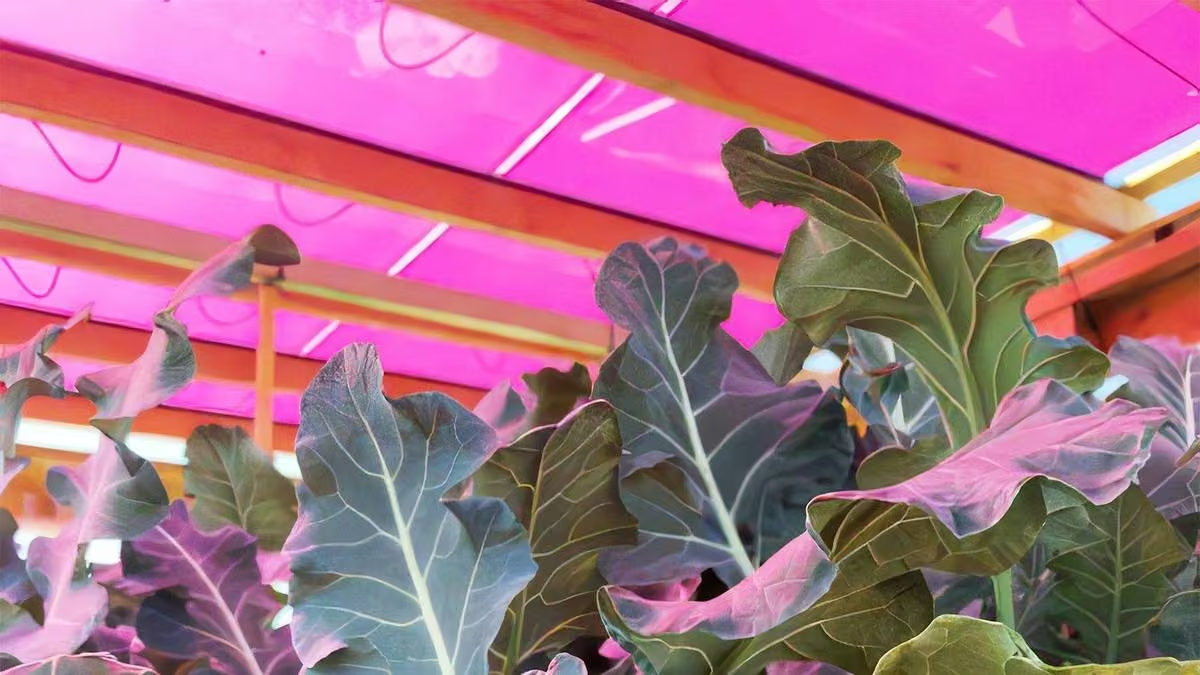
Under magenta solar panels passing a fraction of the sunlight, broccoli reached full head weight 25 days late while the panels made power.
Placing solar panels over a garden blocks the sun. That normally harms plant growth since most crops require plenty of light. However, that has proven not to be the case under all circumstances.
A new study shows that growing broccoli under special pink solar panels actually helps the plants use sunlight more efficiently.
While it took the broccoli an extra 25 days to mature, they still grew to full size because the semi-transparent panels were designed to let through the best red and blue light for growing.
This setup could allow farmers to harvest both crops and renewable energy from the exact same field.
Silvia Ma Lu of Mälardalen University in Västerås, Sweden, led the work. Her co-authors came from the same University and from two Italian institutes, the Institute for Sustainable Plant Protection in Florence and Università Cattolica in Piacenza.
“The basic concept is quite straightforward,” Ma Lu said. “The solar panels use part of the incoming sunlight to generate renewable electricity while allowing part of the light to pass through to the crops growing underneath.”
Why the panels are magenta
A leaf absorbs blue and red light and reflects more of the green, which is why plants look green. A magenta filter does the opposite, passing red and blue and blocking green.
So a magenta solar panel lets through the colors that a crop, such as broccoli, uses and absorbs the rest to make power.
Each panel is a sheet of glass with thin strips of a light-absorbing material, cadmium telluride, spaced across it. A magenta plastic layer inside the glass tints the light that passes between the strips.
Growing crops under panels is called agrivoltaics, and most projects use dark solar panels that cast heavy shade .
Ma Lu’s team built two canopies, each about 13 by 16 feet (4 by 5 meters) and 5 feet (1.5 meters) tall at the low edge.
One used panels the maker rates as 50 percent transparent, the other 70 percent. Under them, broccoli received about 13 and 19 percent, respectively, of the growing light that reached a third, open plot.
Harvest was delayed 25 days
Seedlings went into all three plots at Kärrbo Prästgård, a farm in central Sweden, on July 2, 2024. There were thus 44 plants per plot, under white insect netting.
The open-field broccoli was ready to cut after 79 days. At that point the plants growing under the panels were shorter, with smaller heads and thinner stems, so the team let them keep growing.
By day 104, the heads under both canopies weighed about the same as the open-field heads had at day 79. Whole plants in the open still weighed more.
The shaded plants had grown 25 to 41 percent more leaves than their neighbors in the sun. No plant in any plot developed a hollow stem, a defect that the team checked for.
A later harvest could also land in weeks when fresh broccoli sells for more, the authors noted.
Shaded leaves used light better
Full sun at midday delivered about 925 units of growing light to the open plot, counted as photons per square meter per second.
The canopies passed 143 and 207 of those units, yet the shaded broccoli produced nearly as much plant matter. Each unit of light yielded up to 4.5 times more dry weight than it did in the open.
Single leaves showed the same pattern under a lamp. Leaves from under the panels photosynthesized faster at every light level than leaves from the open plot.
On sunny days the open-field plants were likely getting more light than they could use, Ma Lu’s team wrote. The shaded plants had adjusted to capture more of the little light they did get.
Afternoons under the panels were about 1.8°F (1.0°C) warmer than in the open plot, and nights about 2°F (1.1°C) cooler. The air was also about 6 percent more humid, so the shaded plants lost less water.
Rain was plentiful from September on and, with drip irrigation before that, soil moisture was not what limited either plot.
Minerals shifted in the heads
At the first sampling, iron in the shaded heads was 37 to 41 percent lower than in open-field heads, and manganese was 38 to 42 percent lower. Zinc was down 18 to 20 percent, copper 12 percent, and dissolved sugars by a third to a half.
Calcium, magnesium, and potassium rose instead, 25 to 54 percent higher under the panels in September. By the second harvest those three had fallen back to match the open-field heads, while the four trace metals stayed low.
“One of the most interesting findings was how similarly the broccoli performed under the two solar panel systems despite their different transparency levels,” Ma Lu said.
“However, these findings are specific to our experimental conditions and should be validated across additional growing seasons and system configurations.”
Power generation alongside food
The denser canopy generated an estimated 447.6 kilowatt hours over the season from panels rated at 1.1 kilowatts, converting 7.2 percent of the sunlight hitting them to electricity. Standard silicon panels convert 20 percent or more.
On paper, the team also scaled the numbers up. By that estimate, 2.5 acres (1 hectare) under these panels would produce as much food and power as 2.9 acres (1.18 hectares) split between a field and a solar farm .
“Configurations similar to our prototype may currently be suitable for smaller-scale applications, such as community gardens, or for integration into greenhouse roofs rather than immediate deployment over large agricultural areas,” Ma Lu said.
Small plots, one summer
Each treatment had one plot, six sampled plants, and a single season in central Sweden behind it. Plants at the canopy edges got extra sun and may have shaded or sheltered the ones measured in the middle.
In the 25 days after the open-field harvest, those plants could have grown side shoots for a second cut that the study did not weigh.
The study also can’t separate the magenta color from plain shade or from the softer, scattered light under glass.
Ma Lu’s team has begun testing the magenta panels, along with red and blue ones, under lab lighting where no outside light leaks in.
The full study was published in the journal Cell Reports Physical Science .
Pvola take
This approach solves the core agrivoltaics conflict by filtering out green light that plants reflect, allowing efficient power generation without stunting growth. The 25-day delay may align harvest with higher market prices, but installers must verify crop-specific light requirements before deployment.
Frequently asked questions
How did researchers at Mälardalen University enable broccoli to grow to full size under solar panels?
They used semi-transparent magenta panels that filter sunlight to transmit optimal red and blue wavelengths for plant growth. This setup allowed the panels to generate electricity while the broccoli reached full head weight, albeit 25 days later than open-field crops.
What was the impact of the magenta solar panels on broccoli dry weight production compared to open sun?
The shaded broccoli produced nearly as much plant matter as open-field crops despite receiving significantly less light. Each unit of light passing through the panels yielded up to 4.5 times more dry weight than the same light in open conditions.
What are the implications of this study for farmers considering agrivoltaics projects?
The study suggests that dual-use land for energy and crops is viable with the right panel technology. Farmers can potentially harvest both renewable electricity and crops from the same field, improving land-use efficiency without sacrificing crop yield.