United States: Minnesota Projects See Promising Early Results from Blending Solar and Agricultural Production
Key facts
- Xcel Energy's Sherco solar facility near Becker hosts 2,200 sheep grazing beneath 1.7 million silicon panels during the growing season
- The 4,700-acre Sherco site is Minnesota's largest solar array and serves as the state's most prominent agrivoltaics demonstration project
- Agrivoltaics experiments are also underway at a community solar garden near Big Lake and a state-funded livestock research operation near Morris
- Internal temperature readings at the Morris research center indicate cows grazing under solar panels are half a degree Fahrenheit cooler
- Minnesota is moving toward a 2040 target for decarbonizing its electric grid, with agrivoltaics seen as a potential solution for rural land use
During the growing season, approximately 2,200 sheep and lambs graze on native prairie grasses beneath and around 1.7 million silicon panels at Xcel Energy’s Sherco solar facility near Becker.
The 4,700-acre site, which stands as Minnesota’s largest solar array, serves as the state’s most prominent demonstration of agrivoltaics, a practice that integrates solar power generation with crop or pasture production on the same land. This approach is not unique to the Sherco project. Other Minnesota solar installations feature sheep grazing and honeybees pollinating ground cover designed to support pollinators, while more advanced agrivoltaics experiments are underway at a community solar garden near Big Lake, a state-funded livestock research operation near Morris, and family-owned corn and soybean fields near Olivia.
Despite challenges such as unruly livestock and the logistical hurdles of operating bulky farm machinery, initial outcomes indicate significant potential for farmers, energy developers, and electric utilities as the state moves toward its 2040 target for decarbonizing the electric grid. If implemented effectively, agrivoltaics could alleviate a primary concern among rural Minnesotans regarding the expansion of solar infrastructure: the fear that increased panel deployment will reduce land available for productive agriculture.
Mike Zastoupil, a food systems specialist at the Minnesota Department of Agriculture, urged the state to prepare for this development, citing its dual benefits for energy generation and the agricultural sector. He noted that relying solely on crop or livestock production leaves producers vulnerable to market fluctuations, whereas integrating renewable energy provides a distinct revenue stream independent of those commodity prices.
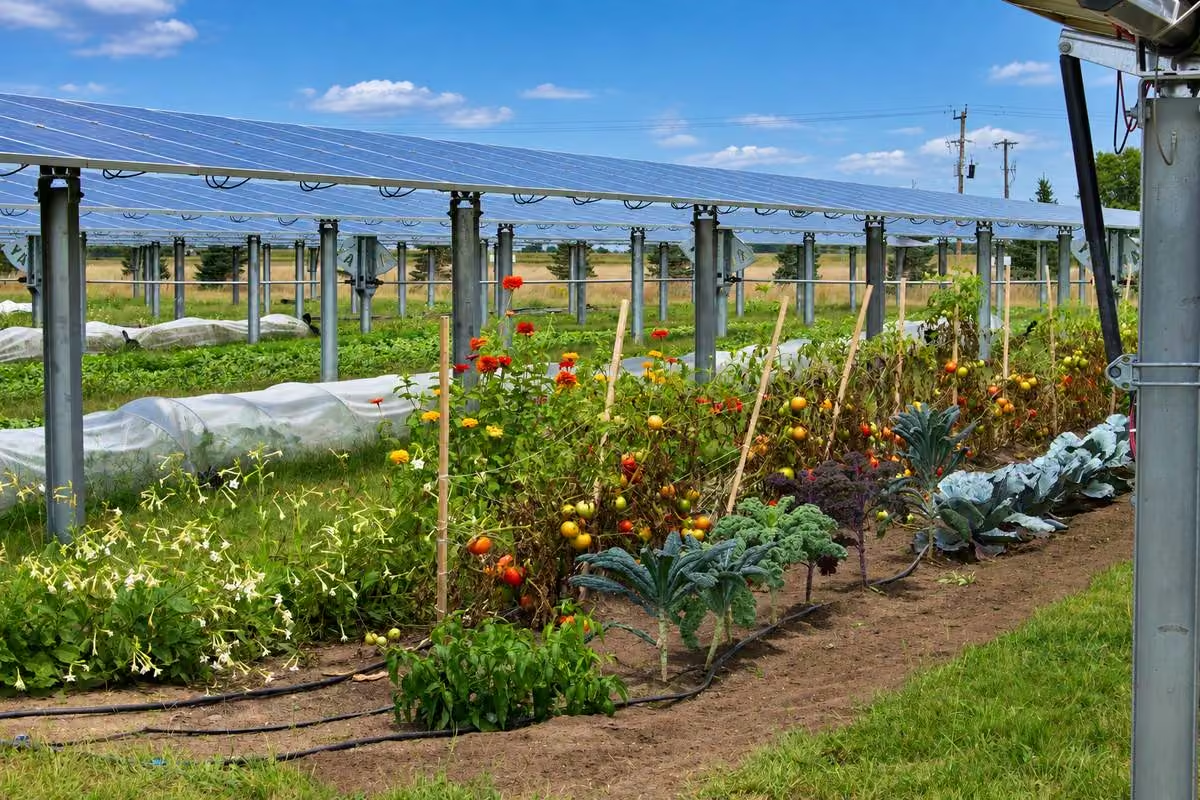
A bountiful harvest is being cultivated beneath the solar panels at the Big Lake facility.
The promise of agrivoltaics is already taking shape at Big River Farms, a solar garden located near Big Lake. This 17-acre facility, which began operations in 2023, represents a collaboration between US Solar, a community solar developer based in Minneapolis, and The Food Group, a nonprofit organization focused on supporting emerging farmers. The site features approximately nine acres of solar panel rows enclosed by fencing, alongside eight acres of open land situated beyond the perimeter.
Peter Schmitt, director of project development at US Solar, noted that the partners initially utilized the unfenced area as a risk-mitigation measure for the first three growing seasons, acknowledging that many farmers lack experience in cultivating crops beneath solar infrastructure.
However, the farmers at Big River Farms have since shifted their preference toward the enclosed sections, valuing the security and privacy afforded by farming under the panels. Schmitt reported that three tenant farmers are currently cultivating roughly 20 distinct varieties of food and ornamental crops within the solar array.
Certain crops are thriving in these partially shaded conditions.
Schmitt highlighted the success of the cucumber harvest, stating that the yield under the array was exceptionally strong and outperformed production in the open field.
Bouquet flowers are also thriving beneath the solar arrays. When rodent populations surged within the predator-free enclosure, posing a threat to crop yields, the research team implemented an unconventional mitigation strategy. As Schmitt noted, they installed a “doggy door” in the perimeter fencing, sized specifically to allow coyotes to pass through and restore natural predation.
Supported by grant funding from the National Laboratory of the Rockies, the former National Renewable Energy Laboratory, University of Minnesota researchers are concluding a two-year investigation into crop performance under the panels at Big River Farms. While the final data will not be released until next spring, preliminary findings indicate that leafy greens, including kale, exhibit superior growth near the solar infrastructure compared to open-field conditions, according to Nathan Eylands, a U of M horticulture professor overseeing the study.
Xcel Energy has expanded its commitment to replacing coal-fired generation with renewable energy sources across the state.
The Big River Farms installation features three experimental crop plots positioned beneath solar panels arranged in north-south rows. These panels are equipped with tracking systems that follow the sun’s trajectory throughout the day. This configuration exposes the vegetation to alternating periods of direct sunlight and shade, offering respite from intense summer heat and radiation while simultaneously curbing soil moisture evaporation.
Eylands noted that open-field conditions can become excessively hot and sunny for certain cool-season crops. The shaded environment also improves working conditions for researchers who spend significant portions of the summer outdoors. “You can get into the shade in three steps,” he observed.
The photovoltaic modules at Big River Farms are monofacial, designed to capture solar energy exclusively on their upper surfaces. Eylands suggested that future studies could investigate the impact of applying reflective coatings to the panel undersides. Such a modification might enhance the light levels reaching the crops, though it could also raise the ambient temperature within the test plots.
Eylands’s team is collaborating with other scientists to counter widespread misconceptions regarding the impact of solar installations on soil and water quality. Following a lab session described as “disheartening” due to the volume of anti-solar myths under review, the group resolved to analyze crops from Big River Farms for the presence of heavy metals such as cadmium. Critics have incorrectly asserted that such metals cause soil toxicity at solar sites, a claim the researchers aim to refute. Eylands noted that the Big River Farms array has been operational for a sufficient duration that any significant leaching of heavy metals would already be detectable in the harvested produce.
“This is great for anyone who wants to dispel these myths. Let’s put some unbiased research in front of them [and show] we can harvest electrons and agricultural products off of the same land,” Eylands said.
Providing shade to keep cows cool
Roughly 100 miles to the west of Big River Farms, a separate team of University of Minnesota scientists manages two solar installations designed to permit unrestricted cattle grazing beneath the panels. The underlying premise is that conditions suitable for shade-tolerant vegetation are equally beneficial for large, warm-blooded livestock.
The West Central Research and Outreach Center, located just outside Morris, has operated these cattle-compatible solar arrays for almost ten years. Brad Heins, a dairy professor, noted at a WCROC conference earlier this summer that internal temperature readings indicate cows grazing under the panels are half a degree Fahrenheit cooler than those in open fields during peak afternoon heat.
He explained that while the temperature difference may appear negligible, it carries significant weight regarding bovine heat stress. “That might not seem like a lot, but in terms of heat stress in a cow, half a degree Fahrenheit can be quite a bit. It can make a big difference in an animal,” he said.
Heins further observed that cattle experiencing heat stress typically increase their movement and panting to release body heat, which accelerates fatigue and dehydration. Data from pedometers and direct field observations confirmed that animals in shaded pastures exhibited reduced activity levels and increased water consumption.
Grazing cattle require constant movement to access fresh pasture. To address this, Heins and his team developed a trailer-mounted, self-powered unit described as a “mobile solar shade power station” last year. The prototype is designed to follow and provide shade for approximately 25 head of cattle. Initial outcomes were sufficiently positive that the team intends to construct a larger version capable of accommodating 40 animals.
Heins characterized the project as a “proof of concept,” noting, “We will see where it goes in the future.”
Both Heins and Schmitt acknowledged that concerns exist regarding the potential for heavy livestock, weighing 1,000 pounds or more, to damage top-heavy solar arrays. However, they argued that such risks are often overstated. Schmitt cited an incident at a US Solar facility in Colorado, where an uninvited herd wandered the site for three days without causing any damage, which he found reassuring. Heins added that, in his “personal view,” tractors and human activity pose a greater threat to solar equipment than cattle do.
The proposed legislation aims to expand the adoption of rooftop photovoltaic systems across residential properties in the state.
“Cows can be placed beneath the same type of panels deployed across open landscapes without any problems,” he stated.
However, accommodating cattle requires elevating the solar arrays above standard heights. Livestock such as sheep, as well as low-growing crops including leafy greens, potatoes, and carrots, can be easily integrated beneath panels installed at conventional elevations.
Aaron Hanson, an energy program specialist at the University of Minnesota, noted that every additional foot of elevation for the mounting structure necessitates that the foundation be anchored at least one foot deeper into the ground. This requirement increases the construction costs for the array and may reduce the economic viability of combining solar energy with agricultural production.
Hanson explained that this cost tradeoff is a primary factor leading some experts in the energy and agricultural sectors to view sheep as the optimal livestock for solar farms, citing the animals’ lower body weight and calm temperament.
The U.S. market presents a favorable environment for the expansion of cattle agrivoltaics, given that Americans consume large volumes of dairy products and beef consumption stands at 85 times the level of lamb. Furthermore, the textile industry is dominated by cotton and inexpensive synthetic fibers, which has negatively impacted the demand for wool. Consequently, unless there are substantial changes in consumer habits, the sector for cattle-based agrivoltaics has considerable potential for growth. Although Hanson has not yet completed a detailed financial analysis, he believes that a combined cattle and solar operation could recoup the higher initial development costs before the solar panels reach the end of their operational life.
The land continues to serve its original agricultural purpose, which is a key factor in the economic viability of the model. Hanson questioned whether this continued use could justify the extra expense of installing elevated solar panels. He concluded that over the duration of a 25-year contract, the answer to that question would be affirmative.
Coexisting solar with corn
Hanson and other specialists remain skeptical about the commercial viability of agrivoltaics across the 16 million acres in Minnesota dedicated to corn and soybeans, the state’s leading annual crops. Current planting machinery is generally too wide to navigate between the structures on standard solar farms, while corn plants grow tall enough to cast shadows on conventional-height panels by late summer.
Practical workarounds exist for both obstacles. In the vicinity of Olivia, family farmers Rolly and Larry Rauenhorst invested approximately $75,000 of their own capital to construct and install 10 customized solar racks. These structures feature panels positioned at a height of 14 feet, significantly above the corn tassels, and are spaced sufficiently apart to accommodate modern agricultural equipment. The installation produces enough electricity to supply a dozen or more households, though it remains far from commercial scale.
Zastoupil noted that while row-crop agrivoltaics is technically feasible, the economic factors are the primary hurdle. “I think it’s possible — it’s just the economics,” he said. “Does it make sense for the solar developer: Are they going to make money on the project? Are the farmers going to increase their yield?”
Perhaps those are the wrong questions to ask.
In 2021, 31% of Minnesota’s corn crop, equivalent to 2.6 million acres, was processed into ethanol for blending into transportation fuels. Aaron Smith, a professor of agricultural economics at the University of California-Berkeley, noted that an acre of corn produces 12 times less total energy and approximately 67 times less useful energy—measured by the vehicle miles traveled by a fuel-efficient gasoline car versus an electric vehicle—compared to an acre of solar panels.
The Clean Grid Alliance, a Minneapolis-based nonprofit, offered a different perspective on land use. With an energy density ranging from seven to 10 acres per megawatt, the organization calculated that less than 75,000 acres of cropland would be sufficient to accommodate all solar projects currently awaiting grid connection in Minnesota. Such an expansion would increase the state’s summertime electric generating capacity by nearly 50%.
Hanson argued that, at least for the foreseeable future, Minnesota possesses ample space to support both commodity agriculture and solar production.
Hanson stated, “The idea that [agrivoltaics] needs to scale up to include commodity crops and big combines, how we’re going to design for these things…that is missing the mark for what our needs are going to be.”
Pvola take
Developers and investors should view agrivoltaics as a strategic pathway to mitigate community opposition and secure land access in rural Minnesota. The demonstrated ability to maintain livestock productivity while generating power addresses a primary concern among rural stakeholders, reducing the social friction that often delays project permitting. By proving that solar infrastructure can coexist with traditional agricultural operations, developers can unlock new sites that were previously considered incompatible with utility-scale solar deployment.
Frequently asked questions
How does the Sherco solar facility in Minnesota integrate livestock grazing with its 1.7 million solar panels?
The facility allows approximately 2,200 sheep and lambs to graze on native prairie grasses beneath and around the panels. This 4,700-acre site is Minnesota's largest solar array and a prominent agrivoltaics demonstration.
What are the reported thermal benefits for cattle grazing under solar panels at the Morris research center?
Internal temperature readings indicate that cows grazing under the panels are half a degree Fahrenheit cooler. This site has operated cattle-compatible solar arrays for almost ten years to study these effects.
How does agrivoltaics in Minnesota support the state's 2040 decarbonization target for the electric grid?
Agrivoltaics alleviates concerns about land use by allowing simultaneous energy generation and agricultural production. This approach supports the state's goal to decarbonize the electric grid by 2040.