Standalone Solar Microgrid Simulated for Rural Secondary School in
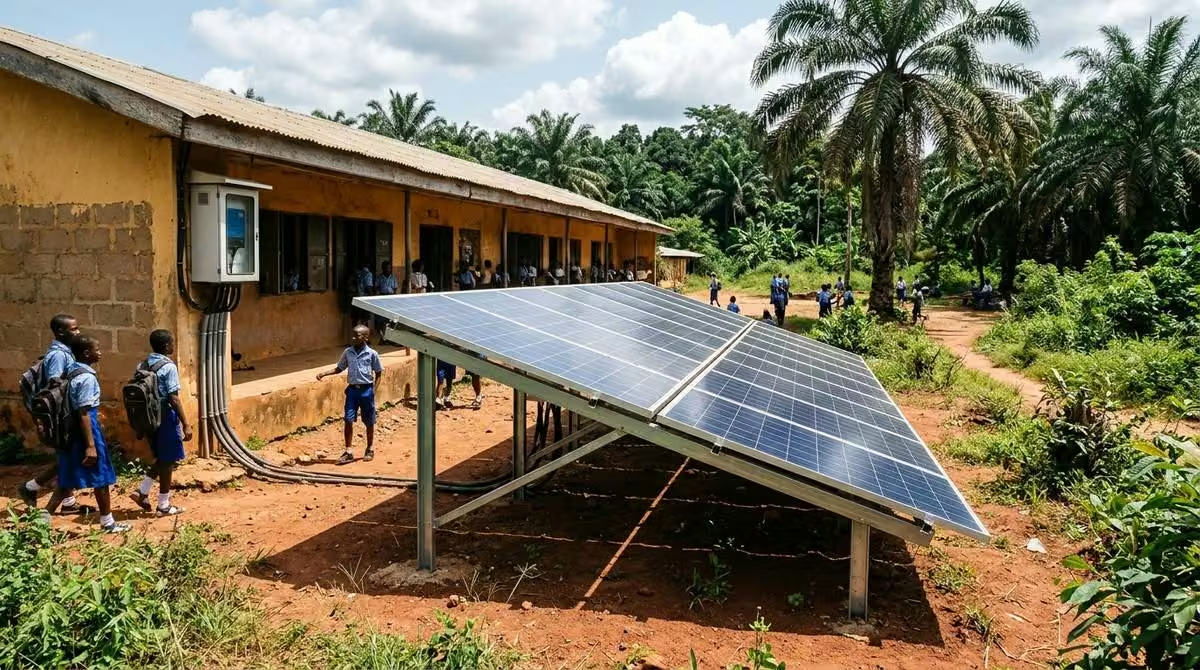
A computational modeling study evaluating off-grid power solutions for rural education has demonstrated that a standalone solar photovoltaic and battery storage system can reliably meet the complete electricity and water pumping requirements of an underserved secondary school in Akpugo, Enugu State, Nigeria. Conducted by Vincent Anayochukwu Ani of the National Centre for Energy Research and Development at the University of Nigeria, Nsukka, the research investigated the technical sizing and economic feasibility of replacing an unreliable national grid connection with a dedicated, decentralized renewable energy installation. Using the Hybrid Optimization of Multiple Energy Renewables simulation platform, the study established that a carefully configured solar array paired with lithium iron phosphate storage could provide uninterrupted power across the entire school year while lowering the levelized cost of energy substantially below that of local diesel generation.
Rural public institutions across Nigeria face chronic disruptions caused by extensive electrical grid instability, frequent power outages that often extend over several consecutive days, and severe voltage fluctuations. At Akpugo Community Secondary School, located in the Nkanu-West Local Government Area, an inconsistent grid connection has historically compromised daily operations, academic delivery, and campus sanitation. The public institution serves approximately 420 active students and 25 teaching and non-teaching personnel across ten standard classrooms, an administrative section, a library, and a combined science laboratory and computer room. The school requires dependable power between its strict operating hours of 08:00 and 14:00 to run classroom lighting, desktop computers, information technology infrastructure, and administrative devices, while maintaining outdoor security lighting and domestic water access.
To capture the institution’s energy requirements without relying on idealized assumptions, the researcher conducted a field-based technical site evaluation and management consultations to compile an empirical load inventory. The school’s electricity consumption was divided into two distinct operational categories: an alternating current primary load and a direct current deferrable load. The alternating current primary demand encompassed classroom and office equipment, including 35 indoor light-emitting diode lamps rated at 7 watts each operating for six hours, 2 projectors at 250 watts for three hours, 2 printers at 50 watts for two hours, a 400-watt photocopier for one hour, 2 desktop computers rated at 120 watts running for eight hours, 25 laptops at 45 watts operating for six hours, 2 wireless routers running continuously for 24 hours, 18 mobile phone chargers running for five hours, 2 smart boards rated at 350 watts operating for three hours, 18 ceiling fans rated at 20 watts running for six hours, and 6 outdoor security lamps rated at 40 watts operating for twelve hours. This baseline equipment schedule established an alternating current consumption profile of 21.53 kilowatt-hours per day, with power demand reaching a peak of 3.61 kilowatts between 12:00 and 12:59 and a minimum baseline demand of 0.04 kilowatts.
Campus water management introduced an essential infrastructure load that was modeled dynamically rather than as a rigid scheduled requirement. The school consumes roughly 5 cubic meters of water per day, drawn from an onsite borehole with a total differential head of 15.7 meters and stored in an elevated plastic tank measuring 2.5 meters tall with a capacity of 10 cubic meters. Rather than routing water pumping through the central inverter as a conventional alternating current demand, the proposed engineering architecture connected a 0.294-kilowatt submersible pump directly to a centralized direct current bus. This direct current coupling eliminated conversion losses through the inverter and isolated sensitive power electronics from the high inductive starting currents characteristic of electric pump motors. Under an average local solar irradiance of 3.9 kilowatt-hours per square meter, the submersible unit achieved a flow rate of 2.6 cubic meters per hour, requiring 1.9 hours of pumping to deliver the baseline daily volume of 5 cubic meters and 3.9 hours to fill the storage tank completely.
Within the simulation framework, the borehole pump was parameterized as a deferrable load with an average daily demand of 0.559 kilowatt-hours, an energy storage ceiling of 1.147 kilowatt-hours, a peak power draw of 0.294 kilowatts, and a minimum load ratio of 85.71 percent based on an operational threshold of 8.4 amperes across a 30-volt bus. This dispatch logic allowed the 10-cubic-meter overhead tank to serve as a hydraulic storage battery. Under the automated dispatch priority hierarchy evaluated at 60-minute intervals, solar generation directly supplied the inflexible alternating current academic load through the converter first. Any surplus solar electricity was immediately routed to the deferrable pumping system. Pumping drew from the battery storage bank only if the overhead water reservoir dropped below a critical safety threshold during periods of low irradiance or night, deferring normal operations until subsequent peak sunlight periods to minimize unnecessary battery throughput.
Meteorological variables were incorporated into the HOMER Pro software using geographic coordinates of 6 degrees 22 minutes 40 seconds North and 7 degrees 35 minutes 18 seconds East, drawing upon a 42-year historical solar dataset compiled by the National Aeronautics and Space Administration from July 1983 to June 2025. Component libraries supplied physical specifications and local market cost estimates in Nigerian Naira. The modeled system utilized 335-watt SunPower X-Series monocrystalline solar modules with a maximum power point voltage of 57.3 volts, an open-circuit voltage of 67.9 volts, and a temperature coefficient of negative 0.29 percent per degree Celsius. Energy storage was modeled using 12-volt, 400-ampere-hour lithium iron phosphate batteries rated for more than 3,000 cycles at an 80 percent depth of discharge with a 96 percent roundtrip efficiency. Converter units were modeled with an initial capital expense of 19,450 Naira per kilowatt, while solar panels and single battery units were priced at 135,500 Naira and 400,000 Naira in initial capital costs, respectively.
Optimization simulations determined that the ideal microgrid configuration capable of fulfilling the school’s 21.53 kilowatt-hour daily requirement comprised a 7.64-kilowatt solar photovoltaic array, a 3.79-kilowatt power converter, and an energy storage system containing 20 battery units arranged in four series strings across five parallel branches to form a 48-volt direct current bus. This setup yielded a total usable storage capacity of 76.8 kilowatt-hours and an autonomy duration of 85.6 hours. Annually, the solar array produced 13,036 kilowatt-hours of electrical energy over 4,380 operating hours with a capacity factor of 19.5 percent. The primary alternating current load absorbed 7,647 kilowatt-hours per year, while the direct current deferrable pumping load consumed 204 kilowatt-hours per year, achieving an annual renewable energy fraction of 100 percent. The system generated 4,697 kilowatt-hours of excess electricity each year, representing 36.0 percent of total production, while battery bank roundtrip throughput totaled 2,128 kilowatt-hours annually against converter losses of 402 kilowatt-hours and battery losses of 86.8 kilowatt-hours.
Reliability analysis demonstrated that the standalone photovoltaic infrastructure provided continuous power security with exceptional operational stability. The annual unmet electrical load was limited to 6.89 kilowatt-hours per year, representing 0.0876 percent of total institutional demand, alongside a capacity shortage of 7.69 kilowatt-hours per year, or 0.0978 percent. This performance yielded a loss of power supply probability of 0.000876, reflecting an overall energy-based system reliability of 99.91 percent throughout the simulated year. Initial capital expenditure for the complete solar installation was calculated at 11,162,292.63 Naira, primarily driven by the battery storage bank at 8,000,000.00 Naira, the solar photovoltaic array at 3,088,648.46 Naira, and the converter at 73,644.17 Naira. Annual operating and maintenance costs were estimated at 242,306.60 Naira, leading to a levelized cost of energy of 140.84 Naira per kilowatt-hour over an assumed 25-year project lifespan.
Comparative financial assessments highlighted significant long-term economic advantages when contrasting the renewable microgrid against fossil-fueled generation and conventional utility tariffs. Although a traditional 3.70-kilowatt diesel generator combined with battery storage required a substantially lower initial capital outlay of 2,562,964.19 Naira, its ongoing operational expenditure reached 6,119,634.00 Naira annually, driven by continuous fuel consumption and maintenance. Over 25 years, the levelized cost of energy for diesel generation rose to 804.02 Naira per kilowatt-hour, approximately 5.7 times higher than the solar system’s 140.84 Naira per kilowatt-hour. The solar configuration yielded total lifecycle net present savings of 67,379,918.68 Naira compared to diesel power, achieving an internal rate of return of 116.5 percent and a simple payback period of 0.9 years. When evaluated against utility pricing frameworks from the Nigerian Electricity Regulatory Commission, the solar microgrid proved more affordable than the premium Band A grid tariff of 209.50 Naira per kilowatt-hour while eliminating exposure to the recurring blackouts that characterize lower, subsidized tariff bands ranging between 40.00 and 62.48 Naira per kilowatt-hour.
Multi-variable sensitivity evaluations confirmed the mechanical and financial robustness of the engineering design across fluctuating environmental and operational conditions. When baseline solar irradiance of 4.93 kilowatt-hours per square meter per day was adjusted across alternative values of 3.93 and 5.93, combined with simulated load growth increments of 5 percent and 10 percent, the microgrid maintained high service reliability, with annual unmet demand never exceeding 6.89 kilowatt-hours. Under an increased solar insolation of 5.93 kilowatt-hours per square meter per day, the required battery storage bank decreased by 20 percent to 16 units, lowering the levelized cost of energy to 122.50 Naira per kilowatt-hour and annual operating expenses to 198,007 Naira, while clipped surplus energy expanded to 8,691 kilowatt-hours. Conversely, a 20 percent drop in solar irradiance required the battery bank to expand to 28 units and the solar array to 9.00 kilowatts, increasing the levelized energy cost to 189.57 Naira per kilowatt-hour while eliminating capacity shortages entirely. Further financial sensitivity modeling revealed that shifting the discount rate from an 8 percent baseline to 12 percent increased the levelized cost of energy to 181.68 Naira per kilowatt-hour, whereas reducing battery service life from 15 years to 5 years increased operating expenses to roughly 1.28 million Naira annually and elevated the unit cost to 272.57 Naira per kilowatt-hour.
The author noted several methodological boundaries inherent in the study’s design. The simulation relied upon calculated load estimates rather than long-term empirical meter readings from the school, focused on a single geographic case study, and omitted physical field validation of the modeled hardware. Furthermore, the analysis did not incorporate complex mathematical representations of solar cell efficiency degradation caused by operational temperature spikes, component aging mechanisms, future demand shifts, or logistical site expenses associated with civil protection, cabling, security, and installation. Despite these operational limitations, the findings demonstrate that coupling a centralized direct current bus with deferrable water pumping provides a cost-effective, technically viable blueprint for eliminating power deficits and enhancing educational infrastructure across rural secondary schools.
Subject of Research: Techno-economic modeling of an off-grid solar photovoltaic and battery microgrid for a rural Nigerian secondary school
Article References: Ani, V. A. (2026). Bridging the educational gap in underserved schools with sustainable energy solution. Frontiers in Energy Research, 14 , Article 1886492. https://doi.org/10.3389/fenrg.2026.1886492
Keywords: solar energy, photovoltaics, microgrids, rural electrification, energy modeling, battery storage, HOMER Pro, Nigeria, Bridging, educational, underserved, schools
News Source: Faith Mcneil. (November 7, 2026). Standalone Solar Microgrid Simulated for Rural Secondary School in Southeastern Nigeria. Scienmag.
Frequently asked questions
What specific microgrid configuration was determined to be optimal for the rural secondary school in Akpugo, Nigeria?
The optimal configuration comprised a 7.64-kilowatt solar photovoltaic array and a 3.79-kilowatt power conversion system. This setup was designed to meet the school's 21.53 kilowatt-hour daily energy requirement using lithium iron phosphate storage.
How does the levelized cost of energy for the simulated solar microgrid compare to local diesel generation in Nigeria?
The study established that the solar microgrid lowers the levelized cost of energy substantially below that of local diesel generation. This economic advantage supports the feasibility of replacing unreliable grid connections with dedicated renewable installations.
What are the initial capital costs for solar panels and battery units in the Nigerian rural microgrid simulation?
The initial capital cost for solar panels was 135,500 Naira per unit, while single battery units cost 400,000 Naira. These figures were used in the HOMER Pro simulation to evaluate the economic viability of the off-grid system.