IEA: Greece Ranks Among Global Leaders in Solar Energy
Key facts
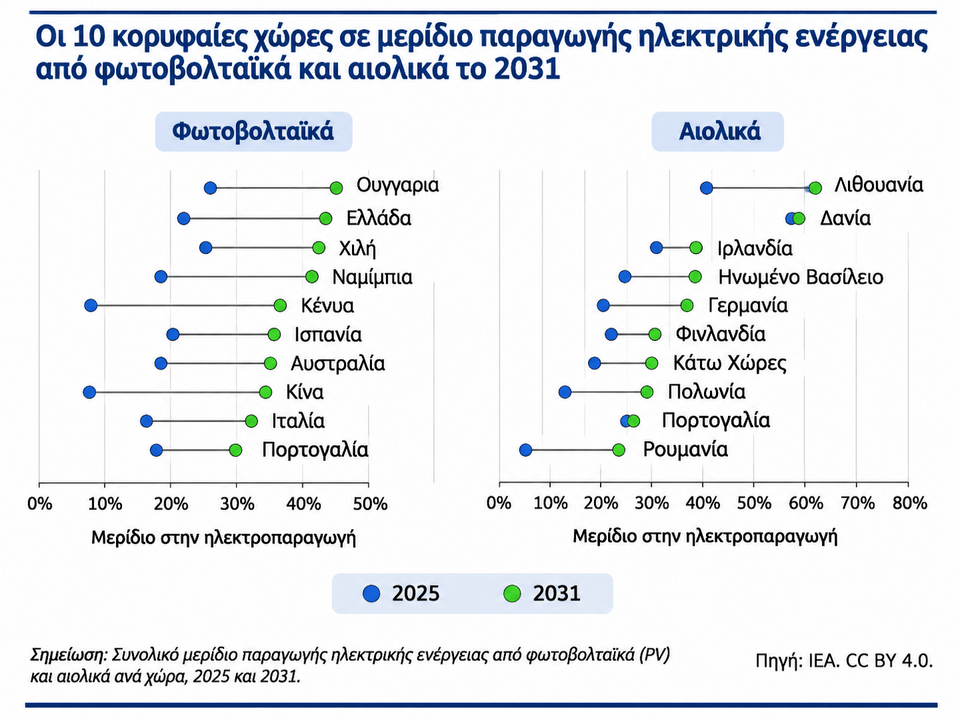
- The IEA projects Greece will rank second globally in solar share of electricity generation by 2031, with a forecast of 39 percent
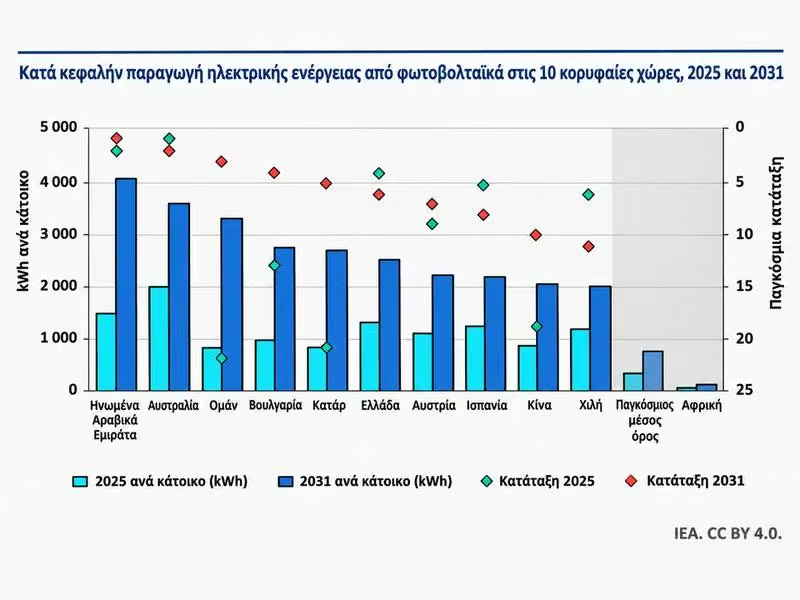
- Greece is currently in the global top 10 for per capita solar electricity generation, exceeding 1,200 kilowatt-hours per capita
- The IEA increased its forecast for new solar capacity in Greece for 2026-2030 from 6.3 GW to 8.4 GW, a 33 percent upward revision
- Hungary is expected to lead the world in solar share of electricity production by 2031 with a projected 41 percent, ahead of Greece and Chile
Greece is cementing its status within the global solar energy elite, as the International Energy Agency (IEA) projects the country will rank second worldwide by 2031 in terms of the share of solar power in its total electricity generation mix.
This forecast underscores the momentum of the domestic Renewable Energy Sources (RES) market. At the same time, it highlights the significant challenges posed by the rapid expansion of photovoltaics in an electrical system that already faces severe constraints.
According to the IEA’s annual “Renewables 2026” report, Greece is already in the global top 10 for per capita electricity generation from photovoltaics. Alongside countries such as Australia, the United Arab Emirates, the Netherlands, and Spain, it is among the markets recording generation levels significantly higher than 1,200 kilowatt-hours per capita.
The International Energy Agency’s forecast for the share of solar power in total electricity generation by 2031 is even more striking. Hungary is expected to lead the world, with solar energy accounting for 41% of its electricity production. Greece follows with 39%, while Chile takes third place at 38%. This projection reflects the fundamental shift underway in Greece’s energy mix, as the country moves from a system that relied on fossil fuels for decades to a model with an increasingly large contribution from renewable sources.
Overall, the share of variable renewables, namely wind and solar, is projected to exceed 55% in Greece by 2031, representing an increase of 26 percentage points compared to 2025.
The International Energy Agency has positioned Greece among the global leaders in solar power, highlighting a planned expansion of nearly 13 gigawatts of new renewable energy capacity over the next six years.
The growth trajectory of the Greek market is also reflected in projections for new installations. The International Energy Agency estimates that between 2026 and 2031, Greece will add nearly 13 gigawatts (GW) of new capacity from renewable energy sources, a 20% increase compared to the 2020-2025 period.
Solar photovoltaics will serve as the primary driver of this expansion, accounting for 74% of the new installations. Wind power is expected to contribute 19%, hydropower 7%, while the share of bioenergy will remain below 1%.
In 2025, approximately 1.8 GW of new solar photovoltaic capacity was connected to the Greek grid, while an additional 800 MW of completed facilities were awaiting grid connection. For the current year, given that new renewable energy installations reached 2.7 GW in the first nine months, full-year forecasts project the addition of another 3.2 GW to the total renewable energy stock, which is expected to exceed 23 GW. If these projections are realized, 2026 will mark a record year for new renewable energy installations, surpassing the previous historical high set in 2024, when approximately 2.73 gigawatts were added.
The International Energy Agency has revised its forecast for renewable energy growth in Greece upward by 33% compared to its previous report. For solar photovoltaics, the estimated new capacity for the 2026-2030 period has been increased from 6.3 GW to 8.4 GW. Similarly, the projection for onshore wind power has been adjusted from 1.3 GW to 2.1 GW.
However, behind these impressive figures lies a growing problem: Greece is gaining the ability to generate large quantities of cheap electricity from the sun, but the grid system cannot always utilize this output. The IEA warns that grid saturation and increasing curtailment of production have become key limiting factors for the further expansion of the market.
As solar photovoltaic generation is concentrated during daylight hours, periods in which available energy exceeds the grid’s absorption capacity are becoming increasingly frequent. This dynamic drives electricity market prices to zero or even negative levels, reducing producer revenues and complicating the financing of new projects.
Photovoltaic installations that lack accompanying storage systems are particularly vulnerable, as they cannot shift their output to hours of higher demand and more favorable pricing.
Batteries and power purchase agreements with industry
The International Energy Agency (IEA) identifies the rapid deployment of electricity storage systems, grid reinforcement, and the reduction of connection times for new projects as critical prerequisites for sustaining the market’s growth momentum. Simultaneously, long-term electricity supply contracts between renewable energy producers and businesses, known as Power Purchase Agreements (PPAs), are gaining significant importance.
These agreements can provide investors with greater revenue predictability, while allowing industries and large consumers to secure electricity under pre-agreed terms. Despite its gradual expansion, the Greek corporate PPA market continues to offer substantial room for further development, according to the IEA.
The acceleration of licensing procedures is also expected to play a significant role. The organization notes that the effective implementation of relevant European reforms could contribute to the faster completion of new solar and wind projects.
The challenge for the days ahead
Under the International Energy Agency’s optimistic scenario, Greece could install approximately 30% more new renewable energy capacity compared to the report’s base case, provided that existing constraints are addressed.
Grid expansion, faster connection of investments, the expansion of storage capabilities, and the establishment of a more stable revenue framework are the key prerequisites for achieving this acceleration.
The IEA report thus highlights the dual reality of the Greek market: on one hand, the country is emerging as a global power in terms of solar energy penetration. On the other, it faces the challenge of effectively utilizing its generated output.
The challenge now is no longer just about how many additional photovoltaic systems will be installed, but how much of the energy they produce can reach consumers and at what cost.
Pvola take
Developers and investors must prioritize grid integration solutions over pure capacity expansion, as the primary bottleneck has shifted from installation to effective energy utilization. The IEA's upward revision of capacity forecasts highlights strong market momentum, but the severe constraints on the electrical system mean that projects must demonstrate reliable power delivery to consumers. Focusing solely on adding new photovoltaic systems without addressing transmission and distribution limitations risks stranded assets and reduced returns for off-takers.
Frequently asked questions
What is the IEA's projected share of solar power in Greece's electricity mix by 2031?
The IEA projects solar power will account for 39% of Greece's total electricity generation by 2031. This places Greece in second place globally, behind Hungary which is forecast to reach 41%.
How did the IEA revise its forecast for new solar PV capacity in Greece for 2026-2030?
The IEA increased its estimate for new solar PV capacity in Greece from 6.3 GW to 8.4 GW for the 2026-2030 period. This represents a 33% upward revision compared to its previous report.
What major challenge does the rapid solar expansion pose for Greece's electrical system?
The rapid expansion of photovoltaics poses significant challenges for an electrical system that already faces severe constraints. The focus is shifting from installation volume to ensuring generated energy can effectively reach consumers.