Dalian Institute Perovskite Slot-Die Module Hits 22.70% Efficiency
The short answer
Researchers at the Dalian Institute of Chemical Physics reported a 22.70% power conversion efficiency for a 54.80 square centimeter slot-die coated perovskite module. This lab-scale result demonstrates a viable pathway to overcome crystallization barriers for scalable, ambient-air manufacturing of high-performance perovskite photovoltaics.
Key facts
- Efficiency
- 22.70% for the 54.80 sq cm module; 26.16% for small-area cells
- Area
- 54.80 square centimeters for the large-area module
- Technology
- Slot-die coating with FASCN and RbSCN synergistic additives
- Status
- Lab-scale research reported in Advanced Materials
- Partner
- Dalian Jiaotong University
A research team led by Prof. YANG Dong from the Dalian Institute of Chemical Physics of the Chinese Academy of Sciences, working in collaboration with researchers from Dalian Jiaotong University, has developed a synergistic additive strategy to facilitate the large-area slot-die coating of methylammonium-free perovskite films. Reported in the journal Advanced Materials, the fabrication approach directly tackles the chemical and physical crystallization barriers that have long hindered the scalable deposition of high-performance perovskite solar cells under ambient-air processing conditions. The collaborative research demonstrates an effective chemical pathway to stabilize scalable processing, marking a key advance toward viable industrial manufacturing.
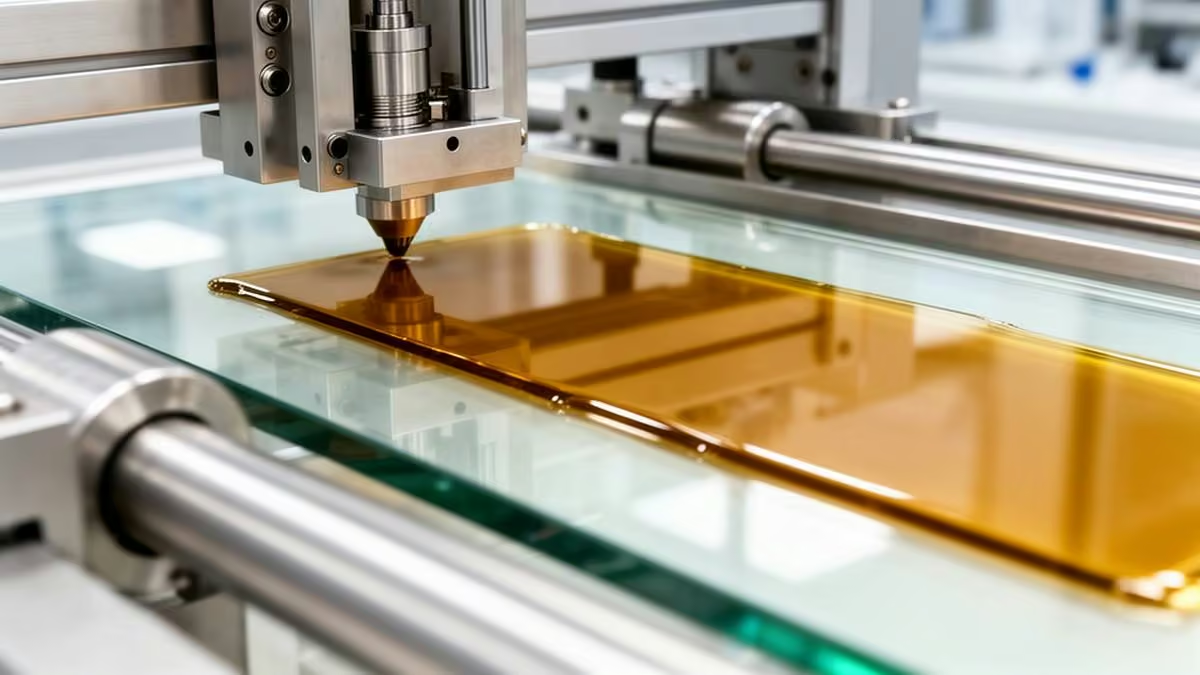
Slot-die coating represents a highly promising manufacturing route toward the industrial-scale commercial production of perovskite photovoltaics, primarily because the technique offers exceptionally high material utilization and seamless compatibility with continuous roll-to-roll manufacturing workflows.
Despite these fundamental operational advantages, the practical application of the methylammonium-free FAxCs1-xPbI3 chemical system has remained difficult during ambient-air coating procedures. The material system exhibits an intrinsically slower crystallization rate alongside a pronounced tendency toward phase segregation when exposed to ambient atmospheric conditions. These combined physical behaviors severely complicate wet-film control, impede uniform crystal formation during open-air deposition, and ultimately compromise the structural phase stability of the resulting perovskite thin films.
To overcome these crystallization hurdles, the researchers devised a targeted synergistic additive system combining formamidinium thiocyanate, abbreviated as FASCN, with rubidium thiocyanate, known as RbSCN. Rather than acting independently, the two chemical additives provide complementary functions across distinct stages of the crystallization sequence, simultaneously guiding the initial nucleation events and stabilizing the desirable crystal structure of the absorbing layer throughout the full coating procedure.
Within this dual-additive mechanism, formamidinium thiocyanate acts primarily to promote uniform crystal nucleation during vacuum-flash treatment and to support subsequent crystal grain growth across the coated area. Concurrently, rubidium thiocyanate functions to preserve and stabilize the photoactive perovskite crystal phase. Specifically, rubidium cations integrate directly into the A site of the perovskite crystal lattice, which relaxes internal lattice strain, lowers the necessary activation energy barrier for forming the photoactive alpha-FAPbI3 phase, and effectively suppresses the emergence of the undesired, non-photoactive delta-FAPbI3 phase.
By coordinating these complementary crystallization dynamics, the research team successfully expanded the permissible processing window for achieving uniform perovskite crystallization to more than 100 seconds. This prolonged operational window allows sufficient time for controlled film solidification, producing thin films that feature a remarkably dense microstructure, noticeably large crystal grains, a uniform vertical compositional gradient throughout the layer thickness, and significantly reduced residual internal stress across the finished film.
When fabricated into small-area perovskite solar cells, the slot-die-coated devices delivered a high power conversion efficiency of 26.16 percent. Furthermore, when the team scaled the fabrication technique to a large-area module featuring an active surface area of 54.80 square centimeters, the device achieved a power conversion efficiency of 22.70 percent, outperforming the 15.8 percent efficiency recorded for an additive-free control module.
In addition to delivering elevated power conversion efficiencies, the synergistic additive formulation substantially enhanced the long-term operational durability of the photovoltaic devices under continuous operational stress. During maximum-power-point tracking evaluation conducted continuously under standard AM 1.5G solar illumination at an elevated operating temperature of 65 degrees Celsius, unencapsulated solar cells retained 97.76 percent of their initial power conversion efficiency after 1,300 hours of continuous operation, in stark contrast to control devices which retained only 65.86 percent of their original efficiency under identical testing parameters.
Pvola take
The 100-second processing window is the critical metric for industrial adoption, as it allows for controlled solidification in continuous roll-to-roll lines. By stabilizing the alpha phase and suppressing delta phase segregation, this chemical strategy addresses the core physical barriers to scalable perovskite production. This moves the technology closer to viable commercial manufacturing standards.
Frequently asked questions
What specific additive strategy did the Dalian Institute of Chemical Physics team develop for slot-die coating perovskite films?
The team developed a synergistic additive strategy to facilitate large-area slot-die coating of methylammonium-free perovskite films. This approach directly tackles chemical and physical crystallization barriers that have hindered scalable deposition under ambient-air conditions.
How does the integration of rubidium cations affect the crystallization of the alpha-FAPbI3 phase in perovskite solar cells?
Rubidium cations integrate into the A site of the perovskite crystal lattice, relaxing internal lattice strain. This lowers the activation energy barrier for forming the photoactive alpha-FAPbI3 phase and suppresses the undesired delta-FAPbI3 phase.
Why is slot-die coating considered a promising manufacturing route for the industrial-scale production of perovskite photovoltaics?
Slot-die coating offers exceptionally high material utilization and seamless compatibility with continuous roll-to-roll manufacturing workflows. These operational advantages make it a highly promising route toward the industrial-scale commercial production of perovskite photovoltaics.