A 2.2-inch lab ice ball hits solar panel glass at 76 mph, and the first crack appears 126 millionths of a second later
Key facts
- Researchers tested fifteen commercial thin-film solar modules with glass encapsulation on both front and rear surfaces
- High-speed imaging captured the impact at 300,000 frames per second to quantify the fracture initiation process
- A 2.2-inch ice ball striking glass at 76 mph resulted in the first crack appearing 126 millionths of a second later
- The study, published in 2024, notes that static tensile strength metrics are insufficient to predict failure under dynamic hail impact
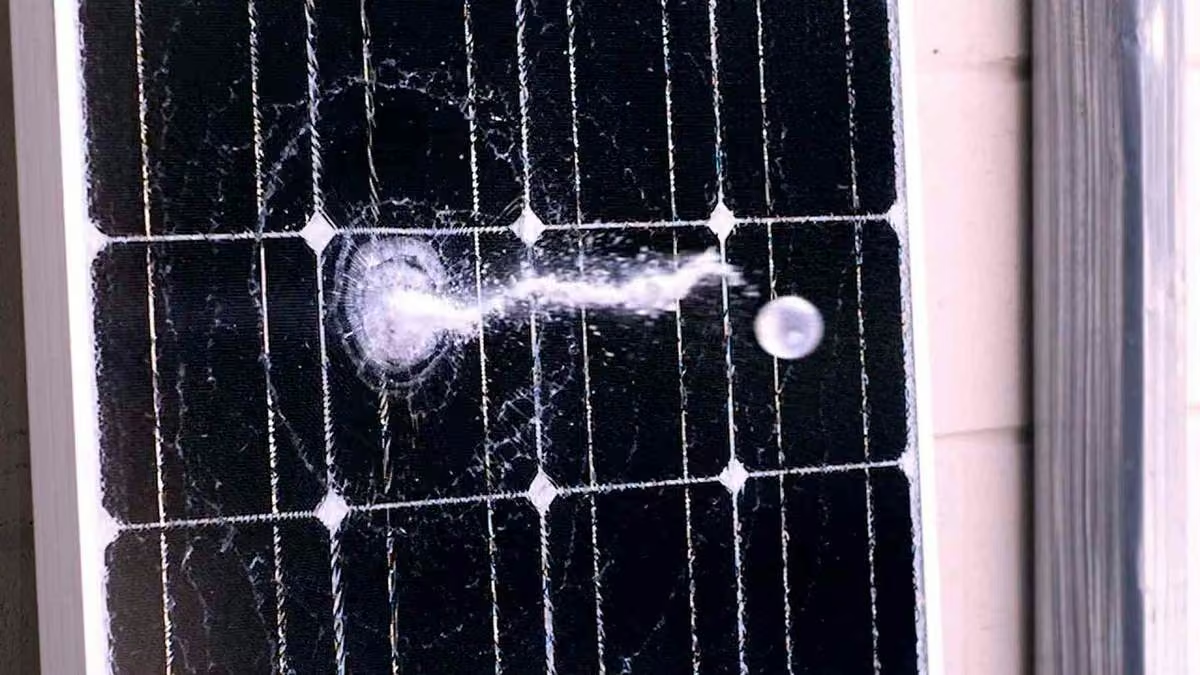
A cloud of ice fragments erupts outward, obscuring the precise square inch under the camera’s lens.
This sequence repeats identically in every recorded trial.
Despite the visual obstruction, the research team extracted quantitative data from the experiments, with the findings published in 2024.
The video evidence has not yet resolved the fundamental question: why does any delay exist?
Glass is a brittle material, and brittle materials are expected to fail instantaneously.
This is the core inquiry behind the high-speed measurements. Why does the fracture process require time?
A single stress metric is insufficient to predict the exact moment of failure.
Glass possesses a defined tensile strength, yet a hailstone can impact the surface without causing any fracture.
This specified strength is a static metric. It characterizes glass subjected to a constant load, a scenario where a microscopic flaw has sufficient duration to propagate and expand.
A hail impact does not constitute a constant load. The entire event concludes in a fraction of the time required for a camera shutter to cycle, while the crack must still initiate at a flaw and propagate outward.
If the applied stress dissipates before the flaw begins to move, no damage occurs.
Consequently, identical stress levels can shatter one pane while leaving the adjacent one intact, contingent upon the duration and velocity of the impact.
This dynamic also explains why two solar panels installed on the same roof can sustain varying degrees of damage from a single storm.
The research team describes this phenomenon as failure that is both time and rate dependent, which is precisely why a stopwatch is necessary for measurement.
The test involved a 2.2-inch ice projectile impacting 1-inch standard glass.
The test projectile is a manufactured object, not a naturally occurring hailstone.
A sphere measuring 2.2 inches in diameter and weighing approximately 2.8 ounces is fired from a barrel at a velocity nearing 76 miles per hour. The impact delivers roughly 46 joules of energy to the front glass of the solar panel.
The photovoltaic module is mounted vertically within a steel frame inside a cushioned enclosure, with the firing barrel aimed directly at its surface.
This test scenario contrasts sharply with the conditions that certified panels are required to withstand. The standard qualification test uses a 1-inch ball weighing about 0.27 ounces, propelled at approximately 51 miles per hour.
While the projectile diameter increases by slightly more than half, the kinetic energy does not scale linearly; it increases multiplicatively.
Calculations indicate that the standard certification test imparts only about 2 joules of energy. Consequently, the severe test condition described here delivers more than twenty times the energy of the baseline test that all commercial panels must pass.
Federal guidelines already advise purchasers in hail-prone regions to specify testing standards that significantly exceed these minimum requirements.
300,000 frames and 15 modules
The experimental setup and the specific conditions governing the data are detailed below.
Fifteen modules, selected for their commercial representativeness, were subjected to the impact tests. All units featured glass encapsulation on both the front and rear surfaces and utilized thin-film technology, a specification that remains critical to the study’s findings.
High-speed imaging was conducted at a rate of 300,000 frames per second. The ice projectiles imparted a median kinetic energy of 47 joules upon impact.
The initial detectable fracture occurred at an average of 126 microseconds after impact, with a standard deviation of 59 microseconds.
A fully confirmed crack appeared at an average of 158 microseconds, exhibiting a standard deviation of 77 microseconds.
Given the substantial overlap between these two distributions, the temporal difference between the initial fracture and the confirmed crack is better characterized as a continuous progression rather than two distinct stages.
The impacts that should have broken and did not
The results redefine the purpose of the specific metric in question.
Simulations of identical impacts revealed that multiple strikes, which left the glass unbroken, still generated local stresses exceeding the static fracture threshold, a dynamic that transforms lower-energy events or rooftop array scenarios into a straightforward rule.
This data provides the evidence for the observed delay and cautions against relying on a single threshold, with the conference paper presenting both findings concurrently.
The authors themselves identify the study's limitations. Ice fragmentation obscured the impact site, and the initial crack was indistinct, issues that persisted despite image processing efforts.
The accompanying measurement faced even greater challenges. Operating at 11,000 frames per second, the companion study reported that the fracture completed within 100 microseconds, a duration below the resolution capability of that frame rate.
Furthermore, fifteen thin-film modules do not represent the entire rooftop fleet.
The value of adopting a specific fracture criterion
The significance of such figures lies not in the values themselves, but in what they represent.
The researchers characterize their findings as foundational data for developing a glass fracture criterion. This standard would enable the prediction of module damage during the impact event, rather than relying on post-impact assessments.
Implementing such a criterion would allow variables including glass thickness, surface coatings, cell configuration, and mounting systems to be evaluated against a unified benchmark, moving beyond the limitations of single pass-or-fail testing protocols.
Related studies have already quantified the deformation profile resulting from impacts. The collision induces a localized depression in the glass, with peak deflection increasing in proportion to the square root of the incident energy.
Meteorological events cannot be scheduled, and conventional testing rigs are limited to firing a single projectile at a fixed velocity and specific location.
High-speed imaging at 300,000 frames per second transforms this isolated event into a quantifiable target, a methodological approach that offers significant value for replication.
Receive the essential weekly insights, filtered from the clutter.
The publication’s most incisive coverage of energy, climate, and environmental issues is available at no cost on a weekly basis.
Pvola take
This research highlights that standard static strength ratings do not accurately predict module survival during high-velocity hail events. Developers and insurers should recognize that dynamic fracture mechanics involve a measurable delay, meaning that impact energy distribution and flaw propagation time are critical variables. Relying solely on static tensile data may underestimate the risk of catastrophic failure in thin-film glass-encapsulated systems exposed to severe weather.
Frequently asked questions
What is the measured delay between hail impact and the first crack in solar panel glass?
The first crack appears 126 millionths of a second after impact. This delay was measured using high-speed imaging at 300,000 frames per second during controlled hail impact tests.
Why do static tensile strength metrics fail to predict solar panel glass failure during hail impacts?
Static metrics assume constant loads allowing flaws to propagate over time. Hail impacts are transient events that conclude faster than camera shutter cycles, requiring dynamic analysis for accurate failure prediction.
How does understanding dynamic fracture delay help solar module manufacturers improve product durability?
It reveals that brittle materials do not fail instantaneously under impact. This insight allows manufacturers to design glass encapsulation that better withstands transient stress events like hail strikes.