These Solar Panels Stay Cool in Hot Climates
Key facts
- Silicon photovoltaic modules lose 0.5 percent efficiency for every degree Celsius above 25 degrees Celsius operating temperature
- In Baghdad, panel surface temperatures can reach 80 degrees Celsius, causing documented efficiency losses of up to 25 percent
- A new cooling system using water-saturated pads and front spraying boosts electrical efficiency by approximately 20 percent
- The cooling system was tested on a 33-degree tilt, representing the optimal fixed angle for solar installations at Baghdad's latitude
- Researchers at Middle Technical University are seeking partnerships with solar developers and HVAC manufacturers for a commercial pilot
Silicon photovoltaic modules face significant performance challenges during summer heatwaves. For every degree Celsius that operating temperatures exceed 25 °C, these panels typically suffer a 0.5 percent reduction in efficiency. This thermal penalty is particularly acute in regions such as Baghdad, where ambient air temperatures frequently surpass 50 °C and sustained solar irradiation can drive panel surface temperatures toward 80 °C. Under such extreme conditions, documented efficiency losses can reach as high as 25 percent.
Researchers in Iraq have developed a novel cooling mechanism designed to mitigate these losses and enhance performance in hot, sunny environments. The proposed system employs a water-saturated pad positioned behind the panel to facilitate evaporative cooling, combined with intermittent water spraying on the front surface to prevent overheating. According to a report published in late September in the journal Results in Engineering, this approach can boost electrical efficiency by approximately 20 percent. The system also produces cooler air, which could potentially be repurposed for building ventilation applications.
Deyaa M. N. Mahmood, a thermal power systems expert at Middle Technical University in Baghdad and the lead author of the study, notes that conventional cooling techniques, including fan-assisted systems and passive ventilation, often fail to maintain optimal temperatures during extreme heat waves. However, the city’s arid climate presents a distinct advantage for alternative strategies. With relative humidity levels hovering between 15 and 20 percent, Mahmood explains that the conditions “provide the ideal thermodynamic environment for highly efficient latent evaporative cooling.”
How Do Solar Panel Cooling Systems Function?
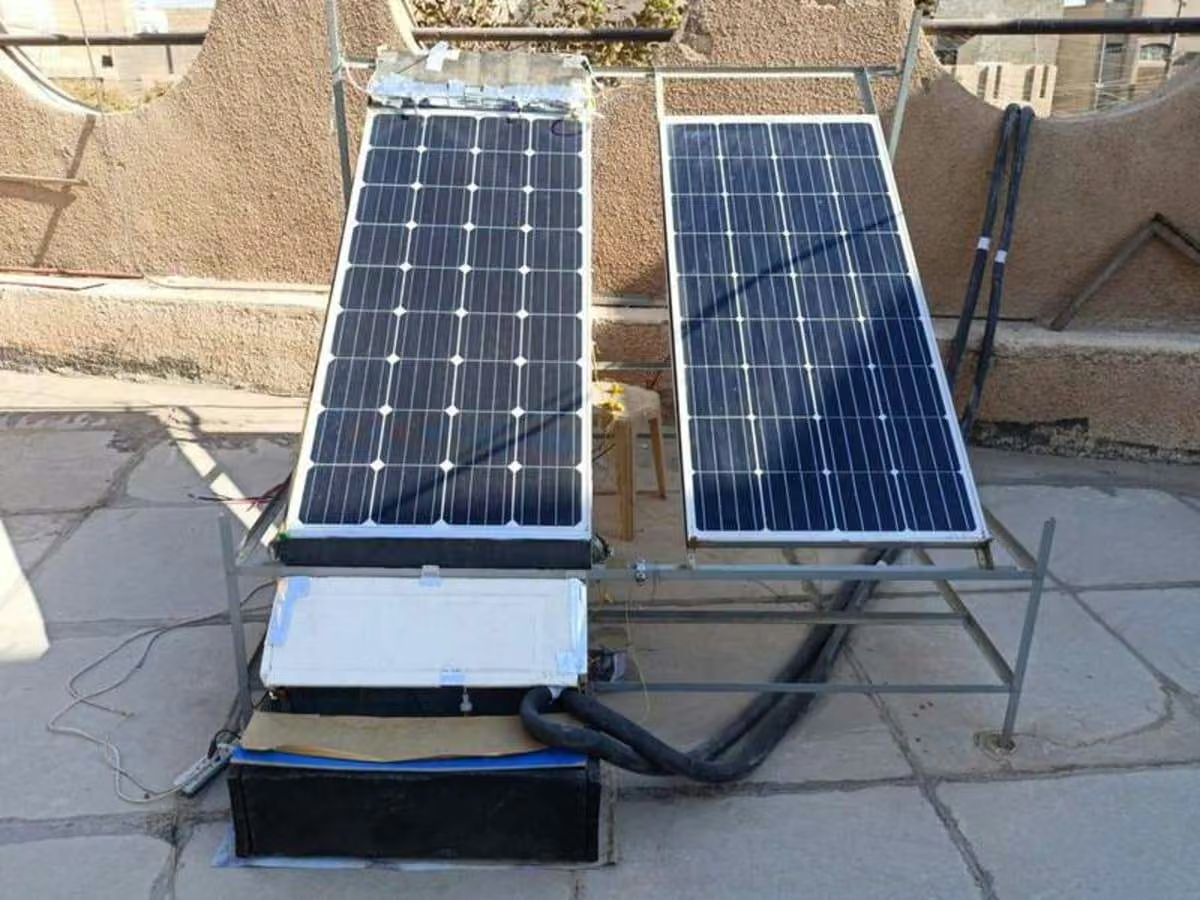
The research team led by Mahmood developed a cooling system for photovoltaic modules that integrates water-spraying nozzles, an evaporative cooling pad, and a temperature sensor. The cellulose-based evaporative pad is positioned against the rear of the solar panel, where a perforated tube ensures uniform water distribution. A fan simultaneously pulls ambient air through the pad, facilitating evaporation and lowering the module's operating temperature.
When the front surface of the panel reaches temperatures between 42 and 45 degrees Celsius, the nozzles automatically activate to spray water across the surface. This action reduces surface heat and clears accumulated dust. A collection tank captures runoff from both the rear pad and the front spray, allowing the water to be recirculated and minimizing the consumption of fresh water.
In the optimal configuration, which utilized a 100-millimeter-thick pad, the panel's temperature decreased by 29.7 degrees Celsius compared to an uncooled unit. The system also achieved an approximate 20 percent improvement in electrical conversion efficiency. Field tests were conducted during July, August, and September, with data recorded during the hottest and sunniest periods in Baghdad.
The design emerged from iterative prototyping, including an earlier model that employed a groundwater-to-air heat exchanger to pre-cool air before it reached the panel. That approach, however, introduced practical constraints due to its dependence on deep-well infrastructure and high pumping energy demands. The current prototype integrates evaporative cooling on the rear of the panel with intermittent water spraying on the front, engaging only when conditions warrant. This configuration enables simultaneous cooling of both surfaces and dust removal, eliminating the need for energy-intensive groundwater systems.
“Combining these two methods addresses the core limitations of standalone systems,” Mahmood says. Rear-only evaporative cooling can become less effective when ambient air temperatures exceed 50 °C.
High ambient temperatures cause a measurable decline in the power output of photovoltaic systems.
A central engineering hurdle in developing the new system was modifying the evaporative cellulose pad to accommodate the 33-degree tilt of the test rig, which represents the optimal fixed angle for solar installations at Baghdad’s latitude. In standard applications, such as evaporative air coolers and greenhouse ventilation, these pads are mounted vertically to allow gravity to distribute water evenly downward. Tilted installation necessitated specific modifications to water flow and distribution mechanisms to avoid dry patches or uneven channeling, according to Mahmood.
Qiaoqiang Gan and Sunmiao Fang, materials science researchers at King Abdullah University of Science and Technology (KAUST) who were not part of the study, noted that achieving a temperature reduction of nearly 30 degrees Celsius under extreme conditions is a significant accomplishment. A review published in Scientific Reports in May indicated that earlier water-spray cooling methods typically yielded temperature drops between 10 and 22 degrees Celsius, alongside electrical efficiency gains in the range of 7 to 24 percent.
However, any assessment of different cooling methods must weigh a wide range of variables. Gan, a professor at KAUST, noted that while the published data on thermal performance is promising, the true worth of photovoltaic cooling systems should be judged by their overall energy yield, water usage, and sustained operational expenses, not merely by how much they lower panel temperatures.
Energy and Water Trade-Offs in PV Cooling
In the system developed by Mahmood, the most effective configuration boosted the average electrical output of a 150-watt photovoltaic module by roughly 16.7 watts. Yet, the setup relied on fans and pumps to circulate and spray water, a factor that could erode those gains. Fang, a postdoctoral researcher at KAUST, notes that any assessment of net electrical benefits must account for actual power consumption and operating cycles.
Mahmood concedes the drawback. “In our single-panel prototype setup, the parasitic energy consumed by the pump and fan actually exceeded the immediate electrical power gain generated by the cooling effect, a well-known limitation inherent to small-scale prototypes,” he says. He adds that this issue could be partially mitigated in full-scale commercial installations, where shared pumping and fan infrastructure can be scaled across a large array, thereby lowering the overhead per panel.
Mahmood also identifies opportunities for energy conservation through the integration of the system with building ventilation infrastructure. He notes that the most unexpected finding was the superior thermal characteristics of the air exiting the rear of the unit. Once this air has passed through the water-saturated cellulose pad, it can be channeled to pre-cool the fresh-air intake components of Heating, Ventilation, and Air Conditioning (HVAC) systems.
Mahmood explains that when the secondary thermal energy conserved by utilizing this cooled exhaust air for HVAC pre-cooling is factored in, the overall net energy balance of the system becomes significantly advantageous.
The thermal management of photovoltaic systems offers a dual benefit by simultaneously reducing the temperature of the panels and the surrounding structures.
The efficacy of the system in cooling structures has yet to be confirmed. Fang points out that the researchers reported an outlet air temperature of approximately 34 °C, a level that would necessitate additional cooling measures to achieve indoor comfort standards.
Implementing such systems in arid environments presents several logistical challenges, including limited water supplies, dust accumulation, mineral scaling, nozzle blockages, and ongoing maintenance requirements. Furthermore, the dependence on powered fans and pumps may hinder deployment in regions characterized by unstable electrical grids.
According to Fang, the technology is best suited for buildings that possess consistent water access and established ventilation infrastructure. However, the expenses associated with installation, retrofitting, power consumption, and upkeep could potentially negate the energy savings for small-scale residential applications or off-grid setups.
Mahmood’s group at Middle Technical University is currently pursuing partnerships with solar project developers and HVAC manufacturers to facilitate a full-scale commercial pilot.
Pvola take
This development offers a promising solution for high-temperature regions where thermal degradation severely impacts yield. By recovering up to 20 percent of lost efficiency, the system could significantly improve the return on investment for projects in extreme climates. However, developers must carefully evaluate the added costs of installation and maintenance to ensure the energy savings justify the capital expenditure, particularly for smaller or off-grid installations.
Frequently asked questions
How much can the new evaporative cooling system improve solar panel efficiency in hot climates like Baghdad?
The system can boost electrical efficiency by approximately 20 percent. It uses a water-saturated pad and intermittent spraying to mitigate thermal penalties that can reach 25 percent in extreme conditions.
What specific thermal conditions in Baghdad cause up to 25 percent efficiency losses in standard silicon photovoltaic modules?
Ambient air temperatures frequently surpass 50 °C, driving panel surface temperatures toward 80 °C. For every degree Celsius above 25 °C, standard panels suffer a 0.5 percent reduction in efficiency.
What is the current status of the commercial pilot for this solar cooling technology developed by Middle Technical University?
The research group is pursuing partnerships with solar project developers and HVAC manufacturers. They are working to facilitate a full-scale commercial pilot to test the system's viability in real-world applications.