Iraq: Will Baghdad’s Solar Panel Cooling Hack Make PV More Efficient
Key facts
- Silicon solar panels lose 0.5 percent efficiency for every degree Celsius above 25 degrees, a critical issue in Baghdad where air temperatures exceed 50 degrees
- Researchers at Middle Technical University reported in Results in Engineering that an evaporative cooling system can improve electrical efficiency by approximately 20 percent
- The proposed cooling design uses a water-soaked pad behind the panel and intermittent front-surface spraying to manage temperatures that can reach 80 degrees Celsius
- The team is actively seeking solar project developers and HVAC manufacturing partners to execute a full-scale commercial pilot of the cooling technology
Summer heat is a major problem for silicon solar panels . They typically lose 0.5 percent of their efficiency for every degree their temperature rises above 25 °C. That’s a problem in hot places like Baghdad, where air temperatures can top 50 °C and prolonged sunlight can push panel surfaces toward 80 °C. In those kinds of extreme conditions, solar panel efficiency has been shown to drop by as much as 25 percent .
But new research out of Iraq could provide a cooling solution that boosts solar panel efficiency in hot and sunny conditions. The system uses a water-soaked pad behind the solar panel to provide evaporative cooling, and intermittent water spraying across its front surface to prevent overheating. This strategy can improve electrical efficiency by about 20 percent, the researchers reported in late September in Results in Engineering . The system also generated cooler air that could potentially be used for building ventilation.
Existing solar panel cooling methods, such as fan-assisted cooling and passive ventilation, can struggle to adequately regulate temperatures under extreme heat, says Deyaa M. N. Mahmood , a thermal power systems expert at Middle Technical University in Baghdad and lead author of the paper. But Baghdad’s extremely dry air offers an opportunity to use a different approach. Its low relative humidity of around 15–20 percent, Mahmood says, “provides the ideal thermodynamic environment for highly efficient latent evaporative cooling.”
How Does Solar Panel Cooling Work?
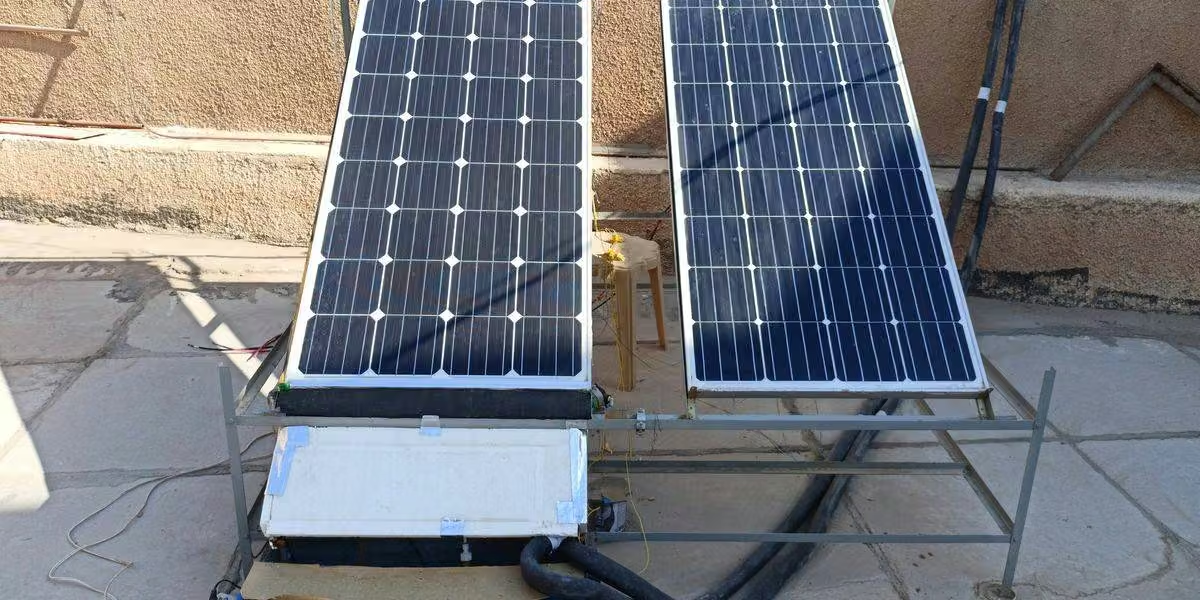
Mahmood and his team’s strategy involves adding water-spraying nozzles, an evaporative cooling pad, and a temperature sensor to a photovoltaic module. The evaporative pad, made of cellulose, covers the back of the solar panel and a perforated tube distributes water evenly across it. Meanwhile, a fan draws ambient air through the pad, causing evaporation and cooling the module.
When the panel’s front surface reaches 42–45 °C, nozzles automatically spray water across it to reduce surface heat and remove dust. A collection tank recovers runoff water from both the rear pad and front spray so it can be recirculated, reducing the amount of fresh water needed.
The experimental setup features a modified PV panel equipped with an evaporative cooling pad on the back with a flexible water distribution tube. Deyaa M. N. Mahmood/Elsevier
In the best-performing configuration with a 100-millimeter-thick pad, the panel’s temperature dropped by 29.7 °C relative to an uncooled panel. Electrical conversion efficiency also improved by about 20 percent. The researchers tested the system in July, August, and September, collecting measurements during Baghdad’s hottest and sunniest hours.
The team arrived at this design after building previous prototypes, one of which used a groundwater-to-air heat exchanger to pre-cool incoming air before reaching the pad. That design, however, added practical limitations by relying on deep-well infrastructure and substantial pumping power. The latest prototype combines evaporative cooling behind the panel with intermittent water spraying on the front, activating only when needed. This allows the system to cool both sides and wash away dust without relying on energy-intensive groundwater systems.
“Combining these two methods addresses the core limitations of standalone systems,” Mahmood says. Rear-only evaporative cooling can become less effective when ambient air temperatures exceed 50 °C.
Solar Panel Efficiency Drops in Hot Climates
An evaporative cooling pad that mounts to the back of the panel stays wet with a water distribution pipe. Deyaa M. N. Mahmood/Elsevier
A key engineering challenge in the new design involved adapting the evaporative cellulose pad to the test rig’s 33° incline—the optimal fixed-tilt angle for solar panels in Baghdad’s latitude. Such pads are typically installed vertically in evaporative air coolers and greenhouse ventilation systems, allowing water to flow evenly downward via gravity. Installing the pad at an angle required adjustments to water flow and distribution to prevent dry spots or water channeling, Mahmood says.
Reducing the temperature of the panel by nearly 30 °C in extreme conditions is impressive, say Qiaoqiang Gan and Sunmiao Fang , materials science researchers at King Abdullah University of Science and Technology ( KAUST ) who were not involved in the research. Previous water-spray cooling efforts reported temperature reductions of about 10 °C to 22 °C and electrical efficiency improvements of roughly 7 to 24 percent, according to a study published in May in Scientific Reports.
But comparisons between cooling technologies should account for many factors. “The reported cooling performance is encouraging, but the ultimate value of PV cooling technologies should be evaluated based on their net energy benefits, water consumption, and long-term operating costs, rather than temperature reduction alone,” says Gan, a professor at KAUST.
Energy and Water Trade-Offs in PV Cooling
In Mahmood’s system, the best-performing configuration increased the average electrical output of a 150-watt PV module by approximately 16.7 W. However, the system used a fan and pumps for water circulation and spraying, potentially impacting those gains. Actual power consumption and operating cycles must be considered when evaluating net electrical benefits, says Fang, a postdoctoral researcher at KAUST.
Mahmood acknowledges the shortcoming. “In our single-panel prototype setup, the parasitic energy consumed by the pump and fan actually exceeded the immediate electrical power gain generated by the cooling effect, a well-known limitation inherent to small-scale prototypes,” he says. This could be mitigated somewhat in full-scale commercial installations, where shared pumping and fan infrastructure can scale across a large array, reducing overhead per panel.
Mahmood also sees potential energy savings from integrating the system with building ventilation. “What surprised us most was the exceptional thermal quality of the rear exhaust air,” Mahmood says. After passing through the water-soaked cellulose pad, the cooled air could be directed to pre-cool Heating, Ventilation, and Air Conditioning ( HVAC ) fresh-air intake units.
“When accounting for the secondary thermal energy saved by using the cooled exhaust air for building HVAC pre-cooling, the total net energy balance of the system becomes highly favorable,” Mahmood says.
Solar Panel Cooling Can Also Cool Buildings
How well the system could cool buildings remains unverified. The researchers reported an outlet air temperature of around 34 °C, which would require further cooling for indoor comfort, notes Fang.
Other deployment considerations in arid regions include water availability, dust buildup, mineral deposits, nozzle clogs, and maintenance. The reliance on powered fans and pumps could also complicate installations in areas with unreliable electricity.
Fang says the technology may suit buildings with reliable water and existing ventilation, but installation, retrofitting, electricity, and maintenance costs could offset savings in small residential or off-grid systems.
Mahmood’s team at Middle Technical University is seeking solar project developers and HVAC manufacturing partners for a full-scale commercial pilot.
Pvola take
Developers in high-temperature regions should view this evaporative cooling approach as a potential efficiency booster, though its viability depends heavily on reliable water access and existing ventilation infrastructure. The primary barrier remains the added cost of installation and maintenance, which may offset energy gains for small residential or off-grid projects. Consequently, this technology is best suited for larger commercial buildings where the 20 percent efficiency gain can justify the additional capital expenditure and operational complexity.
Frequently asked questions
How much does the new evaporative cooling system improve solar panel efficiency in Baghdad's extreme heat conditions?
The system improves electrical efficiency by about 20 percent. This performance gain is achieved by using a water-soaked pad for evaporative cooling and intermittent water spraying to prevent overheating.
What specific engineering challenge did the researchers face when adapting the cooling pad to the test rig in Baghdad?
The team had to adapt the evaporative cellulose pad to the test rig's 33-degree incline. This angle represents the optimal fixed-tilt configuration for solar panels at Baghdad's specific latitude.
What type of commercial partners is the Middle Technical University team seeking for the full-scale pilot of this cooling technology?
The team is seeking solar project developers and HVAC manufacturing partners. They aim to move the technology from research to a full-scale commercial pilot to validate its practical application.