Sweden bets on magenta solar panels: they allow broccoli cultivation and electricity production on the same land
Key facts
- Researchers at Mälardalen University in Sweden tested semi-transparent magenta solar panels to enable simultaneous broccoli cultivation and electricity generation
- The magenta panels selectively filter sunlight by allowing red and blue radiation to pass through for plant photosynthesis while intercepting other wavelengths for power
- The experimental prototypes used cadmium telluride photovoltaic cells arranged in opaque strips across glass surfaces to manage the balance between crop growth and energy yield
- The study aimed to determine if solar radiation could be shared between food production and electricity generation without hindering crop growth due to excessive shade
The coexistence of agriculture and photovoltaic power generation has emerged as a major challenge in the energy transition. While installing solar panels on agricultural land improves the utilization of available space, it creates a significant issue: the excessive shade cast by conventional modules can hinder crop growth.
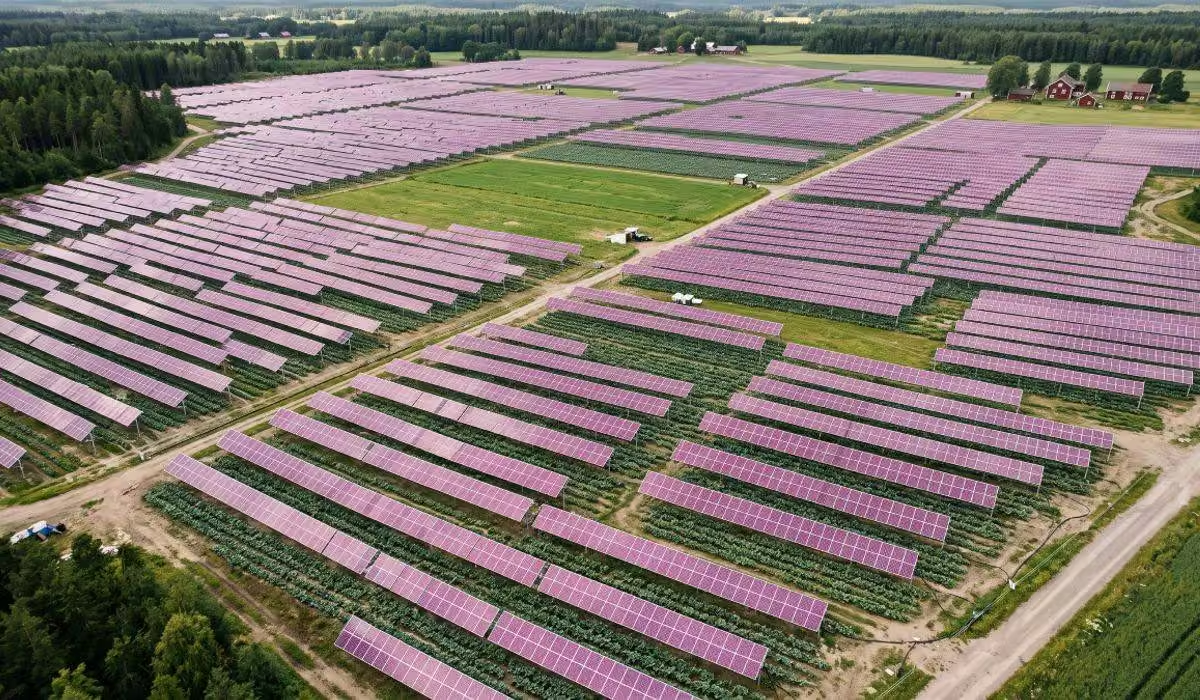
To address this limitation, researchers at Mälardalen University in Sweden tested an innovative alternative using semi-transparent magenta solar panels capable of selectively filtering sunlight.
The experiment was conducted on broccoli crops and aimed to determine whether it is possible to share solar radiation between two simultaneous activities: food production and electricity generation.
How do magenta solar panels work
The technology hinges on a more efficient allocation of solar light wavelengths.
The magenta panels allow a substantial portion of red and blue radiation to pass through, targeting the specific spectral bands that plants utilize most effectively for photosynthesis. The remaining solar energy is intercepted by photovoltaic cells to generate electricity.
To assess the system, researchers deployed two experimental structures, each measuring approximately 20 meters by 20 meters. One structure incorporated panels with 50% transparency, while the other utilized modules with 70% transparency. As a baseline for comparison, a conventional plot fully exposed to sunlight was also cultivated.
The initiative has yielded promising results for broccoli cultivation.
Throughout the 2024 agricultural season, researchers monitored a range of variables, including temperature, soil and air humidity, photosynthetic activity, plant yield, and the nutritional quality of the harvest.
The findings were surprisingly favorable.
At harvest time, the broccoli grown beneath both types of panels yielded results very similar to those from the uncovered plot. This demonstrated that the partial reduction in light did not significantly impact the final production.
However, a notable difference was observed: the growth cycle was extended. Crops developed under the panels required approximately 25 additional days to reach commercial maturity.

Greater efficiency in light utilization
Although growth rates were lower, researchers observed a marked improvement in the plants' ability to utilize the available radiation.
In systems employing 50% transparent panels, light use efficiency was approximately 4.5 times higher than that recorded in crops exposed directly to sunlight.
For modules featuring 70% transparency, the improvement reached 2.8 times compared to conventional cropping methods.
According to the study's authors, these findings suggest that a more balanced distribution of radiation could optimize certain physiological processes in plants, even under conditions of reduced light intensity.
The challenge of balancing agriculture and energy production
The primary challenge facing this technology lies in striking the optimal balance between agricultural output and power generation.
The greater the amount of light that penetrates the panel and reaches the crops, the less energy remains available for conversion into electricity. Conversely, as the efficiency of power production increases, the radiation received by the plants diminishes.
The prototypes featured in the study incorporate cadmium telluride photovoltaic cells arranged in opaque strips across glass surfaces. The number of cells installed directly dictates the equilibrium between the dual uses of the land.
The electricity yield of these systems falls short of that generated by standard photovoltaic installations.
Researchers acknowledge that this approach results in lower energy output compared to conventional photovoltaic systems.
During the analyzed season, the magenta panels generated approximately 224.7 megawatt-hours per hectare, a figure roughly 100 megawatt-hours lower than that of a conventional ground-mounted solar installation of equivalent surface area.
This economic disparity will require careful evaluation in future commercial deployments.
Some experts argue that offsetting the reduced electricity generation would necessitate additional agricultural yields to balance the system's profitability, a calculation that depends on prevailing energy prices and the market value of the cultivated crops.
Potential applications in orchards and greenhouses
Researchers currently view the technology as particularly suitable for smaller-scale projects.
Among the most promising applications are community orchards, greenhouses and farms, where the generated electricity could be used directly to power irrigation, cooling, storage systems or agricultural machinery.
Any surplus energy could also be fed into the local power grid, thereby increasing the overall utility of the land.
The future of agrivoltaics, in color
The Swedish research team is continuing to explore new configurations using panels in various hues, including red and blue variants, to better isolate which aspects of the observed effects are specifically attributable to the magenta wavelength and which are merely a function of the total light transmission.
While long-term trials across diverse crops and climatic conditions remain necessary, the current findings indicate that it is possible to sustain agricultural yields comparable to those of conventional farming while simultaneously generating renewable energy on the same plot of land.
Amid rising global demand for food and clean electricity, such agrivoltaic systems could emerge as a valuable mechanism for maximizing land use, enhancing agricultural sustainability, and accelerating the energy transition without competing for available territory.
Pvola take
This development offers a viable pathway for agrivoltaic projects to overcome the traditional trade-off between energy yield and agricultural viability. By using spectral filtering to direct specific wavelengths to crops, developers can maintain land productivity while generating power, which is critical for securing permits in regions with strict agricultural land-use regulations. The ability to balance these outputs through cell density provides a flexible design parameter for optimizing site-specific returns.
Frequently asked questions
How do magenta solar panels enable simultaneous broccoli cultivation and electricity production at Mälardalen University?
The panels selectively filter sunlight by allowing red and blue radiation to pass through for plant photosynthesis. The remaining solar energy is intercepted by photovoltaic cells to generate electricity, balancing the needs of both activities.
What specific photovoltaic cell technology is used in the magenta solar panel prototypes tested in Sweden?
The prototypes incorporate cadmium telluride photovoltaic cells arranged in opaque strips across glass surfaces. The number of cells installed directly dictates the equilibrium between the dual uses of the land.
What is the primary trade-off identified in the study regarding the efficiency of power production versus crop growth?
As the efficiency of power production increases, the radiation received by the plants diminishes. This trade-off requires careful calibration of the photovoltaic cell density to maintain viable crop yields while generating electricity.