Middle East: Power Storage Costs in the Gulf Reach $74, with Four Key Factors at Play (Report)
Key facts
- A recent report estimates the levelized cost of electricity storage in the Gulf Cooperation Council at approximately $74 per megawatt-hour
- The cost model simulates a 2,500 megawatt-hour battery facility, with 2,000 megawatt-hours designated as usable capacity
- The model includes an 80% margin to compensate for the gradual degradation of battery performance over time
- High ambient temperatures in the region accelerate cell degradation, a factor that must be accounted for in storage cost modeling
The economics of battery storage in the Gulf are shaped by several variables, including the scale of initial capital outlays, the price of electricity for charging, and ongoing operational and maintenance expenses.
A recent report, reviewed by the Washington-based Energy Research Unit, estimates the levelized cost of electricity storage across the Gulf Cooperation Council at approximately $74 per megawatt-hour. This figure is derived from a hypothetical model of a gigawatt-scale battery project.
This cost structure emerges as solar power generation costs in the region have fallen to levels that make it economically viable to store solar energy and dispatch it during evening peak demand periods.
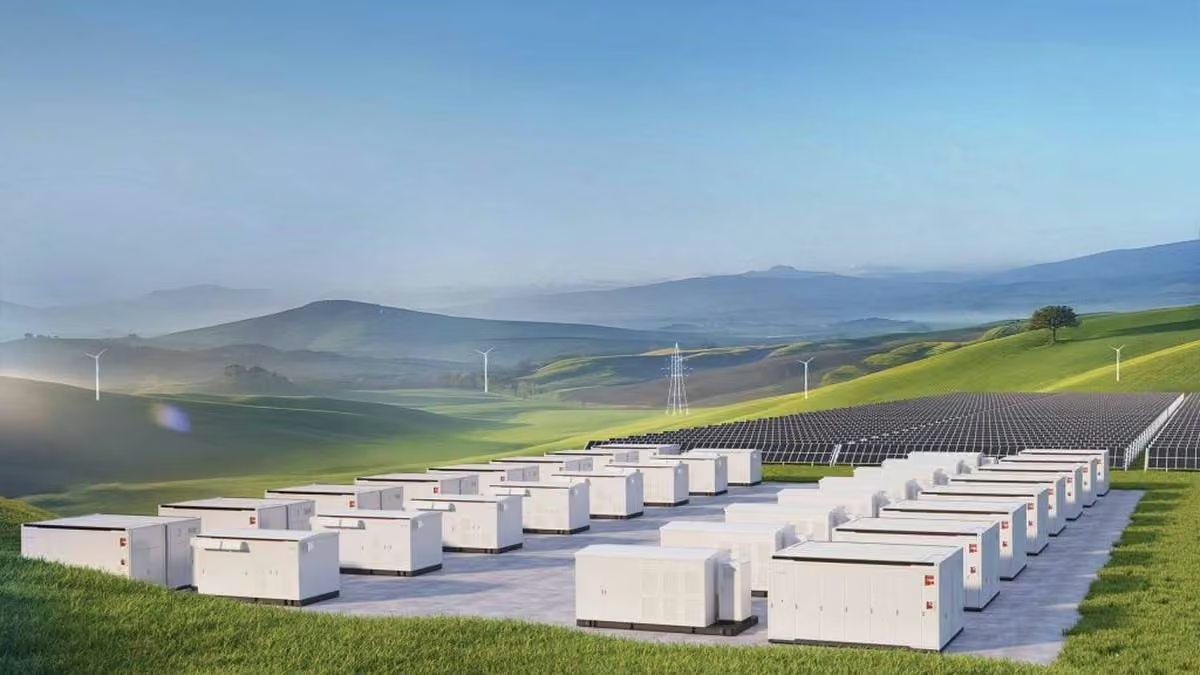
The model simulates an independent battery storage facility in the Gulf with a total capacity of 2,500 megawatt-hours, of which 2,000 megawatt-hours is designated as the usable capacity.
Solar power in the Gulf Cooperation Council countries
Renewable energy, led by solar power, is a cornerstone for reducing emissions in the Gulf Cooperation Council states, a shift driven by costs falling to record lows.
In 2025, Saudi Arabia signed agreements to purchase solar-generated electricity at rates ranging from $11 to $13.6 per megawatt-hour.
The Shu'aiba 1 project set a global record in 2021 at $10.4 per megawatt-hour.
As generation costs reach these levels, the economic viability of shifting solar output to evening peak demand hours becomes a focal point.
To determine the cost of electricity transfer in dollars per megawatt-hour, analysts use the Levelized Cost of Storage (LCOS), a metric that measures the total cost of storing and transmitting electricity via a Battery Energy Storage System (BESS).
The calculation relies on a discounted cash flow model that incorporates capital expenditures, operation and maintenance costs, the cost of charging batteries with solar power, system efficiency, auxiliary energy consumption, and the residual value at the end of the project’s life. The net present value of total costs is then divided by the net present value of the electricity delivered over the project’s lifespan.
To assess the levelized cost of electricity storage for a gigawatt-scale project, the analysis is based on a theoretical, standalone battery storage facility with a capacity of 2,500 megawatt-hours.
The usable capacity stands at 2,000 megawatt-hours, representing 80% of the total, a margin designed to compensate for the gradual degradation of battery performance over time.
A report by D. Desert Energy indicates that modeling the levelized cost of storage in the Middle East and North Africa region must account for the area's harsh operating conditions.
The report explains that high ambient temperatures accelerate cell degradation. According to findings by the Energy Research Unit, this results in a capacity loss rate approximately three times higher at 55 degrees Celsius compared to 25 degrees Celsius.
These conditions also necessitate robust thermal management systems, which add between 5% and 8% to the initial capital costs. Furthermore, additional cooling requirements reduce the actual round-trip efficiency of the alternating current system to between 85% and 88%.
Power storage costs in the Gulf
Under the default model for a 2,500-megawatt-hour battery system, the levelized cost of electricity storage in the Gulf region stands at approximately $74 per megawatt-hour.
The report clarifies that this figure serves as a reference value derived from the model, rather than an estimate of the levelized cost across the entire Gulf storage market.
According to data tracked by the Energy Research Unit, capital expenditures account for 62% of the total cost of electricity storage in the Gulf, while charging costs represent 20% and operation and maintenance expenses make up the remaining 18%.
The cost structure reveals that initial capital investment is the most significant factor influencing the economics of electricity storage, particularly given the availability of low-cost solar power for battery charging.
Nevertheless, operation and maintenance costs remain a critical component, given their contribution to the overall cost of electricity storage in the Gulf.
Furthermore, financial models require sensitivity analysis because real-world conditions do not always align with base-case assumptions. The accuracy of the model depends on its inputs, including costs, revenues, discount rates, inflation, and technical assumptions, all of which are subject to change.
Sensitivity analysis tests the impact of variations in these key factors by calculating the project’s levelized storage cost.
The model indicates that storing solar energy and utilizing it at different times presents an economic opportunity in the Gulf Cooperation Council countries.
At a cost of approximately $74 per megawatt-hour, battery storage can convert low-cost solar power into stable, dispatchable electricity. According to the report, this solution can compete with new gas-fired power plants in certain applications across the Gulf states, depending on gas prices, capacity factors, financing terms, and grid requirements.
Pvola take
Developers in the Gulf should view the $74 per megawatt-hour storage cost as a viable threshold for competing with new gas-fired plants. This economic parity is driven by record-low solar generation costs, which make storing energy for evening peak dispatch financially attractive. Investors must, however, factor in accelerated battery degradation from high ambient temperatures when evaluating long-term project returns.
Frequently asked questions
What is the estimated levelized cost of battery storage in the Gulf according to the recent report?
The estimated levelized cost is approximately $74 per megawatt-hour. This figure is derived from a hypothetical model of a gigawatt-scale battery project in the region.
What are the specific capacity parameters of the battery storage model used in the Gulf cost analysis?
The model simulates a facility with a total capacity of 2,500 megawatt-hours. Of this total, 2,000 megawatt-hours is designated as the usable capacity to account for degradation.
How does the $74 per megawatt-hour storage cost impact the competitiveness of solar-plus-storage in the Gulf?
At this cost, battery storage can convert low-cost solar power into dispatchable electricity. The report indicates this solution can compete with new gas-fired power plants depending on gas prices and financing terms.