Are There Too Many Battery Storage Facilities? Experts Disagree on the Ideal Number
Key facts
- Martin Pich of MND estimates 3 to 4 gigawatts of battery storage will be built in the Czech Republic by the end of 2028
- Pich suggests that deploying storage at this scale could reduce electricity prices by 5 to 15 percent in the Czech market
- Michal Macenauer of EGU argues the market will only support several hundred megawatts of battery storage capacity
- ČEZ plans to bring its first large-scale battery storage facilities into operation in the Czech Republic in 2027
- Projects exceeding 100 megawatts are being constructed by a group backed by billionaire Pavel Tykač in the region
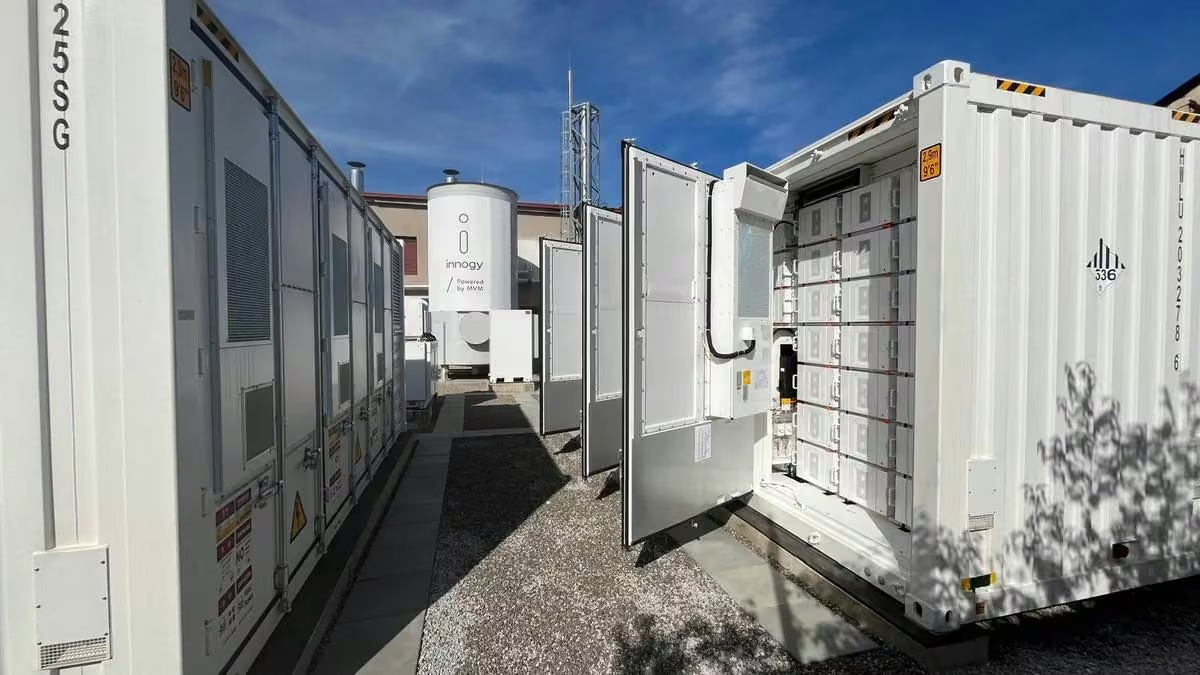
Large-scale battery energy storage systems are essential for ensuring the safe and reliable operation of the electrical grid, a point on which experts agree. However, opinions diverge on how many such facilities the Czech Republic actually requires. There is also uncertainty regarding the exact capacity and power output of the battery storage units that have already been completed.
Martin Pich, head of the trading division at energy company MND, represents the optimistic camp. He estimates that large battery storage facilities with a combined power output of 3 to 4 gigawatts will be built in the Czech Republic by the end of 2028. According to Pich, the potential for using these systems to balance electricity prices throughout the day will be exhausted at that point, rendering further construction pointless. Drawing on experiences from other countries, he suggests that deploying storage at this scale could reduce electricity prices by 5 to 15 percent.
Macenauer: 1 GW is sufficient
Michal Macenauer, head of strategy at consultancy EGU, offers a more pessimistic outlook. He argues that the market will only support several hundred megawatts of battery storage capacity, with a ceiling of one gigawatt. “Flexibility alone cannot replace the essential investments in power plants and energy grids. Economics will always be the deciding factor. Flexibility will only develop to the extent that its operation and investment prove profitable,” Macenauer added.

Macenauer noted that large-scale battery storage, even when paired with renewable energy sources, struggles to compensate for the loss of nine megawatts of capacity from coal-fired power plants. The primary solution will come from new gas-fired combined heat and power plants and power stations, which investors are set to construct in the coming years with state support. Improved utilization of smaller battery storage systems in households and businesses would also contribute to grid stability. These distributed systems currently deliver a substantial 2.5 gigawatts of capacity, yet their potential for maintaining network stability remains largely untapped.
Bulgaria as a model?
Martin Pich cited the example of Bulgaria, which has unexpectedly emerged as a European leader in battery storage deployment. The country's installed capacity now stands at 5.4 gigawatts, with the majority of this capacity commissioned by investors within the past year. The results have been swift, as spot electricity prices during morning and evening peak hours have dropped significantly in Bulgaria. In recent years, intraday price volatility, driven by the mismatch between consumption and solar power generation, has been among the primary challenges facing the electricity market.

The conditions in the Czech Republic and Bulgaria are not comparable. A surge in battery installations in Bulgaria has been fueled by substantial European subsidies that cover up to half of the investment costs. In contrast, the majority of battery storage facilities in the Czech Republic are developed without public subsidies, with the exception of limited support from the Modernization Fund.
Race Against Time
The energy storage sector is currently experiencing a surge in activity. Second Foundation, in partnership with other stakeholders, and the Sev.en group, backed by billionaire Pavel Tykač, are constructing large-scale battery storage facilities with capacities exceeding 100 megawatts. Slightly smaller projects are being developed by SUAS Group in collaboration with Slovakia’s EIF, as well as by MND. ČEZ also has significant plans for the sector, though the company will not bring its first large-scale batteries into operation until 2027 and 2028.
A lack of reliable statistics regarding the capacity and power of large battery storage systems in the Czech Republic presents certain challenges. The Energy Regulatory Office lists 37 issued licenses on its website, with the total capacity of these licensed facilities reaching approximately 165 megawatts. An additional 29 batteries are awaiting license approval. In practice, this process is protracted and can take several months. For instance, SUAS Group waited eight months for the license for its 10-megawatt battery.

Different regulations apply when a battery storage system is integrated into a power plant. In such cases, the operator is not required to apply for a license, provided that the battery's capacity does not exceed 1.2 times the installed capacity of the electricity generation facility. Consequently, equipment located within the premises of power plants and heating plants, such as the large-scale energy storage units at the C-energy heating plant in Planá nad Lužnicí, do not require a separate license.
The battle for the regulatory energy market
As the Economic Daily reported two weeks ago, battery storage investments have become a source of disappointment for a number of investors. This is particularly true in cases where the investor intended to focus on providing control energy to the Czech Transmission System Operator (CEPS). Rising competition has driven the prices of power balance services down by 58 percent compared to the previous year.
Success in this sector now hinges on complex IT systems and access to various energy markets. Larger energy groups with the requisite expertise hold a distinct advantage. These include MND, Solar Global, and Second Foundation, the latter of which operates through its subsidiary Nano Energies. Other battery investors are often left with no choice but to find a stronger partner who can grant them access to energy markets in exchange for an appropriate commission.
Discussion
Do not miss
The Russian ice is back in play, and the situation in the Czech Republic is no exception. Brussels has highlighted a critical obstacle that could complicate the broader energy landscape.

Pvola take
Developers face significant uncertainty regarding the optimal scale for new battery projects in the Czech Republic, as expert estimates for required capacity vary drastically. This divergence creates a high-risk environment for investors, since the market may saturate at a level far below current construction pipelines. Consequently, project viability depends heavily on accurate long-term demand forecasting rather than simple capacity expansion.
Frequently asked questions
What is the estimated total power output of battery storage facilities in the Czech Republic by 2028 according to MND?
Martin Pich of MND estimates that 3 to 4 GW of large-scale battery storage will be built by the end of 2028. He believes this capacity will exhaust the potential for balancing electricity prices throughout the day.
How does Michal Macenauer of EGU view the market capacity for battery storage in the Czech Republic?
Michal Macenauer argues that the market will only support several hundred megawatts of battery storage capacity. He suggests that the current market conditions impose a lower ceiling on viable storage deployment compared to optimistic projections.
What potential impact on electricity prices is associated with deploying 3 to 4 GW of battery storage in the Czech Republic?
Deploying storage at this scale could reduce electricity prices by 5 to 15 percent. This estimate is based on experiences from other countries where large-scale storage has been used to balance supply and demand.