Italy: Agrivoltaics in Appidè: Crops Between Panels and Municipal Appeal
Key facts
- A 54.4 megawatt agrivoltaic facility in Corigliano d’Otranto is currently undergoing an authorization process
- The municipality of Corigliano d’Otranto has initiated a legal challenge to contest the project’s environmental permits
- The project, named Corigliano 43.8, is promoted by ARNG Solar XI Srl, part of the Aer Soléir group
- A public presentation for the project was held on November 6 at the Castle’s Cavallerizza hall
- Compensation measures ranging from 75,000 to 230,000 euros have been proposed for the Single Authorization procedure
Follow Il Gallo Live News on WhatsApp; click here
In Corigliano d’Otranto, the future of the Appidè area is unfolding along two parallel tracks: the authorization process for a 54.4 megawatt agrivoltaic facility and the legal challenge initiated by the municipality to contest the project’s environmental permits. At the center of this dispute is a debate over land use, the continuity of agricultural activities, and the impact of concentrating multiple energy projects within the same territory.
The “Corigliano 43.8” project, promoted by ARNG Solar XI Srl, a company within the European group Aer Soléir, was presented on Friday, November 6, at 6:00 p.m. in the Cavallerizza hall of the Castle. The event, titled “Reasons in Contrast” and organized by the association Spazio a Sud, drew a large number of local residents. Mayor Ada Fiore was absent, citing the city council’s vote against the project and the ongoing litigation as the reasons for her decision.
Cassandra Panizza, president of the association, stated that the evening’s goal was to provide balanced information, grounded in verifiable data, regarding the relationship between solar power generation and agricultural operations.
How the land will be allocated
The development is situated in the southwestern outskirts of the town. Ilaria Angelelli, a land-use planner at NRG Plus Italia, outlined the site allocation, which designates 87.1 hectares for agricultural use and 13.4 hectares for photovoltaic infrastructure, representing approximately 13 percent of the total designated area.
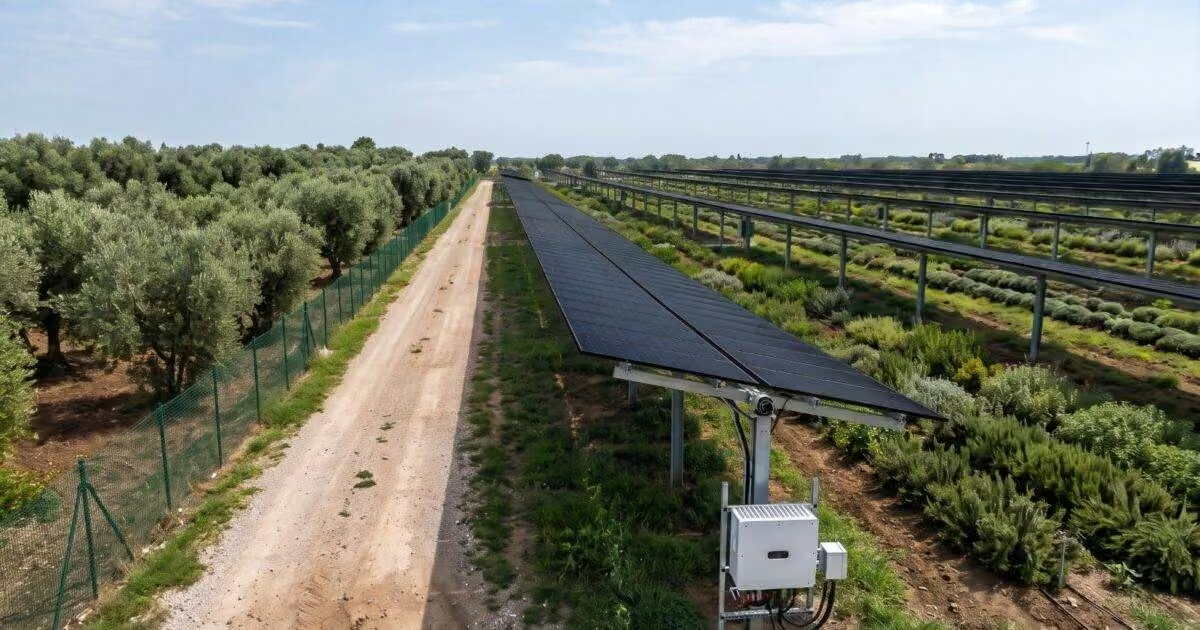
The solar panels will be elevated and mounted on single-axis trackers, devices that allow the modules to rotate in alignment with the sun’s trajectory. A clearance of 9.85 meters will be maintained between rows to accommodate the passage of agricultural machinery and field operations. Internal cabling will be buried underground, while the concrete foundations will occupy approximately 1,130 square meters, according to the technical specifications provided.
The project’s peak capacity is set at 54.4 megawatts, whereas the figure referenced in the project name corresponds to the 43.8 megawatts of maximum power to be fed into the grid. The connection to the Galatina substation will be established via an underground cable that will traverse Cutrofiano, Sogliano Cavour, Seclì, Aradeo, and Galatone.
The total investment is estimated at 42.9 million euros. According to projections by the project proponents, the facility’s output would meet the energy needs of approximately 37,000 households, while preventing the release of 45,600 tonnes of carbon dioxide annually.
Crops, olive trees and beekeeping
The agricultural management of the site will remain under the control of landowner Massimo Rota, who will collaborate with a local company. Rota presented the project as an opportunity to bring farmland back into production during a period marked by the widespread abandonment of rural land.
The plan calls for crops to be grown between the solar modules, the planting of nearly six hectares of Leccino olive trees along the perimeter, and the installation of beehives for apiculture. According to the presentation, the land will be cultivated without the use of herbicides or pesticides, and soil fertility will be analyzed annually.
Davide Briganti, from 3Bee, detailed the measures designed to support bees and other pollinators. Maurizio Cezzi, an agronomist and president of Confagricoltura Lecce, emphasized the need to regenerate the countryside following the Xylella crisis. He also highlighted the fire risk posed by abandoned land and the opportunities that energy self-production offers to agricultural businesses.
Landscape protection measures and the dismantling process
The visual mockups depict olive trees planted outside the perimeter fence, serving to screen the facility from view. The design calls for a camouflage-colored fence without plastic mesh, along with electrical cabinets whose shapes, materials, and colors are inspired by local architectural styles. Trees and hedges must be maintained throughout the operational life of the installation.
The accompanying documentation states that no night-time lighting will be installed and asserts that operations will generate no noise or interference with groundwater aquifers.
Upon the expiration of the planned 30-year term, the structures must be dismantled and the land returned to exclusively agricultural use. A surety bond has been designated to cover the costs of decommissioning.
Inspections and offset measures
Riccardo Carrai, head of development at Aer Soléir, estimated that the construction phase would last one year. He announced that environmental monitoring would be conducted prior to and during the works, as well as throughout the entire operational phase, with checks carried out by Arpa.
According to the commitment made by the company, the results will be updated and made available for consultation on the project’s website, through which residents will also be able to submit questions. “The community will be able to agree with us on public-interest interventions to be carried out as compensation, which is why institutional dialogue is fundamental,” Carrai stated.
A range of 75,000 to 230,000 euros has been proposed for potential compensation measures, to be defined with the municipalities during the Single Authorization procedure. Among the destinations discussed are interventions for schools and public utility works.
The proposal also includes ten hectares of environmental works and green space interventions, in addition to the required mitigations, along with the involvement of local businesses and workers and the promotion of agricultural production, including olive oil and honey.
Technical assessments and the permitting process
Daniela Salzedo, president of Legambiente Puglia, argued for a faster transition to renewable energy to reduce reliance on fossil fuels. She identified the continuity of agricultural activities and the protection of biodiversity as essential conditions for the development of agrivoltaic systems.
Engineer Tommaso Farenga detailed the operational mechanics of the proposed installations. Based on his assessment, he stated that the selected area does not contain any restrictive constraints that would prevent the project. Paolo Maria Congedo, a lecturer and vice president of the Order of Engineers in the province of Lecce, also contributed to the discussion, focusing on technical specifications and the outlook for energy independence.
Stefania D’Amato, an attorney at the Sticchi Damiani law firm, outlined the public participation mechanisms integrated into the authorization process. She maintained that the project is situated within a zone deemed suitable for such development.
On the administrative front, Italy’s Ministry of Environment and Energy Security issued a positive environmental impact assessment on May 21, 2026, accompanied by specific conditions and recommendations. In contrast, the Ministry of Culture raised objections regarding the project’s potential impact on the local landscape and its archaeological significance. The construction phase will involve coordination with the local Superintendency to manage any potential archaeological discoveries.
According to available information, the process for obtaining the single authorization remains ongoing.
The municipality has confirmed its opposition to the project.
Mayor Fiore’s administration has filed an appeal with the Lecce Administrative Court, challenging the environmental assessments issued by the regional government and the national ministry. The city argues that the proposed project is incompatible with local land characteristics and existing planning instruments.
The municipal council formally registered its opposition on July 30, with only Andrea Coccioli abstaining from the vote. The city has also initiated legal proceedings against a separate agrivoltaic project submitted by Sorgenia.
Although invited by the event organizers, the mayor declined to attend the meeting, citing the council’s recent decisions and the ongoing legal process. Coccioli, however, emphasized the need for a deeper examination of the project and the importance of keeping dialogue open. “If the facility is built, the municipality must sit at the table with the company to secure genuine compensations for the area: environmental, social, and economic,” he stated.
The overall impact on the countryside
Environmental and local groups have also challenged the clustering of multiple facilities within the same area, citing the Sorgenia and Bardoscia2 projects. Their central concern is the cumulative impact of these developments on the rural landscape.
This issue intersects with the regional debate over the draft law governing areas suitable for renewable energy. The proposal includes protections for agricultural land, olive groves, and the landscape, while prioritizing the agricultural function in agrivoltaic installations. The regional committees have also given a favorable opinion to an amendment addressing the assessment of cumulative impacts.
Loredana Capone and Stefano Minerva, representatives of the Democratic Party, further highlighted the request for clarification from the Ministry of the Environment regarding how already-authorized plants are counted against Puglia’s 2030 energy targets.
For Appidè, the decisive step remains the authorization procedure, which is currently affected by the municipality’s appeal. It is within this process that the projections presented at the Castle will have to confront the regulatory conditions, objections, and local consequences.
Pvola take
This dispute highlights the critical importance of early and transparent community engagement for agrivoltaic developers in Italy. The municipality’s legal challenge demonstrates that local opposition can significantly delay permitting, even when compensation mechanisms are proposed. Developers must prioritize institutional dialogue to mitigate regulatory risks and ensure project viability in contested territories.
Frequently asked questions
What is the status of the 54.4 MW agrivoltaic project in Corigliano d’Otranto?
The project is currently facing a legal challenge initiated by the municipality to contest its environmental permits. The dispute centers on land use, agricultural continuity, and the impact of multiple energy projects in the same territory.
What compensation range has been proposed for the Corigliano 43.8 agrivoltaic project?
A range of 75,000 to 230,000 euros has been proposed for potential compensation measures. These measures are to be defined with municipalities during the Single Authorization procedure to address local concerns.
How does the Corigliano d’Otranto dispute affect solar developers in Italy?
The dispute underscores the need for robust community engagement and clear compensation frameworks. Developers must navigate local opposition and legal challenges to ensure project approval and maintain social license to operate.