South Korea: Why Is Solar Power Being Wasted? The Hidden Bottleneck Behind 100GW of Renewable Energy
Key facts
- South Korea's national backlog for renewable energy grid connection requests reached 3.546 GW as of May 2026
- The Honam region accounts for 2.298 GW of the pending capacity, representing 64.8% of the national total
- Transmission networks typically require five to 15 years to build, while generation projects take one to five years
- The government announced a power grid innovation plan on September 29 to address infrastructure mismatches
Prologue | The plants are standing idle while the grid hits its limits
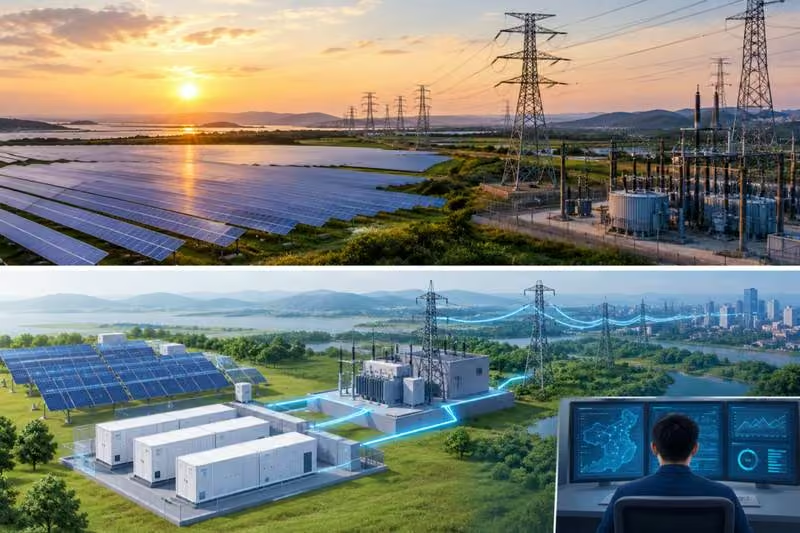
South Jeolla and North Jeolla provinces stand as the epicenter of South Korea's solar power generation, boasting abundant solar irradiance and extensive land suitable for power plants. Yet, a persistent disconnect has emerged between construction and grid integration. Many facilities, once built, remain unable to connect to the transmission network, or operators are forced to curtail output during peak generation hours. This friction stems from a fundamental mismatch in the pace of development between generation infrastructure and the electrical grid.
As of May 2026, the national backlog for renewable energy grid connection requests totaled 3.546 GW. A staggering 2.298 GW of this pending capacity is concentrated in the Honam region, accounting for 64.8% of the national total. The data underscores how the bottleneck in grid infrastructure has intensified precisely in the regions where renewable energy projects are most densely clustered.
Output curtailment further exposes the limitations of the current system. According to data released by the Ministry of Climate, Energy and Environment in July 2026, the total volume of curtailed power reached 169.8 GWh in 2025. In the first five months of 2026, cumulative curtailment hit 161.8 GWh, already achieving 95.3% of the previous year's annual total. The government noted that the curtailment rate for the same period stood at 0.3%, a figure it described as lower than those in major overseas markets, indicating stable grid management.
These two metrics, however, paint a complex picture. While the national average curtailment rate may appear low, specific regions can still suffer from significant connection delays and substantial generation losses.
On September 29, the government unveiled a comprehensive plan to overhaul the power grid. To accommodate over 100 GW of renewable energy by 2030, the strategy aims to expand transmission acceptance capacity from 119 GW to 171 GW, and distribution acceptance capacity from 84 GW to 110 GW. For the Honam region specifically, the targets are to raise transmission capacity from 37 GW to 64 GW, and distribution capacity from 18 GW to 30 GW.
The critical factor is not the target figures themselves, but the actual timeline for when connections and transmission become operational. If the grid lacks sufficient capacity, power plants cannot feed their generated electricity into the system. During periods when grid acceptance capacity is insufficient, output must be restricted. The success of the 100 GW renewable energy goal hinges not only on expanding generation assets but equally on the ability to receive and transmit that power.
The output control rate stands at 0.3 percent, while the number of control interventions in South Jeolla Province has surged 41-fold over the past two years.
The government projected that South Korea’s domestic renewable energy curtailment rate would stand at 0.3% in the first half of 2026. Officials noted this figure is lower than the 3.6% recorded in China, 6.2% in Japan’s Kyushu region, 3.8% in California, 3.5% in Germany, and 5.8% in the United Kingdom. They also emphasized that the forecast remains within the 3% ceiling outlined in the 11th Basic Plan for Electricity Supply and Demand.
South Jeolla Province displayed a distinct trend in curtailment frequency. The number of curtailment events rose from two in 2023 to 27 in 2024, and further to 82 in 2025, representing a 41-fold increase over two years. A 52-kilometer, 154-kilovolt transmission line connecting Muan and Sinan was completed on May 30, 2026. The government estimated that this infrastructure project would resolve connection delays affecting 190 megawatts of renewable energy capacity.
Curtailment rates and curtailment frequencies measure different aspects of grid management. The curtailment rate indicates the proportion of limited power relative to total generation, while the frequency counts how often output restrictions are applied. Repeated short-duration curtailments can drive up the frequency count, yet the annual curtailment rate may remain low if restrictions are concentrated in specific time periods.
The International Energy Agency’s “Renewables 2025” report compares national curtailment rates while explicitly noting differences in data scope and timeframes. Some countries aggregate solar and wind data together, whereas UK statistics include only wind power. Methodologies for distinguishing between generation reductions driven by economic factors and those caused by grid constraints also vary. These statistical discrepancies are reflected in international comparison figures.
Curtailment also impacts the revenue of power generators. A 2025 study published in the journal “Energy Policy” analyzed the South Korean curtailment compensation framework, finding that the absence of a systematic compensation mechanism forced renewable energy operators to absorb curtailment-related losses. The researchers categorized the causes of curtailment and proposed a compensation system that assigns responsibility based on specific causes.
Parliamentary audit hearings highlighted the discrepancy between national averages and local conditions. The surge in curtailment frequency in South Jeolla indicates the accumulation of grid constraints in specific areas. Data on how curtailment frequency and restricted generation volumes have changed since the completion of the Muan-Sinan transmission line, along with shifts in operator losses, will serve as key indicators for assessing the project’s effectiveness.
The completion rate for transmission and substation infrastructure stands at 30.3%, with 67.7% of the plan to resolve connection backlogs relying on just 30 substations.
As of May 2026, the volume of renewable energy projects awaiting grid connection stood at 3,546 MW, with the Honam region accounting for 2,298 MW, or 64.8% of the total. Commercial renewable energy capacity has surged more than fivefold, rising from 7,090 MW in 2016 to 37,111 MW in 2025. However, the construction of transmission and substation infrastructure has failed to keep pace with this rapid expansion in generation capacity.
According to data submitted by the Korea Electric Power Corporation (KEPCO) and the Korea Energy Agency to Rep. Kim Wi-sang of the People Power Party, who serves on the National Assembly’s Climate, Energy, Environment and Labor Committee, only 2,202 circuit-kilometers (c-km) of the 7,266 c-km planned for transmission and substation infrastructure between 2017 and 2025 had been completed, resulting in a completion rate of just 30.3%. Distribution network expansion has also lagged significantly. Of the 35 long-term distribution projects initiated in 2025, only three, or 8.6%, had been completed.
During the National Assembly inspection, Rep. Kim criticized policies that prioritized power plant expansion, noting that while generation facilities can be built in one to five years, transmission networks require five to 15 years. He warned that delays in grid construction, particularly in the Honam region where connection backlogs are concentrated, could also hinder the attraction of industries such as semiconductors.
KEPCO has outlined a plan to clear the 3,417 MW connection backlog between 2026 and 2030. However, resolving 2,314 MW, which represents 67.7% of the target, requires the construction of 30 new substations. Since 2021, the average time to build a new 154 kV substation has been 74 months. Construction schedules for 23 of the planned 30 sites are concentrated between 2028 and 2030, meaning a significant portion of the backlog resolution target depends on projects scheduled for the latter half of the plan.
The International Energy Agency’s “Electricity 2026” report estimates that more than 2,500 GW of renewable energy, storage, and large-scale power demand projects worldwide are waiting for grid connection. While power plants for solar and wind energy can be constructed in one to five years, transmission networks typically take five to 15 years. This discrepancy in construction timelines is a primary driver of domestic connection backlogs, a problem exacerbated by the concentration of generation projects in the Honam region and the low completion rate of transmission and substation infrastructure.
On September 29, the government announced a power grid innovation strategy and lifted the designation of Honam region grid management substations effective October 1. The plan prioritizes grid connection for existing waiting applicants, while new applications will resume under a reformed system in January 2027. By 2030, the government aims to increase national transmission capacity by 52 GW and distribution capacity by 26 GW. Specifically for the Honam region, the targets are to raise transmission capacity from 37 GW to 64 GW and distribution capacity from 18 GW to 30 GW.
Lifting the designation of grid management substations alters the interconnection process and operational protocols, though it does not directly shorten the construction timelines for substations and transmission lines. Since a significant portion of the backlog in interconnection requests relies on the establishment of new substations, the actual timing of grid connections is dictated by site acquisition, permitting, and the schedules for groundbreaking and completion.
Delays in interconnection also postpone the return on investment for power developers. Even after facilities are completed, electricity sales cannot commence until the equipment is connected to the grid. During this waiting period, financial costs and land lease fees continue to accrue. Consequently, both the available interconnection capacity and the specific date of actual connection determine project profitability. If the government’s 2030 targets diverge from developers’ commercial operation schedules, investment risks increase.
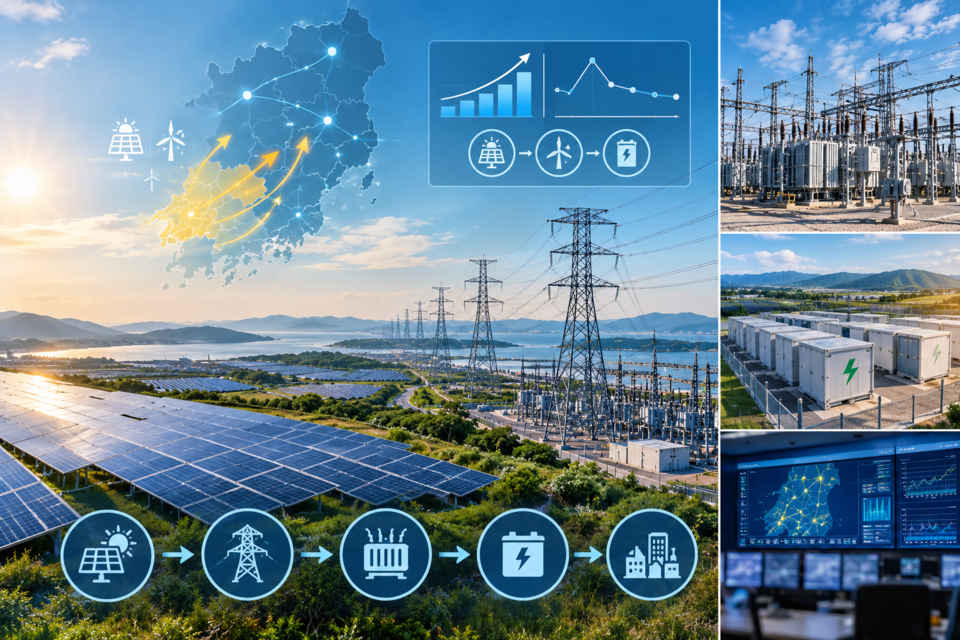
The 128-megawatt energy storage system is being integrated with a 182.4-megawatt solar power facility, highlighting the distinct operational roles of storage units and inverters in the grid.
To address the long lead times associated with expanding transmission infrastructure, the government is prioritizing the optimization of existing distribution networks and the broader deployment of energy storage systems. The Honam ESS project, announced in July, is designed with a capacity of 128 megawatts and 640 megawatt-hours. The plan involves installing storage units across 32 distribution lines to facilitate the additional connection of 182.4 megawatts of solar capacity that is currently in a queue. Nine integrated power plant operators have been selected for this initiative.
The 128 megawatt figure represents the instantaneous charge and discharge power, while the 640 megawatt-hour figure indicates the total energy storage capacity. Dividing the storage capacity by the rated output yields a nominal duration of five hours. However, actual discharge times vary depending on battery efficiency losses, state of charge, and grid operating conditions. These systems store electricity during peak solar generation periods and release it when line capacity becomes available or demand increases, thereby alleviating congestion during specific time slots.
The fact that the 182.4 megawatts of solar capacity awaiting connection exceeds the 128 megawatt output of the ESS does not imply that the storage units serve as one-to-one replacements for the power plants. Instead, the strategy involves coordinating solar generation schedules with ESS charge and discharge cycles to improve the utilization rate of the distribution network. If storage units are installed on lines that do not correspond to actual congestion points, their effectiveness will be limited. Furthermore, distribution-level ESS alone cannot resolve the shortage of long-distance transmission lines.
Grid stability presents a distinct technical challenge. Solar power is fed into the grid through inverters, which do not inherently provide the physical inertia offered by the rotating masses of coal or gas turbines. Nevertheless, depending on the control methodology employed, inverters can offer frequency response and voltage support functions.
A review paper on grid-forming inverters, published in the journal IET Renewable Power Generation in 2024, analyzed control technologies for maintaining voltage and frequency stability in grids with a growing share of inverter-based resources. Grid-forming inverters operate by establishing voltage and frequency references. Their design must account for current limits, energy storage capabilities, and specific grid conditions.
Domestic researchers also examined the control stability of grid-forming inverters in a 2024 paper published in IEEE Access. The study highlighted that inverter output can become unstable under certain grid conditions. Consequently, the mere installation of inverters does not automatically ensure grid stability functions.
The International Energy Agency’s report, Electricity 2026, proposes a combination of storage systems, demand response, flexible generation sources, grid-forming inverters, and synchronous condensers to manage grids with high shares of solar and wind power. Grid congestion, time-specific supply surpluses, and voltage issues stem from different causes, and the appropriate mitigation equipment varies accordingly.
The Hwamun energy storage system project is designed to alleviate distribution grid congestion and facilitate the connection of solar power facilities. Addressing the shortage of transmission lines requires reinforcing the transmission network, while voltage and frequency issues are managed through inverter control and grid-support equipment. Key metrics for evaluating the investment’s effectiveness include the actual charge and discharge volumes of the energy storage system, the reduction in output curtailment, and the commercial operation performance of newly connected power plants.
The plan to accommodate 100 gigawatts of renewable energy is a complex task that extends beyond generation capacity to include transmission and substation infrastructure, the resolution of regional connection backlogs, the operation of energy storage systems, and the grid-support functions of inverters. The connection backlogs in Hwamun and the output curtailment in South Jeonnam emerged from the disparity in pace between power plant construction and grid expansion. This imbalance translates into delayed revenue for power developers, increased operational burdens on the grid, and the need for additional investment in power infrastructure.
Epilogue | From the Era of Power Generation to the Era of Grid Operations
Historical power policies focused on expanding large-scale power plants and transmission networks to meet rising demand. In the renewable energy era, generation sources are distributed across multiple regions, and output fluctuates based on solar irradiance and wind speed. This shift in generation methods has fundamentally altered the conditions for grid operations.
Current connection backlogs and output curtailment have emerged because existing power infrastructure cannot keep pace with the rapid growth of distributed generation facilities. Going forward, the competitiveness of a national energy system will depend on the ability to integrate generation expansion with inter-regional power transfer, time-based storage and supply, and grid stability.
Grid delays are not solely an issue for power developers. They delay the return on private investments and create uncertainty regarding the timing of power supply required by industrial complexes. Investing in transmission networks and storage systems also incurs significant costs. Determining who bears the cost of grid investments and who benefits from them is a critical economic issue in the energy transition.
The plan to reach 100GW of renewable energy capacity by 2030 is a challenge that goes beyond merely expanding generation facilities; it requires a complete restructuring of the entire power system. Success is not determined solely by installed capacity. The practical foundation for scaling up renewable energy is a system capable of stably absorbing generated power and delivering it to the required locations at the necessary times.
Please support News Penguin, which is striving to combat the climate crisis, through your donations.
Pvola take
Developers face significant execution risk because the current grid infrastructure cannot absorb the rapid pace of solar deployment in the Honam region. The severe mismatch between construction timelines for generation and transmission assets means that even fully built projects may remain idle or face forced curtailment. Investors must prioritize locations with confirmed grid capacity to avoid stranded assets and ensure reliable revenue streams for their renewable energy portfolios.
Frequently asked questions
What is the size of the renewable energy grid connection backlog in South Korea as of May 2026?
The national backlog for renewable energy grid connection requests totaled 3.546 GW. A significant portion of this pending capacity is concentrated in the Honam region, which accounts for 64.8% of the national total.
Why are solar power plants in South Korea's Honam region unable to connect to the transmission network?
The disconnect stems from a fundamental mismatch between the pace of generation infrastructure development and electrical grid expansion. Transmission networks typically take five to 15 years to build, far longer than the one to five years required for solar plants.
How does the grid connection bottleneck impact solar project developers in South Korea?
Operators are forced to curtail output during peak generation hours, and many facilities remain idle after construction. This friction reduces the practical utility of installed capacity and undermines the financial viability of renewable energy projects in affected regions.