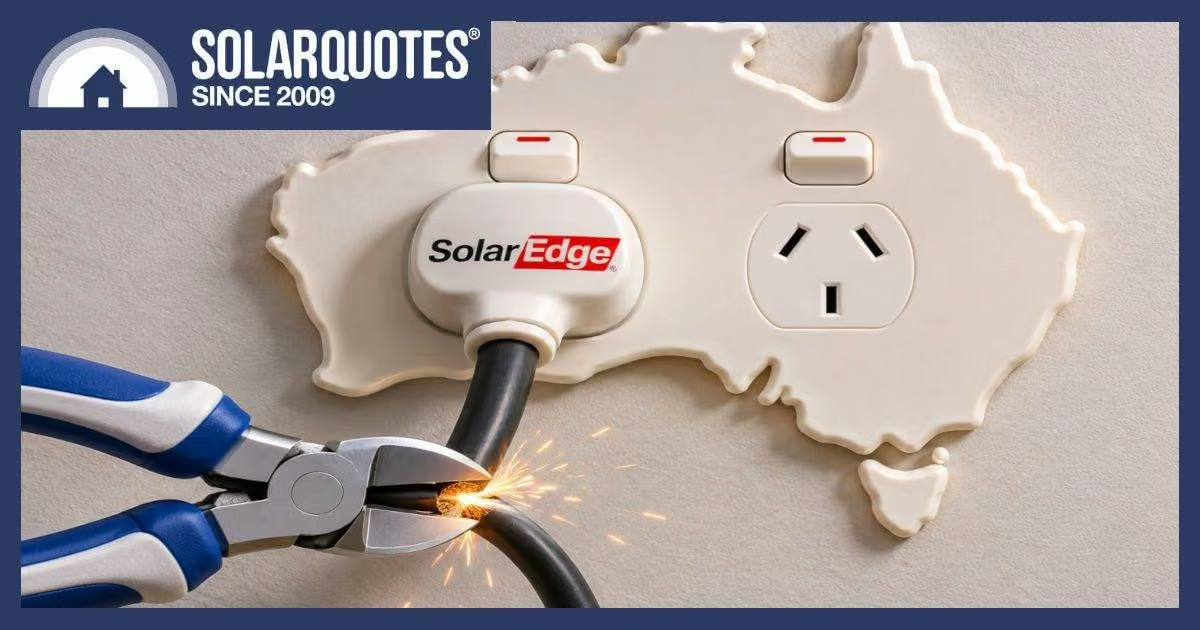
SolarEdge Cuts Ties With Australia
Key facts
- SolarEdge is ceasing all operations in Australia, ending its presence in the local solar and storage market
- Customers have a two-week window to place new orders, with all deliveries scheduled to complete by December 18
- SolarEdge has laid off its Australian workforce, leaving existing customers to rely on international support channels
- The company's exit follows a trend of instability, with SMA withdrawing from the Australian residential market earlier this year
SolarEdge, a manufacturer of inverters, solar panels, batteries, and EV chargers, has announced it is ceasing operations in Australia. The company, which has long been a subject of debate among installation professionals due to its specific product lineup, is ending its presence in the market.
Customers have a two-week window to place new orders, with deliveries scheduled to be completed no later than December 18. Those intending to upgrade or expand current installations must act within this timeframe.
What Are the Implications for Existing SolarEdge Customers?
Warranty and technical support will remain available through the company’s international call center and online self-service resources. However, reports indicate that SolarEdge has laid off its Australian workforce, a development that raises concerns about the quality of local assistance customers can anticipate in the future.
SolarEdge has long appeared on SolarQuotes’ list of recommended brands, prompting the company to back its products with the Good Install Guarantee. This guarantee is based on the principle that the firm will not endorse equipment it would not be comfortable installing in its own home.
Several members of the SolarQuotes team have personally installed SolarEdge inverters and battery systems. While their specific reactions to the announcement are not detailed, it is clear that no one is satisfied with the news. Consequently, SolarEdge has been removed from the company’s recommended brand lists.
The company expresses hope that SolarEdge will uphold its commitments, noting that a 12-year warranty period represents a substantial long-term obligation. For installers, this extended warranty duration has now become a significant liability in their sales discussions.
The more complex hurdle may lie in supporting Australian network operators and their specific connection protocols. Distribution network service providers are progressively adopting internet-linked, dynamically managed systems that demand solar installations and electric vehicle chargers react to signals issued by the grid operator.
Ensuring these devices respond appropriately, and verifying their continued functionality following the Australian Energy Market Operator’s requirement for annual testing of backstop controls, could necessitate direct involvement from inverter manufacturers. However, the absence of local operational knowledge presents a significant obstacle.
SolarEdge has been removed from our recommended inverter chart, and the company has also been excluded from comparable listings for other product categories.
The departure of local technical expertise is regrettable, and sympathy is extended to the affected employees, though the broader Australian solar sector, which remains robust, is expected to absorb the displaced workforce.
At least one SolarEdge employee interviewed expressed relief at the conclusion of the situation, citing the resulting certainty and the opportunity to utilize accrued long service leave.
Mixed Views
A new SolarEdge package was recently showcased at the All Energy conference, but the product will not be available in the Australian market.
The author has previously installed several SolarEdge units, though the experience was incidental. A former employer had purchased pallets of low-cost solar panels that came with integrated SolarEdge optimizers, a fact that was not initially recognized. The integrated components simplified the installation process and functioned as expected.
SolarEdge has cultivated a dedicated following among technicians who appreciate the system’s design flexibility, high efficiency, panel-level monitoring, rapid shutdown safety features, and the ability to significantly oversize panel capacity. In one recent case, a SolarEdge system was deployed for only four panels. The setup was AC-coupled to a separate hybrid inverter, a decision made to correct a flawed design by a sales representative.
For the broader industry, however, SolarEdge has often been viewed as a complex and unreliable option. Many professionals consider the equipment a source of frustration, preferring to avoid the technical challenges associated with its installation and maintenance.
The primary factor driving installers away from SolarEdge in the past has been the complicated process for obtaining warranty replacements. Certain models have a documented history of high failure rates, a fact that is acknowledged by SolarEdge.
The dynamic between installers and support teams was a game of mutual pretense. Both sides were aware of the other’s knowledge, yet technical support staff would continue to act uninformed, requesting additional site inspections and further photographic evidence of electrical tests.
Identifying a failed inverter was a routine occurrence. The requirement to submit images of multimeter readings served no diagnostic purpose; it was a procedural formality intended to frustrate the installation workforce.
Moving On
In markets such as the United States, “rapid shutdown” regulations have allowed SolarEdge and Enphase to secure substantial market share. While these companies are unlikely to vanish in the near term, they have recently faced significant headwinds, financial losses, and organizational restructuring. Despite the recent surge in battery adoption, the Australian market, characterized by intense competition from Chinese manufacturers, has proved too difficult for SolarEdge to sustain.
At the time of publication, SolarEdge maintains an active website for Australia and has not responded to inquiries seeking clarification on its local operations.
SolarEdge’s solar panels have been removed from the Clean Energy Council’s approved product list, rendering them ineligible for use in new installations that qualify for the federal solar rebate. It is anticipated that the company’s other product lines will face similar delisting.
Some industry observers may welcome the departure. As previously noted, the company’s tendency to issue legal threats has been poorly received by both the solar industry and consumers.
The company has severed ties with the Australian market, a move that has left many customers grappling with the aftermath. Several homeowners have reported frustrating interactions with SolarEdge’s warranty department, though one technician in Queensland, Benjamin Cox, was singled out for providing exceptional service. In other cases, entire system warranties were erroneously declared void, while another customer contacted the outlet this week to celebrate the removal of SolarEdge hardware from their property.
A significant number of existing installations have been retrofitted with hybrid battery systems from different manufacturers, as the cost of removing optimizers and rewiring solar arrays proved prohibitive. Additionally, some consumers have chosen to stop doing business with the firm, citing moral objections to supporting a company headquartered in a conflict zone.
For those who remain committed to using optimizers, iStore presents an alternative option. While the company does not provide monitoring services, its devices can be deployed selectively and are manufactured by the world’s largest inverter producer.
A Turbulent Time For Solar
The announcement by SolarEdge marks the most recent major blow to a solar firm in a period of fierce market rivalry. The sector has already witnessed significant turmoil, with Sonnen entering voluntary administration and SMA withdrawing from the Australian residential and commercial inverter market earlier this year.
How To Contact SolarEdge
Consumers currently navigating warranty claims or other issues with SolarEdge are encouraged to share their experiences on the company’s dedicated review pages for inverters, solar panels, batteries, and EV chargers.
Pvola take
This withdrawal creates immediate supply chain risks for installers and developers who have specified SolarEdge equipment in their project pipelines. The abrupt cessation of local operations and the layoff of the domestic workforce significantly increase the complexity of warranty management and technical support for end-users. Projects relying on this specific hardware must now navigate a more fragmented support landscape, which may impact long-term system reliability and customer satisfaction.
Frequently asked questions
What is the final deadline for placing new SolarEdge orders in Australia before the company ceases operations?
Customers have a two-week window to place new orders, with deliveries scheduled to be completed no later than December 18. This timeframe allows existing customers to upgrade or expand their current installations before the market exit.
How will SolarEdge support existing customers in Australia after laying off its local workforce?
Warranty and technical support will remain available through the company’s international call center and online self-service resources. The layoff of the Australian workforce raises concerns about the quality of local assistance customers can anticipate in the future.
What impact does SolarEdge's withdrawal have on Australian solar installers and the broader market stability?
The withdrawal adds to market turmoil, following Sonnen entering voluntary administration and SMA withdrawing from the residential and commercial inverter market. Installers must now navigate a more complex landscape with reduced local support and potential supply chain disruptions.