Solar panel cleaner combines electrostatic force with ionic wind
The short answer
A team from Algerian universities built a prototype hybrid dust-removal system that removed more than 95% of sand by mass in laboratory conditions. This dual-action approach addresses the significant efficiency losses caused by dust accumulation on solar panels in arid regions.
Key facts
- Efficiency
- Removed over 95% of dust by mass at loadings up to 90 g/m2 in lab tests.
- Area
- Tested on a 0.1 m2 section of PV glass with a 60 cm wide cleaning head.
- Technology
- Combines electrostatic pre-lift with corona-induced ionic wind for particle transport.
- Status
- Laboratory proof-of-concept prototype with a filed patent application.
- Partner
- Djillali Liabes University, Ibn Khaldoun University, Mustapha Stambouli University, University of Blida.
A research team in Algeria has developed a hybrid dust-removal system for PV panels that combines an electrostatic plate with a corona-induced ionic wind. The researchers built a prototype and filed a patent application .
“The primary novel contribution lies in this two-stage approach: The electrostatic field of the leading plate is intended to oppose particle adhesion and pre-lift the dust, which is then transported away by the electrohydrodynamic drag force of the ionic wind,” the researchers said. “By combining particle detachment and transport, this dual-action strategy overcomes the limitations of standalone electrohydrodynamic methods.”
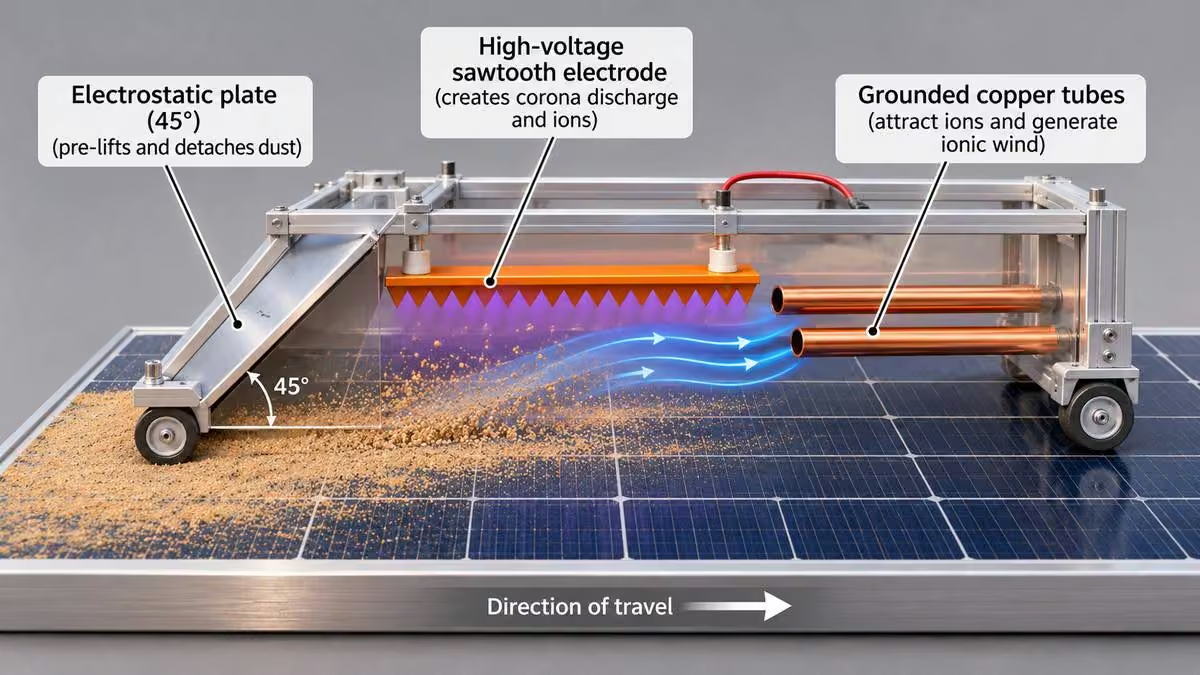
The researchers built a 60 cm-wide cleaning head mounted on a wheeled platform that moves along a horizontal PV panel, covering its full width in a single pass. At the front, a metal plate inclined at 45 degrees generates an electric field that helps lift sand grains from the glass surface. Behind the plate, a high-voltage sawtooth electrode produces a strong electric field at its tips, ionizing the surrounding air and generating a localized electrical discharge known as a corona. As the ions move toward two grounded copper tubes, they propel surrounding air molecules, creating an ionic wind that sweeps away the loosened sand grains.
To test the system, the researchers evenly distributed sieved, dry sand collected from the Algerian Sahara over a roughly 0.1 m² section of PV glass, with initial dust loadings ranging from 30 g/m² to 130 g/m². They weighed the sand before and after a single cleaning pass to calculate the percentage removed by mass. They also varied the applied voltage, travel speed, plate-to-glass distance, dust loading, and grain size, while measuring the discharge current and outlet airspeed.
The researchers conducted each test twice at a temperature of around 25 C and a relative humidity of approximately 45%. They compared the hybrid system with a standalone ionic-wind system under identical operating conditions.
In laboratory tests, the hybrid system removed more than 95% of deposited dust by mass at initial loadings of up to 90 g/m². The system achieved this performance at an applied voltage of 20 kV, a travel speed of 3.3 cm/s, and a plate-to-glass distance of 2 cm. At a dust loading of 130 g/m², removal efficiency dropped to approximately 55%. The researchers suggested that the upper dust layers may have shielded underlying particles from the electric field or airflow.
“While this work establishes the core proof-of-concept at a fixed panel inclination of 0°, future research will expand upon these findings to evaluate performance under broader field parameters,” the researchers said. “Subsequent investigations will examine the combined impact of variable panel tilt angles and gravitational assistance, assess the influence of environmental factors such as relative humidity and moisture-induced particle adhesion, and evaluate long-term operational durability for automated field integration.”
The researchers presented their findings in “ Hybrid electrostatic–ionic wind system for efficient dust removal from photovoltaic panels ,” published in the Journal of Electrostatics . The research team included scientists from Algeria’s Djillali Liabes University of Sidi Bel-Abbes , Ibn Khaldoun University of Tiaret, Mustapha Stambouli University of Mascara, and the University of Blida.
Pvola take
The 95% removal rate at moderate dust loadings validates the dual-action mechanism for arid environments. However, the drop to 55% at 130 g/m2 highlights a critical limitation for heavy soiling scenarios. Field validation under variable tilt and humidity is essential before this technology can be considered for commercial deployment.
Frequently asked questions
What is the primary novel contribution of the hybrid dust-removal system developed by Algerian researchers?
The system uses a two-stage approach where an electrostatic field pre-lifts dust, and ionic wind transports it away. This dual-action strategy overcomes the limitations of standalone electrohydrodynamic methods for panel cleaning.
What are the key physical components of the 60 cm-wide cleaning head prototype built by the research team?
The prototype features a metal plate inclined at 45 degrees to generate an electric field for lifting sand. Behind it, a high-voltage sawtooth electrode ionizes air to create a corona discharge that drives the ionic wind.
How did the researchers validate the performance of the electrostatic-ionic wind cleaning system in their laboratory tests?
They measured the mass of sand removed before and after a single cleaning pass to calculate removal percentages. Tests were conducted at 25 C and 45% relative humidity, varying voltage, speed, and dust loading parameters.