Sonnedix Oita 125 MWh BESS Starts Operation in Japan
The short answer
Sonnedix Oita battery entered commercial operation on November 15 at 125 MWh, co-located with a 39 MW solar plant in Japan. Osaka Gas will control the asset and purchase all discharged electricity, shifting solar output to higher-value evening periods under the FIP framework.
Key facts
- Capacity
- 30 MW
- Energy
- 125 MWh
- Duration
- 4.2 hours
- COD or milestone
- November 15
- Offtaker or owner
- Osaka Gas
- Location
- Oita City, Japan
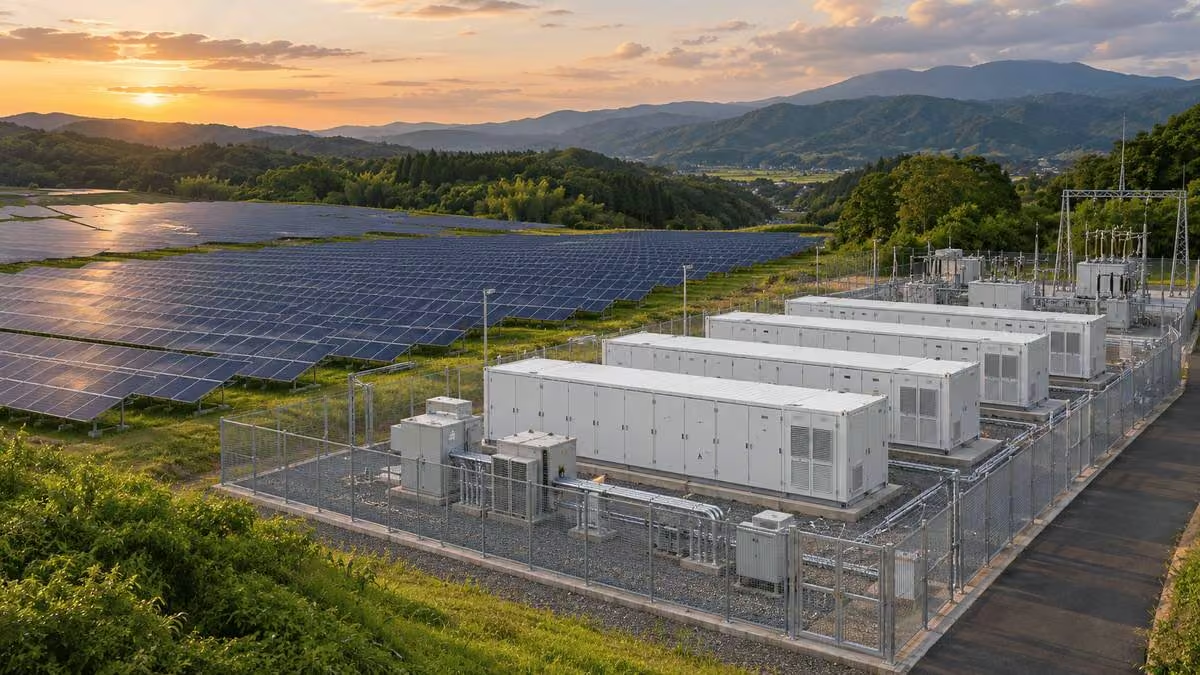
The Sonnedix Oita battery entered commercial operation on November 15 beside an existing solar plant in Oita City, Japan, according to separate November 16 announcements from Sonnedix, Osaka Gas and Toshiba. The milestone moves Sonnedix Japan’s first battery energy storage project from construction into service.
The system is rated at approximately 30 MW/125 MWh and is co-located with a roughly 39 MW solar plant that has operated since March 2020. At its nameplate ratings, the battery’s energy-to-power ratio is about 4.2 hours, although the companies have not disclosed its usable capacity or tested discharge duration.
Sonnedix said the project uses Tesla Megapack systems supplied by Tesla Japan. Toshiba completed engineering, procurement and construction work, including equipment procurement, site preparation, electrical work and integrated testing.
Sonnedix Oita battery adds dispatchable capacity to existing solar
The battery gives the operating solar site a way to store a portion of daytime generation and discharge it later. Toshiba’s commissioning announcement said the system is intended to capture solar electricity that otherwise could have been affected by output curtailment and release it during evening or nighttime periods.
The 125 MWh energy rating is not equivalent to annual output or guaranteed deliverable energy. Actual operation will depend on state-of-charge limits, auxiliary loads, degradation allowances, market instructions and the plant’s interconnection conditions. The partners did not publish round-trip efficiency, cell chemistry, the number of Megapack units or commissioning-test results.
Toshiba described the installation as Japan’s largest battery co-located with renewable generation. That is a company claim tied to the announced configuration, not an independently audited national ranking. The company also said the project was its first EPC assignment for a battery installed alongside renewable generation.
Osaka Gas will control the battery and manage the electricity
The plant-operating company is jointly owned by Sonnedix and Osaka Gas. Osaka Gas said it will remotely control the battery after commercial operation and purchase all electricity generated by the solar plant and discharged from the storage system.
The solar project has also moved from Japan’s feed-in tariff, or FIT, framework to the feed-in premium, or FIP, system. Under FIP, renewable generators sell electricity into the market and receive a premium on top of the market price rather than relying on a fixed FIT purchase price. That structure makes the timing of generation and discharge more commercially relevant, because storage can move solar energy toward periods when it has greater system and market value.
The arrangement differs from the long-term capacity-payment structure supporting the separate Nozu battery project in Oita Prefecture , which reached financial close in September but is not yet operating. It is closer in physical configuration to the operating Sandrini solar-and-storage site in California , where a four-hour battery was added beside an existing solar facility, although the market contracts and grid rules are different.
What operating data would confirm the project’s impact
Commercial operation confirms that construction, connection and commissioning have advanced far enough for the project to enter service. It does not establish how often the battery will cycle, how much curtailed solar generation it will recover or how it will divide dispatch among wholesale-market activity and grid-balancing needs.
The most useful next disclosures would be monthly charge and discharge volumes, availability, captured-curtailment data and operating revenue by market. Those figures would show whether the Sonnedix Oita battery is primarily shifting solar output, responding to price signals or providing a broader mix of flexibility services.
Pvola take
This project validates the co-located solar-storage model in Japan’s evolving market. By moving from FIT to FIP, the asset captures value by shifting energy to peak hours, a strategy critical for developers seeking revenue stability without fixed tariffs.
Frequently asked questions
What is the operational status and capacity of the Sonnedix Oita battery project in Japan?
The Sonnedix Oita battery entered commercial operation on November 15 with a rating of approximately 30 MW and 125 MWh. It is co-located with a 39 MW solar plant that has been operating since March 2020.
Which companies were involved in the engineering and supply of the Sonnedix Oita battery system?
Toshiba completed the engineering, procurement, and construction work for the project. The system utilizes Tesla Megapack units supplied by Tesla Japan, with Osaka Gas managing the remote control operations.
How does the Sonnedix Oita battery project impact solar generation and grid stability in the region?
The battery allows the site to store daytime solar generation and discharge it later, mitigating output curtailment. It provides dispatchable capacity to support wholesale market activity and grid-balancing needs.