Sungrow 36 MW Grid-Forming BESS Black Starts Dominican Grid
The short answer
A 36 MW, 40 MWh battery system in the Dominican Republic executed a black start, energizing 70 kilometers of transmission lines without external power. This capability is critical for grid stability as renewable penetration increases and synchronous inertia declines.
Key facts
- Capacity
- 36 MW
- Energy
- 40 MWh
- Offtaker or owner
- Dominican Republic grid operator
- Location
- Dominican Republic
- COD or milestone
- Successful black start of 70 km transmission lines
Restoring power to a grid does not always require spinning up a conventional power plant. In the Dominican Republic, a 36 MW, 40 MWh battery system successfully energized up to 70 kilometers of 138 kV and 69 kV transmission lines without initially relying on an external source to establish the necessary electrical conditions for the operation.
The distinctive aspect of this maneuver was that the storage system itself generated the required voltage and frequency references to energize the infrastructure. This capability, known as black start, enables the initiation of grid recovery without dependence on an external power supply.
The event highlights one application of grid-forming technology, which allows inverters to function as voltage sources and perform roles traditionally associated with the synchronous machines found in conventional power plants.
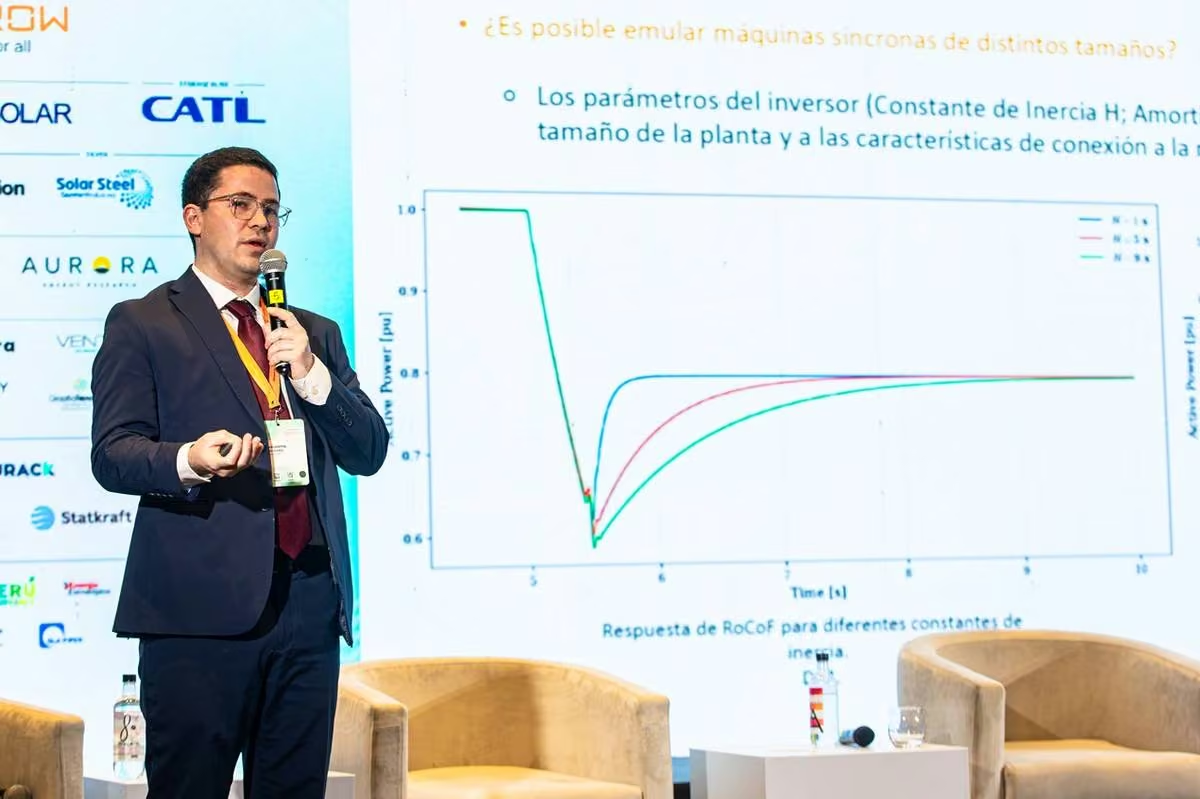
Valentin Romero, an application engineer for Sungrow’s energy storage systems division in Latin America, noted during the Future Energy Summit (FES) Peru 2026 that grid-following technology is not inherently flawed, as it has provided the stability necessary to reach the system’s current operational state. However, he argued that as renewable energy penetration increases, the industry must shift toward predominantly grid-forming operations.
While grid-following inverters require an existing electrical reference to function, grid-forming equipment can establish that reference through its own control algorithms. This distinction becomes critical as solar and wind generation expands, since their integration can reduce the relative share of conventional synchronous machines, thereby diminishing the available inertia in electrical systems.
Reduced inertia can accelerate frequency fluctuations during disturbances and shorten the time available for control mechanisms to respond, heightening the demand for technologies capable of contributing to grid stability.
Dominican Republic adds requirements for energy storage
The Dominican Republic concluded 2025 with renewable energy accounting for 25% of its electricity generation, according to the National Energy Commission (CNE). The country continues to pursue a target of reaching 30% by 2030. The expansion of these sources has introduced new requirements for flexibility and grid support to maintain the stability of the Interconnected National Electric System (SENI).
Concurrently, the Electricity Superintendency approved resolutions SIE-164-2025-MEM and SIE-178-2025-MEM. These regulatory instruments establish authorization procedures and technical requirements for energy storage systems, with specific provisions for those integrated with variable renewable generation projects.
The regulatory framework addresses issues related to electrical stability, frequency and voltage regulation, and facility response to grid disturbances. These conditions broaden the criteria that developers must consider when designing projects and selecting equipment.
The shift aligns with a new phase in procurement. On November 2, the Dominican Republic launched a tender for up to 200 MW and 800 MWh of battery storage, targeted exclusively at existing solar and wind farms that maintain long-term supply contracts with distribution companies.
The tender, with an award scheduled for February 25, 2027, specifies four-hour duration systems, 15-year supply agreements, and a 12-month implementation period. Furthermore, the storage capacity is capped at 50% of the associated renewable plant's nominal capacity.
The country is also preparing a separate call for projects with final concessions, covering 600 to 900 MW of new renewable generation. This initiative includes storage equivalent to 50% of the generation capacity, with a four-hour duration.
The planned expansion of installed capacity highlights a key technical issue: what services the batteries must provide and how their performance will be verified in grids with a growing share of inverter-based generation.
Read more
The Dominican Republic has released a tender for 200 megawatts and 800 megawatt-hours of battery storage, with the contract award scheduled for February 2027.
From synthetic inertia to oscillation control
Romero presented simulations demonstrating how Sungrow inverters restored stable operating conditions amid fluctuations in the short-circuit ratio (SCR), ranging from a value of 40 down to 1. The latter scenario depicts a significantly weaker grid, where maintaining stability demands more rigorous control responses.
The technology also enables operators to fine-tune equipment behavior during disturbances and adjust the speed at which systems react to frequency deviations.
“By varying the inertia constant configurations, we can achieve a system response that mimics a machine with either higher or lower inertia,” the specialist explained.
This capability, known as synthetic inertia, allows for the replication of specific responses typically provided by synchronous machines. From an operational standpoint, it offers the flexibility to configure how energy storage systems deliver or absorb power in response to system variations.
Grid operators can also use the inverters to manage power oscillations and supply reactive current to maintain voltage stability. These functions remain available whether the battery energy storage systems are injecting or absorbing energy, a capability that stems from the bidirectional nature of the technology.
“It is important to note that this is a feature of the technology, not a mandatory requirement for every system that will be installed,” Romero warned.
This distinction is significant for developers and operators, as the selection of technical features must align with the specific conditions at the point of interconnection and the particular requirements of the electrical grid, rather than applying a uniform configuration across all facilities.
The tests that will underpin the new roles
Before integrating a battery energy storage system equipped with advanced controls, developers must verify that its dynamic response aligns with grid conditions. Romero outlined a three-stage process for this validation: dynamic modeling, field testing, and certification.
The initial phase may involve hardware-in-the-loop tests, which employ real-time digital simulators to replicate power system behavior and assess converter responses prior to installation.
Field trials serve to confirm performance during commissioning, while certification attests to compliance with relevant technical standards. The procedure may also include post-installation checks to ensure that operational conditions remain stable throughout the facility’s service life.
In a related development, Sungrow concluded a grid-forming validation campaign in April 2026, comprising 14 scenarios over 138 hours and verified by TÜV Rheinland. The tests utilized a 30 MW grid simulation platform to reproduce disturbances and stringent operating conditions.
The company also disclosed that its technical teams achieved a voltage reference through black start in under 20 seconds. This result was obtained during testing conditions and differs from the operational experience reported in the Dominican Republic.
For the Dominican market, where new energy storage projects must meet specific technical and operational requirements, these capabilities introduce new variables into technology selection and certification processes.
The experience detailed by Sungrow illustrates how battery energy storage systems can evolve from managing energy to performing active roles in grid stability and recovery. This transformation is beginning to gain significance in markets with high renewable energy penetration.
Pvola take
This demonstration validates the operational necessity of grid-forming storage in markets with high inverter-based generation. As the Dominican Republic mandates 4-hour storage for new renewable projects, developers must prioritize equipment capable of establishing voltage and frequency references to meet evolving regulatory stability requirements.
Frequently asked questions
How did the 36 MW battery system in the Dominican Republic achieve black start for transmission lines?
The system generated the necessary voltage and frequency references to energize 70 km of lines. This capability allows grid recovery without relying on an external power source to establish initial electrical conditions.
What specific grid-forming capability did the Sungrow system demonstrate during the black start event?
The inverters functioned as voltage sources to perform roles traditionally associated with synchronous machines. This allowed the storage system to initiate grid recovery independently of conventional power plants.
How does the Dominican Republic's 200 MW tender impact storage technology selection and certification processes?
The tender introduces new variables into technology selection due to operational requirements for grid stability. These capabilities necessitate updated certification processes for storage systems in grids with high inverter-based generation.