RWE Starts 262.5 MWh LFP BESS in Sicily
The short answer
RWE commenced construction on a 262.5 MWh battery storage facility in Ragusa, Sicily, on November 10, 2026. The project targets commercial operation in late 2027 to provide grid-forming services and balance the Italian power system.
Key facts
- Capacity
- 62.5 MW
- Energy
- 262.5 MWh
- Duration
- 4 hours
- Chemistry
- Lithium-ion
- COD or milestone
- Construction started November 10, 2026; COD targeted late 2027
- Offtaker or owner
- RWE
- Location
- Ragusa, Sicily, Italy
RWE commenced construction on its first battery storage facility in Italy in Ragusa on November 10. The project integrates 62.5 megawatts of power capacity with a 150-kilovolt grid connection, designed to support network stability, with commercial operation targeted for late 2027.
The German energy company announced the start of construction on its first large-scale storage battery in Italy on November 10, 2026. Located in Ragusa, Sicily, the installation is set to deliver 62.5 megawatts of power and provide 262.5 megawatt-hours of energy storage capacity. It is engineered to assist in balancing the electrical grid and, in the long term, deliver technical stability services.
According to a statement released by RWE on November 10, the facility is scheduled to come online by the end of 2027. Consequently, this represents a construction project that has just begun, rather than a battery already available for use by the Italian power system.
A 62.5 MW battery designed for peak consumption
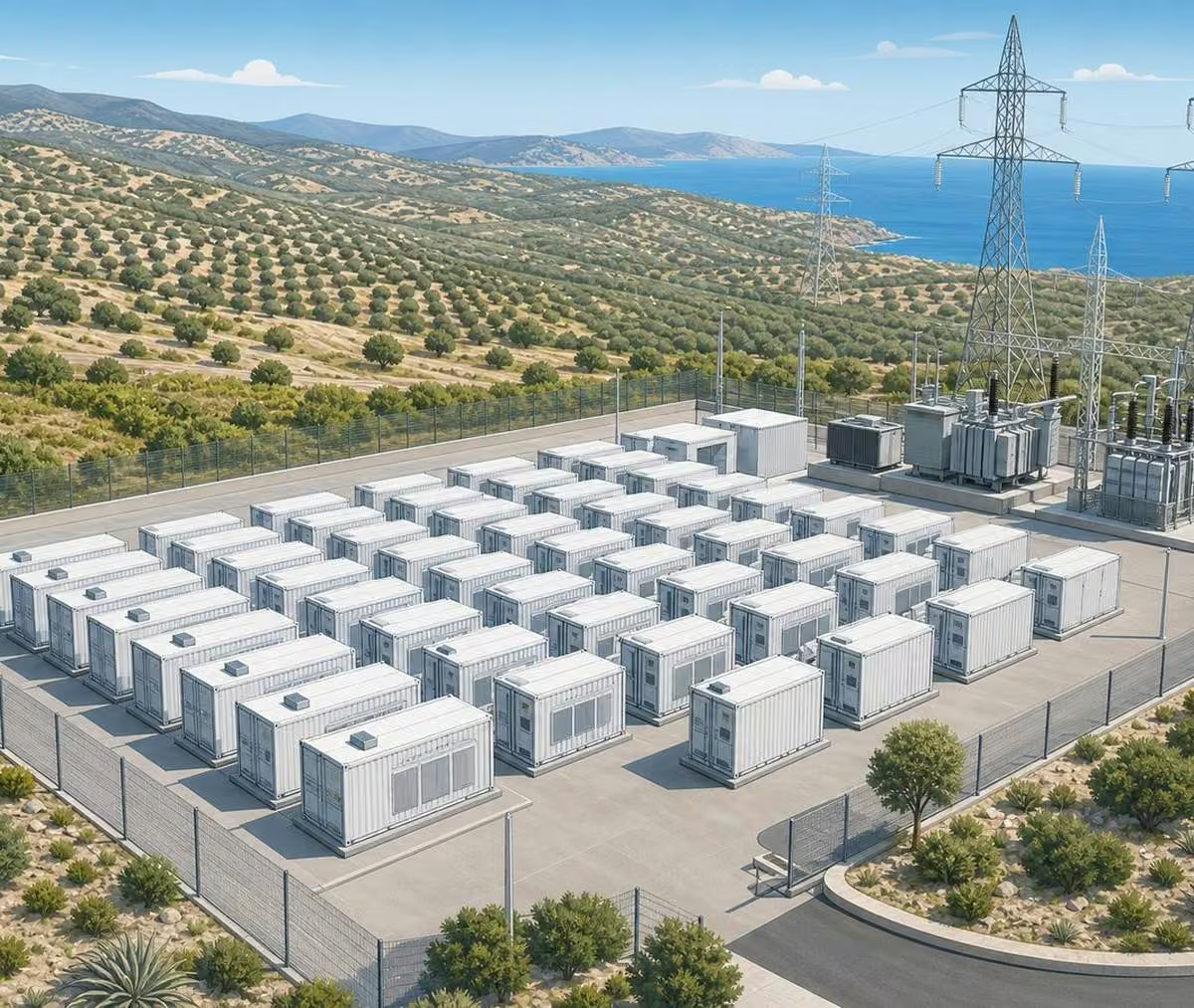
The Ragusa project will feature 42 containers fitted with lithium-ion batteries. The announced specifications correspond to approximately four hours of high-power discharge. Power, measured in megawatts, defines the amount of electricity the facility can inject at any given moment, while capacity, measured in megawatt-hours, represents the total energy it can store and subsequently release over a period.
This distinction is critical. A 62.5 MW battery does not generate a constant 62.5 MW of power. It charges when electricity is available and discharges when its value to the grid is highest. Conversion losses and operational rules determine the final amount of energy returned to the system.
RWE estimates that the future equipment could help cover the evening peak demand for approximately 21,000 households for four hours, based on the company’s consumption assumptions. This comparison does not reflect the actual consumption of all households in Sicile, nor does it imply that the site will operate at full capacity every evening.
High-voltage interconnection and grid stability services
Beyond the battery systems themselves, RWE plans to construct the necessary grid connection infrastructure, including a transformer linked to the 150-kilovolt network. This technical aspect is critical, as the value of energy storage depends as much on its location and ability to exchange power with the grid as on the size of its modules.
The company stated that the facility will be eligible to participate in balancing services, helping to offset discrepancies between electricity generation and consumption. It also noted that the equipment will incorporate grid-forming functions, designed to provide instantaneous reserve services that contribute to system inertia.
In conventional power systems, frequency stability relies partly on the rotating masses of large synchronous machines. As renewable generation connected via power electronics increases, grid operators are seeking alternative methods to reinforce this stability. Battery converters operating in grid-forming mode can help establish voltage and frequency references under certain conditions.
The announcement of this technical capacity does not, however, guarantee that all services will be commercially operational upon grid connection. The specific terms of these services will depend on the outcomes of testing, the regulations set by the grid operator, and the relevant authorizations.
Sicily, a region where grid flexibility is gaining in value
The expansion of wind and solar power is increasing the value of shifting electricity from certain hours to others. In Sicilia, as in other regions, storage systems can absorb temporary surpluses and supply energy during peak demand, though they do not eliminate the need for reinforcing transmission lines and interconnections.
RWE already operates wind farms and photovoltaic installations in Italy. The Ragusa project represents a diversification of its capabilities toward electrical flexibility. Globally, the company states it operates approximately 1.7 gigawatts of battery capacity, with an additional 3 gigawatts under construction.
For European grid operators, the primary interest in this project lies in the combination of three factors: multi-hour energy storage, direct connection to a high-voltage grid, and the announced capability to provide stability services. The actual performance of the facility can only be assessed after construction, testing, and the commencement of operations, which is expected in late 2027.
Pvola take
This project marks RWE’s entry into large-scale storage in Italy, leveraging its existing renewable portfolio in the region. The 150 kV connection and grid-forming capability address critical stability needs as renewable penetration rises in Sicily.
Frequently asked questions
What are the power and energy capacity specifications of the RWE battery storage project in Ragusa, Sicily?
The RWE facility in Ragusa is designed to deliver 62.5 megawatts of power with a 262.5 megawatt-hour energy storage capacity. The project is scheduled to reach commercial operation by the end of 2027.
How does the RWE Ragusa battery project support grid stability through its technical design?
The installation incorporates grid-forming functions to provide instantaneous reserve services and contribute to system inertia. It is also eligible to participate in balancing services to offset discrepancies between electricity generation and consumption.
What is the timeline for the RWE battery storage project in Italy to become operational?
Construction on the RWE battery facility in Ragusa began on November 10, 2026. The project is targeted for commercial operation by late 2027, marking the start of its contribution to the Italian grid.