Egypt 1,000 MW Solar Grid Connection Awarded by EETC
The short answer
Egyptian Electricity Transmission Company awarded Giza Cable Industries a contract to modify a 220 kV line for a 1,000 MW solar and 600 MWh storage project. This infrastructure upgrade is critical for integrating large-scale renewable capacity into the unified grid without curtailment.
Key facts
- Capacity
- 1,000 MW solar and 600 MWh battery storage
- Stage
- Grid connection contract awarded
- EPC or contractor
- Giza Cable Industries
- Grid connection
- 220 kV line modification in Middle Egypt
- Location
- Minya, Maqousa, and western Mallawi
Egyptian Electricity Transmission Company (EETC) has awarded a grid connection contract for a 1,000-megawatt solar project paired with 600-megawatt-hour battery storage. The 220-kilovolt transmission line project underscores the infrastructure requirements associated with renewable energy expansion.
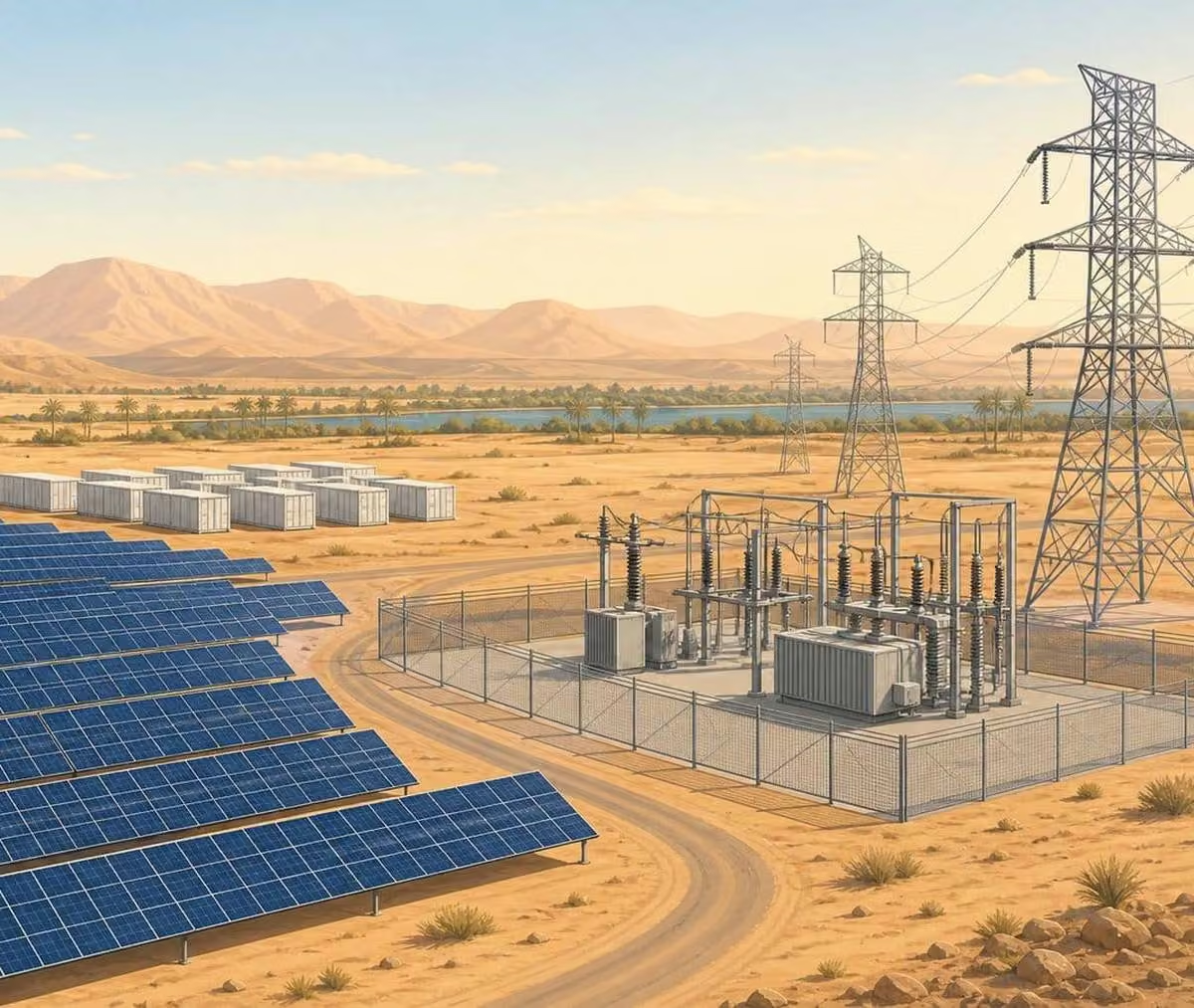
Egypt is advancing its efforts to integrate large-scale renewable energy facilities into the national grid. The state-owned EETC signed an agreement with Giza Cable Industries to modify a 220-kilovolt transmission line, enabling the connection of a 1,000-megawatt solar plant and a 600-megawatt-hour battery system to the national network. The contract covers transmission infrastructure only and does not indicate that all generation and storage capacity is currently operational.
The contract was reported on November 8 by several Egyptian media outlets, including Al-Mal and El Mogaz, and subsequently covered by Cleantech Media on November 9. The new construction work focuses on the Middle Egypt region and the equipment required to transmit generated power to the unified grid.
An existing transmission line is being upgraded to accommodate new power flows.
The announced scope involves modifying the double-circuit overhead transmission line connecting Minya, Maqousa, and western Mallawi. A spur will be installed to facilitate both incoming and outgoing connections to the Infinity Power Holding substation at the 220 kV voltage level. This technical work prepares the grid to accept and transmit additional electricity volumes.
Giza Cable Industries has been awarded the construction contract. Reports covering the announcement indicate an estimated completion timeline of approximately ten months. This schedule remains a contractual target that may shift depending on the progress of civil engineering, assembly, electrical protection, and testing operations.
It is crucial to distinguish between the different components: the photovoltaic plant generates electricity, the battery temporarily stores energy, and the transmission line conveys power flows. While their overall utility relies on technical coordination, each element serves a distinct function and follows its own implementation schedule.
Why a 600 MWh battery changes the management of a solar park
A solar facility with an announced capacity of 1,000 MW can generate substantial power during daylight hours, provided sufficient solar irradiance. However, it offers no guarantee of comparable output at night. Energy storage aims to shift a portion of this generation across time, particularly to help meet demand outside the peak photovoltaic production window.
The disclosed battery capacity is 600 MWh, a measure of energy rather than instantaneous power. Without confirmed data on maximum charge and discharge rates in MW, it is impossible to precisely calculate the duration for which the system could supply the grid at a specific rate. Actual performance will also depend on losses, state of charge, and dispatch protocols.
High-voltage interconnection is as critical as storage. If transmission lines and substations cannot absorb the generated flows, renewable energy output may be curtailed even with fully operational solar panels. Grid modernization facilitates the integration of variable resources, though it does not eliminate the need for coordinated system-wide operations.
An investment in Egyptian power grid flexibility
The project forms part of Egypt’s strategy to expand renewable energy capacity and reinforce the national grid. Authorities have already determined that wind and solar developments must be paired with transmission lines and storage equipment. In April, the Egyptian presidency emphasized the critical role of new storage and grid-connection infrastructure in ensuring supply security.
Beyond Egypt, the initiative highlights a challenge common to power systems undergoing energy transitions: adding new renewable generation capacity is insufficient unless substations, transmission lines, and flexibility resources advance in parallel. The next concrete milestone will be the completion of grid-connection works and the finalization of operational protocols for the equipment, which remain pending.
Pvola take
The award highlights that transmission infrastructure is the primary bottleneck for renewable integration in Egypt. Without these specific grid upgrades, the 1,000 MW capacity cannot be effectively utilized, making grid investment a prerequisite for project bankability.
Frequently asked questions
What is the scope of the grid connection contract awarded by EETC for the 1,000 MW solar project in Egypt?
The contract covers the modification of a 220-kV transmission line to connect the solar plant and battery storage. It does not indicate that the generation and storage capacity is currently operational.
Which company was awarded the contract to upgrade the transmission infrastructure for the Egyptian solar and storage project?
Giza Cable Industries was awarded the contract to modify the 220-kV transmission line. The work focuses on the Middle Egypt region to enable power transmission to the unified grid.
How does the 600 MWh battery storage system support the 1,000 MW solar plant in the Egyptian grid integration plan?
The battery storage aims to shift a portion of solar generation across time to meet demand outside peak production hours. This helps address the lack of solar output at night and supports grid stability.