Korea Zinc Secures 69% Stake in Solarcycle JV to Recover Panel Metals
The short answer
Korea Zinc signed an agreement with Solarcycle to establish Jupiter, a joint venture valued at approximately $519 million. The deal combines Solarcycle’s US collection network with Korea Zinc’s smelting technology to extract silver and copper from decommissioned solar panels.
Key facts
- Amount
- $519 million enterprise value
- Valuation
- $519 million
- Use of proceeds
- Recover silver and copper from solar panels
- Location
- United States
- Investors
- Solarcycle, Korea Zinc
Korea Zinc is making a full-scale entry into the US resource circulation business by partnering with Solarcycle, a US company specializing in solar panel recycling. Korea Zinc announced on the 17th that it has signed an agreement with Solarcycle to establish a joint venture named Jupiter. Once the deal closes, Korea Zinc's side will exercise 70% of Jupiter's voting rights, with the plan to combine Solarcycle's US panel collection network with Korea Zinc's smelting and refining technology to expand the recovery of valuable metals including silver and copper.
The transaction will be structured by combining the stake in electronics recycling company Ebtvera held by Pedalpoint, Korea Zinc's US resource circulation subsidiary, with Solarcycle's business division. Pedalpoint will contribute its Ebtvera stake to Jupiter as an in-kind contribution, while Solarcycle will change its existing corporate name to SCI Hold.Co and contribute all shares of the newly established Solarcycle entity that will handle the business.
Upon completion, Jupiter's ownership will be split between Pedalpoint at 69% and SCI Hold.Co at 31%. However, the stake held by Pedalpoint carries no voting rights, and SCI Hold.Co will exercise 100% of Jupiter's voting rights. In exchange, Pedalpoint will hold 70% of SCI Hold.Co's voting rights, giving Korea Zinc indirect control of Jupiter through both entities. The board will consist of five members, three of whom will be nominated by Pedalpoint. The CEO will be Solarcycle's Suvi Sharma, and the CFO will be Ham Kyung-woo of Pedalpoint.
Korea Zinc estimated Jupiter's enterprise value at approximately $519 million (about 690 billion won) by simply adding together the values of the Ebtvera and Solarcycle stakes being contributed. The final value may differ once net debt and transaction-related adjustments are reflected.
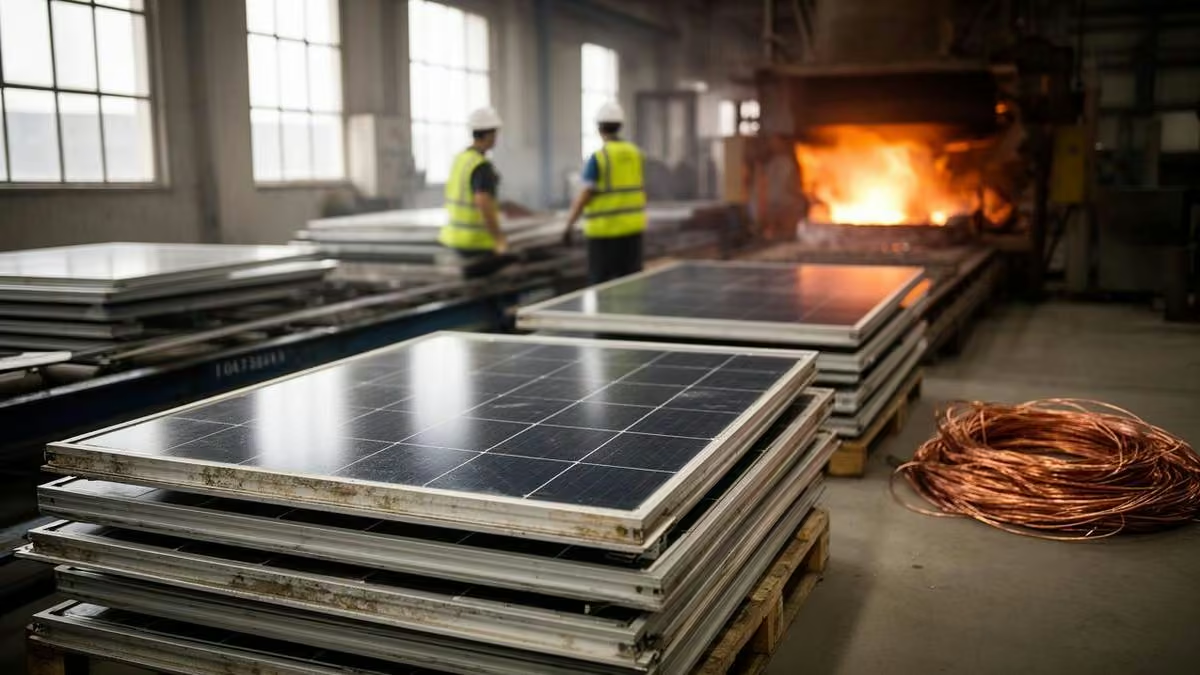
The JV's core lies in linking Solarcycle's US panel collection network with Korea Zinc's non-ferrous metal smelting and refining capabilities. Solar panels are composite structures mixing glass, aluminum, silicon, silver, and copper, making efficient pre-treatment and smelting processes essential to economically extract valuable metals. In particular, the glass separation process is considered a key variable determining the profitability of the recycling business due to its high technical difficulty and cost burden. Korea Zinc is pursuing a plan to replace the glass separation process with an alternative method using its existing smelting technology.
Solarcycle has been operating a solar panel collection and recycling business in the US. According to data released last April, the company processed 484,036 solar panels in 2024. Its cumulative equity investment raised has exceeded $80 million (about 110 billion won), with Microsoft, Fifth Wall, and HG Ventures among its major investors. Microsoft announced a strategic investment in Solarcycle in October 2024, emphasizing the importance of expanding renewable energy equipment deployment and building a circular supply chain for raw materials. Heritage Group, a US environmental and chemical conglomerate with over 90 years of history, also participated in a 2023 investment through its corporate venture capital arm HG Ventures.
Solarcycle began operating a solar panel recycling facility in Cedartown, Georgia, in January of this year. It plans to secure processing capacity of 1 million panels per year by year-end and ultimately expand to 5 gigawatts (GW) annually.
Market prospects are also favorable. With solar power installations surging in the US and other major countries, decommissioned panels are expected to increase sharply as previously installed equipment reaches the end of its service life. Through this JV, Korea Zinc aims to build a foundation for securing recycled raw materials while expanding a circular business model that supplies valuable metals recovered from waste panels back as industrial raw materials.
A Korea Zinc official said, "Through the establishment of this joint venture, we have laid the groundwork to stably secure solar panel waste, a recycled raw material, in the US," adding, "We will continue to enhance our competitiveness in recovering valuable metals such as silver and copper while continuously expanding the US local resource circulation value chain."
This move is seen as Korea Zinc, which has focused on non-ferrous metal smelting, broadening its resource circulation footprint from waste batteries and electronic waste to solar panel waste. Analysts say securing a local raw material procurement network can reduce logistics costs and supply uncertainty. However, since panel recycling involves high process difficulty such as glass separation and takes time to monetize, the utilization rate and processing unit price at the Georgia facility are cited as variables that will determine future performance.
Once added, BigGo Finance appears first in Google Search Top Stories, so you get the broadest, most up-to-the-minute, and most comprehensive global financial news first.
Pvola take
This structure allows Korea Zinc to secure a critical supply chain for recycled metals without building new collection infrastructure. By leveraging Solarcycle’s existing US network and its own refining capabilities, the JV addresses the high cost of glass separation, a key barrier to profitable panel recycling.
Frequently asked questions
What is the ownership structure of the Jupiter joint venture between Korea Zinc and Solarcycle?
Korea Zinc's subsidiary Pedalpoint will hold a 69% economic stake in the Jupiter joint venture, while Solarcycle's entity holds 31%. Pedalpoint's stake carries no voting rights, allowing Solarcycle to retain operational control through its 31% share.
How many solar panels did Solarcycle process in 2024 according to the reported data?
Solarcycle processed 484,036 solar panels in 2024, demonstrating its operational scale in the US recycling market. This volume highlights the company's established collection network and processing capacity prior to the joint venture formation.
What specific metals does the Jupiter joint venture aim to recover from recycled solar panels?
The joint venture aims to recover valuable metals including silver and copper from end-of-life solar panels. Korea Zinc will utilize its existing smelting and refining technology to process these materials, potentially reducing the need for complex glass separation steps.