JinkoSolar Defies China's Slump: To Deliver 75 GW in 2026, Projects Up to 20% Growth in Latin America for 2027
Key facts
- Jinko Solar projects 70 to 75 GW in global module deliveries for 2026, including 4 GW for Latin America
- Domestic Chinese solar demand contracted by approximately 25% in 2026, impacting global delivery volumes
- Jinko Solar anticipates a 15% to 20% increase in Latin American solar demand for 2027 compared to 2026
- European solar demand is estimated at 70 GW annually, with Jinko Solar expecting stable investment levels
- New Jinko Solar products for Latin America and Europe are available for orders, with deliveries expected by late 2026
Jinko Solar projects that it will conclude 2026 with global photovoltaic module deliveries in the range of 70 to 75 GW, a figure that includes 4 GW destined for Latin America, despite a 25% contraction in domestic Chinese demand.
The company is maintaining shipment volumes at levels comparable to the previous year, a stability underpinned by an increased commercial footprint outside of China.
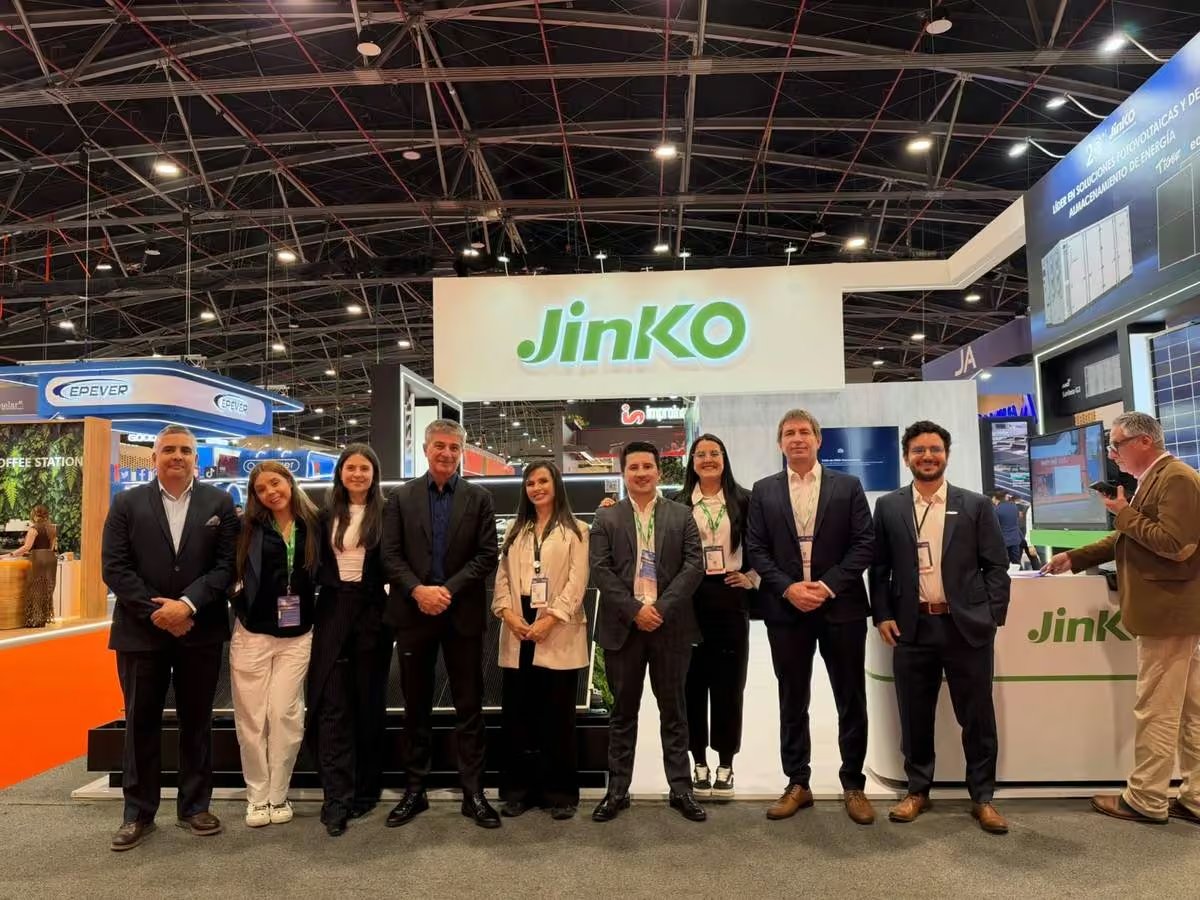
“2026 has been a very good year. As anticipated, the Chinese market declined by approximately 25%, which impacted global module delivery volumes. However, we are already looking ahead to 2027, which I believe will be better,” stated Alberto Cuter, Jinko Solar’s vice president for Latin America and Italy.
“Regarding potential growth in Latin America, we could see an increase of 15% to 20% compared to 2026 across all countries,” he told Energía Estratégica in an exclusive interview during ExpoSolar Colombia 2026.
This outlook implies a shift in the geographic distribution of demand. While China is expected to maintain demand levels similar to current figures over the next fiscal year, Latin America presents expansion opportunities that exceed those projected for Europe, a region where Jinko anticipates relatively stable market behavior.
Against this backdrop, the manufacturer has also adjusted its commercial strategy, prioritizing contracts with more favorable economic terms while abandoning deals that demand excessively low prices.
This approach gains significance in light of the company's preliminary financial results for 2025, during which Jiangxi Jinko reported revenues of 65,490 million yuan (approximately $9.5 billion), a year-on-year decline of 29.18%.
Over the same period, the net loss attributable to shareholders reached 6,790 million yuan ($984.5 million), compared with a profit of 98.9 million yuan ($14.34 million) recorded in 2024.
Given this landscape, the recovery of demand in international markets has become increasingly critical for the manufacturer, which identifies particularly favorable prospects in Colombia.
“Colombia is taking off significantly. Although the country did not have many utility-scale projects this year, next year will see more than 2 GW of projects,” Cuter stated.
Mexico also ranks among the markets with the highest potential, while Ecuador presents opportunities linked to challenges in electricity supply.
In that country, the shrimp farming industry is among the sectors facing specific power supply challenges, largely due to scheduled outages that disrupt operations. This dynamic is creating opportunities for new solar installations aimed at industrial consumption.
"The Argentine market is also set to see significant growth. There were very few projects this year, but next year will see a major increase, with companies such as YPF, 360Energy, and MSU leading the way," stated the Vice President of Jinko Solar for Latin America and Italy.
Regarding Europe, Cuter estimates that annual solar demand hovers around 70 GW and believes that the diversification of energy supply will remain a key factor in sustaining investment.
The imperative to reduce reliance on imported fuels keeps solar generation on the table, given its shorter implementation timelines and competitive costs.
On a global scale, industry growth mirrors this trend. Cumulative solar capacity expanded from 100 GW in 2012 to 1 TW in 2022, with the second terawatt milestone reached just two years later.
In parallel, Jinko Solar has reached 400 GW in global module sales, according to figures provided by the executive. The company began operations in 2006 and moved into cell and module manufacturing in 2009, supporting the sector’s expansion through efficiency improvements and cost reductions.
Energy storage and higher-efficiency modules: Jinko Solar’s strategy
Beyond its regional growth outlook, the Chinese manufacturer is expanding its battery business through its Jinko ESS division, which deploys specialized commercial, technical and logistics teams to pursue new opportunities in Brazil, Chile, Mexico and Ecuador.
A key commercial focus is the Brazilian storage auction, where the company is working with its partners to position itself for future projects. This effort is particularly significant given that 296 GW of BESS capacity is currently registered to participate, a figure that will be adjusted following the evaluation process conducted by the Empresa de Pesquisa Energética.
“We are positioning ourselves very well with our partners, so we are eager to see how it unfolds,” Cuter stated. He added that in several countries, battery integration is gaining greater weight in negotiations, thereby altering the composition of commercial bids.
“Now almost all projects require batteries, with around 20% of the capacity needing to be battery storage,” he noted.
Technological innovation in solar remains a central pillar of the company’s strategy. The Tiger Neo 3.0 accounted for 30% of Jinko Solar’s global module sales in 2026, while its market share in Latin America exceeded that figure.
“In Latin America, more than 50% of our sales are Tiger Neo 3.0, because the region has recognized the commercial advantage of the 3.0 technology for generating more energy,” the executive stated.
The company’s roadmap extends beyond current offerings, as Jinko Solar has already unveiled and begun production of the Tiger Neo 5.0. This new model features a module efficiency of up to 25.52% and a power output of 510 W, targeting primarily residential, commercial, and industrial applications.
Orders for the product are now being accepted for Latin America and Europe, with deliveries expected by the end of 2026, ensuring availability for new projects in the coming fiscal year.
“2027 will be challenging, but we have a highly established team that has been doing excellent work for many years,” concluded the vice president of Jinko Solar.
Pvola take
Developers in Latin America should prioritize securing module supply chains now, as regional demand is projected to grow significantly while Chinese domestic demand shrinks. This geographic shift creates a favorable environment for installers to lock in pricing and availability before the 2027 expansion. The stability of Jinko's shipment volumes despite the Chinese slump indicates that international markets are becoming the primary growth engine for major manufacturers, reducing supply-side risks for regional projects.
Frequently asked questions
What is JinkoSolar's projected global module delivery volume for 2026 and how much is allocated to Latin America?
JinkoSolar projects 70 to 75 GW in global module deliveries for 2026, with 4 GW specifically destined for Latin America. This volume is maintained despite a 25% contraction in domestic Chinese demand, reflecting a strategic shift toward international markets.
How does JinkoSolar expect Latin American solar demand to change in 2027 compared to 2026 levels?
JinkoSolar anticipates a 15% to 20% increase in Latin American solar demand in 2027 compared to 2026. This growth outlook exceeds projections for Europe, where annual demand is estimated to remain around 70 GW, driven by diversification of energy supply.
Which companies are leading solar adoption in Latin America according to JinkoSolar's regional vice president?
YPF, 360Energy, and MSU are identified as leading companies in the region's solar adoption. JinkoSolar is accepting orders for new products in Latin America and Europe, with deliveries expected by the end of 2026 to support upcoming projects.