Luminous Robotics Sets Melbourne Solar Robot Plant For 2027
The short answer
Luminous Robotics is establishing a $39.7 million manufacturing facility in Melbourne to produce solar installation robots, with production starting in Q2 2027. This localizes supply for Australia’s 80 GW pipeline and targets a 2.5x speedup over manual labor.
Key facts
- Technology
- Pallet Lumi v2 and Install Lumi robots for automated solar panel installation
- Status
- Pilot trials completed in Victoria and NSW; mass production facility planned for 2027
- Partner
- Australian Renewable Energy Agency (ARENA) providing $17.8 million funding
United States-based robotics company Luminous Robotics is progressing plans to establish production facilities in Melbourne where it will manufacture a fleet of robots designed to accelerate utility-scale solar deployment and reduce construction costs.
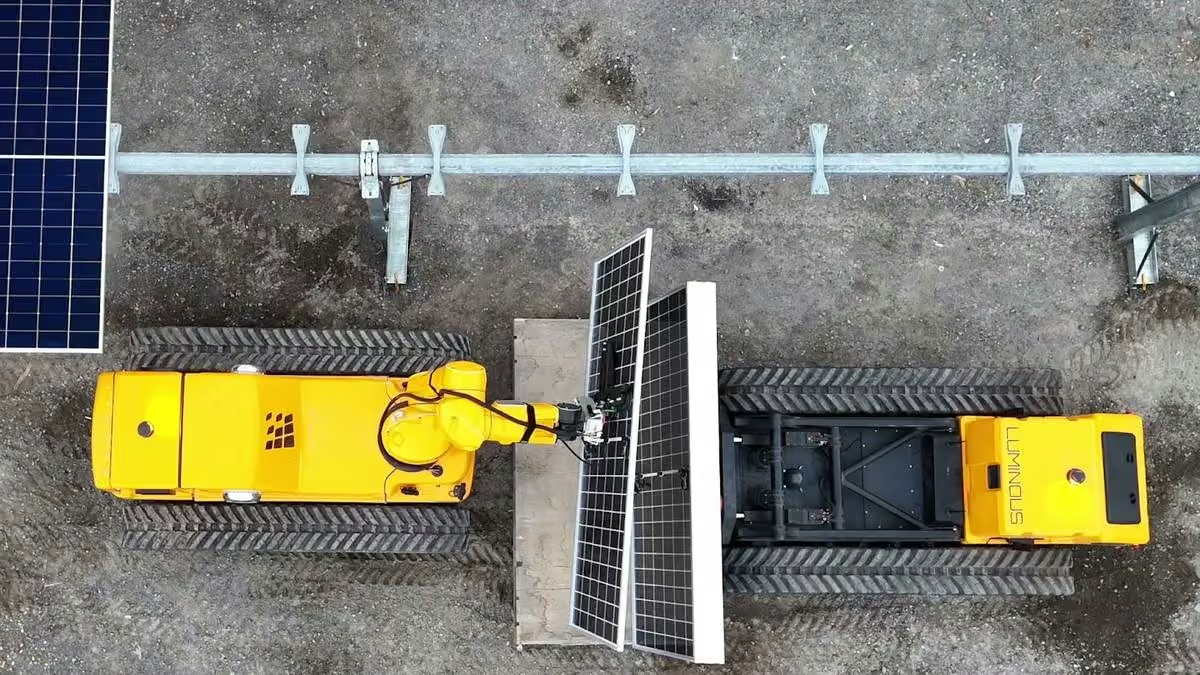
Luminous has developed a specialised robotics fleet that includes two complementary platforms designed to automate solar panel installation on large-scale solar farms. The company’s architecture includes the Pallet Lumi v2, a robotic platform that transports solar panels along the installation row, and the Install Lumi that collects the panels individually and places them onto the mounting structure.
The company said its current generation of automated robot allows for solar panels to be installed with a cycle time as low as 40 seconds.
Luminous Australia General Manager Tenzin Crouch said the application of coordinated robotics system has already been successfully trialled at large-scale solar builds in Victoria and New South Wales (NSW) and the company is now looking to scale up manufacturing.
“We have proven that these robots do work in Australia, doing some of the hardest work on site,” he said. “The next step is to turn that into scale.”
Luminous is planning to establish a $39.7 million manufacturing facility, backed by $17.8 million from Australian Renewable Energy Agency (ARENA), in Melbourne with Crouch confirming he expects to sign the lease for a factory site in the coming weeks. Fit-out will begin in early 2027, with production starting in the second quarter.
“We’ll establish that facility Q1 next year and have first robots off the production line Q2 next year,” he said, adding that the project is expected to deliver about 100 pallet and install Lumi robots by 2029.
“We have an initial production run of five robots by mid-year next year,” he said. “And then from there, that facility is targeted to produce about 15 robots every six months across both generations of the pallet and the plate installation.”
Crouch said the Lumi platform takes on the heavy, repetitive work of lifting and placing solar panels with the current generation of robots up to 2.5 times faster than existing labour practices. The company is working towards about a four times efficiency, unlocking the potential to significantly lower solar farm construction costs.
“And because the machines are electric, that would allow for overnight operations which would be a game-changer,” Crouch said, adding the shift towards commercial-scale local manufacturing is the opportunity to take robots already working alongside Australian solar crews and build them at a scale that matches the work ahead.
“There’s approximately 160 GW of projects in Australia’s development pipeline,” he said. “Even if 50% of them don’t get through DA, there’s still 80 GW over the next 10 years so there’s a lot to do.”
In addition to the Australian market, Luminous sees the Melbourne facility as a potential base to serve New Zealand, South America and Southeast Asia.
“We see Australia as a sort of export hub for the region,” Crouch said. “New Zealand is not a huge market but it’s quite growing quite a lot, Chile as well, and then obviously up into Southeast Asia.”
Luminous said the Lumi robots will be assembled and tested at the Melbourne facility, with Australian suppliers fabricating metal parts from the outset. As the fleet grows, the company will look to bring more local suppliers into production.
“It is going to start mostly as assembly, but our intent is to over the course of the project onshore a lot of the fabrication aspects of that as well,” Crouch said. “So the local supply chain is going to level up.”
Pvola take
Localizing robot assembly in Melbourne addresses the labor bottleneck in Australia’s 80 GW solar pipeline. By targeting a 2.5x installation speedup, Luminous aims to reduce construction costs for utility-scale projects. The shift from trial to factory production signals a move toward scalable, electric-driven deployment.
Frequently asked questions
What is Luminous Robotics planning to manufacture in Melbourne for the Australian solar market?
Luminous Robotics is planning to manufacture a fleet of robots designed to automate solar panel installation. The facility will produce the Pallet Lumi v2 and Install Lumi platforms to accelerate utility-scale solar deployment.
What is the target production volume for Luminous Robotics' Melbourne facility by 2029?
The project is expected to deliver about 100 pallet and install Lumi robots by 2029. An initial production run of five robots is targeted for mid-year next year, with subsequent output of about 15 robots every six months.
How does Luminous Robotics' automated system impact the installation cycle time for solar panels?
The current generation of automated robots allows for solar panels to be installed with a cycle time as low as 40 seconds. This automation aims to reduce construction costs and accelerate the deployment of large-scale solar farms.