CrossBoundary Energy Starts 526 MWh BESS at Kamoa-Kakula in DRC
The short answer
CrossBoundary Energy started delivering 30 MW of guaranteed baseload from a 526 MWh battery system at the Kamoa-Kakula Copper Complex in August 2026. This project demonstrates how large-scale storage can convert intermittent solar into reliable industrial power, significantly reducing diesel dependence for critical mining operations.
Key facts
- Capacity
- 123 MVA
- Energy
- 526 MWh
- Chemistry
- LFP
- COD or milestone
- Commercial operation on 12 August 2026
- Offtaker or owner
- CrossBoundary Energy
- Location
- Kolwezi, Democratic Republic of the Congo
Sixteen months after the power purchase agreement was signed, DHYBRID’s Universal Power Platform (UPP) coordinates 233 MWp of solar and a 526 MWh battery system at the Kamoa-Kakula Copper Complex in the DRC into a guaranteed 30 MW of baseload, 24 hours a day, seven days a week, with peaks of 55 MW. In its first month of operation, the plant displaced around 4 million liters of diesel.
Since 12 August 2026, Africa’s largest copper mine has been running on solar baseload. In its first month of operation, the plant displaced around 4 million liters of diesel, worth roughly USD 11 million. DHYBRID Power Systems GmbH engineered the battery system and provides the control platform for the facility that CrossBoundary Energy developed, owns and operates at the Kamoa-Kakula Copper Complex near Kolwezi, Democratic Republic of the Congo: 233 MWp of solar and a 123 MVA / 526 MWh battery system are delivering a guaranteed 30 MW output around the clock, with peaks of 55 MW, sixteen months after the power purchase agreement was signed.
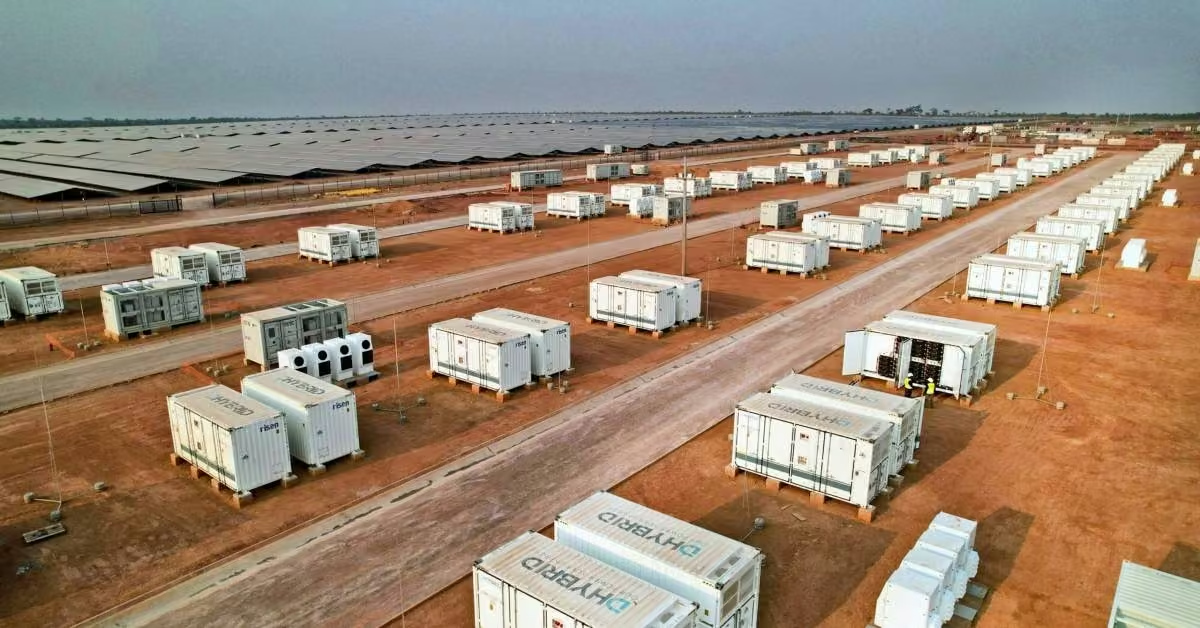
DHYBRID provided the engineering, design and supply of the 123 MVA / 526 MWh battery energy storage system, as well as factory acceptance testing, on-site commissioning and the Energy Management System. The UPP is the central control layer for the entire plant: 513 photovoltaic inverters, 90 battery inverters, 180 battery containers, more than 200 power quality meters, protection relays, meteorological sensors, UPS and HVAC units, and more than 400 managed network switches, over 1,300 devices in total.
Reliable baseload from a fluctuating source. The mine does not buy fluctuating solar power; it buys reliable and predictable baseload power. Kamoa Copper S.A. set the requirement at 30 MW, available at any hour of any day with 95% availability. The UPP’s Baseload Application turns that requirement into a plant-wide setpoint. A forecasting algorithm shows the operator twenty-four hours ahead how much the plant can deliver; the operator sets the value, and the platform decides every second how to split up to 180 MW of solar between the mine and the batteries, how far to charge for the night, and how to hold the setpoint through cloud cover and load swings. The customer only sees constant power output.
“For the operator, the power output of the plant is controlled by one button: ask for 30 MW and you get 30 MW, ask for 50 MW and you get 50 MW of stable output. Our forecasting algorithm tells the operator twenty-four hours ahead what the plant can deliver, and the UPP holds that setpoint by coordinating more than 1,300 devices in real time to make sure intermittent solar power becomes renewable, reliable baseload,” says Tobias Reiner, CTO and Managing Director of DHYBRID Power Systems GmbH.
Four OEMs, one plant. The facility combines 357,048 Aiko solar modules, Sungrow photovoltaic inverters and medium-voltage stations, Risen SYL battery containers and EPC Power power conversion systems. None of the four makes the control layer. DHYBRID’s platform is manufacturer-independent by design, which let CrossBoundary Energy choose each component on its merits and still operate the result as a single power plant. The same platform runs DHYBRID systems at more than 100 sites in around 30 countries, from Maldivian atolls and critical infrastructure in Europe to the Rio Tinto QMM mine in Madagascar.
Built to be trucked to Kolwezi. DHYBRID customized the 180 battery containers for the project’s logistics, including road-weight limits on the 3,080 km route from Durban port to Kolwezi. Each unit was factory-tested by DHYBRID in China before shipping and commissioned on site by DHYBRID engineers. The plant exported its first electricity in June 2026, thirteen months after site access, and reached commercial operation on 12 August. CrossBoundary Energy expects the facility to produce around 300,000 MWh a year and avoid roughly 78,750 tonnes of CO₂ annually.
DHYBRID has been awarded the contract to expand the Kamoa-Kakula battery system by a further 35 MWh to an installed capacity of 561 MWh, with commercial operation targeted for January 2027. The additional capacity will be integrated seamlessly into the existing control layer without changes to the plant’s operating interface. Kamoa-Kakula plans to further raise its on-site solar baseload capacity to 120 MW within 18 months.
Pvola take
This deployment proves that hybrid solar-storage plants can meet strict industrial baseload requirements, a critical step for decarbonizing heavy industry in grid-weak regions. By guaranteeing 95% availability, the project shifts the value proposition of storage from peak shaving to firm power generation, opening new markets for developers in Africa.
Frequently asked questions
What is the guaranteed baseload output of the solar and battery system at the Kamoa-Kakula Copper Complex?
The system delivers a guaranteed 30 MW of baseload power 24 hours a day. It can also provide peaks of up to 55 MW when required by the mine's operational needs.
How much diesel did the Kamoa-Kakula solar and storage plant displace in its first month of operation?
The plant displaced approximately 4 million liters of diesel in its first month. This reduction in fuel usage is estimated to save roughly USD 11 million in operational costs.
What is the planned expansion for the battery system at the Kamoa-Kakula Copper Complex?
The battery system will be expanded by 35 MWh to reach a total installed capacity of 561 MWh. Commercial operation for this additional capacity is targeted for January 2027.