US Proposes Section 301 Tariffs: Solar Modules Face 20% to 35% Rates
The short answer
The USTR proposed Section 301 tariffs on solar modules from 14 economies, with rates ranging from 15% to 35%. These duties would stack on existing AD/CVD measures, significantly increasing import costs for US developers sourcing from Asia.
Key facts
- Jurisdiction
- United States
- Instrument
- Section 301 Investigation
- Status
- Proposed, open for public comment
- Effective date
- Comments due January 5, 2027
- Scope
- Solar cells, modules, lithium-ion batteries
- Rate or target
- 15% to 35% depending on origin
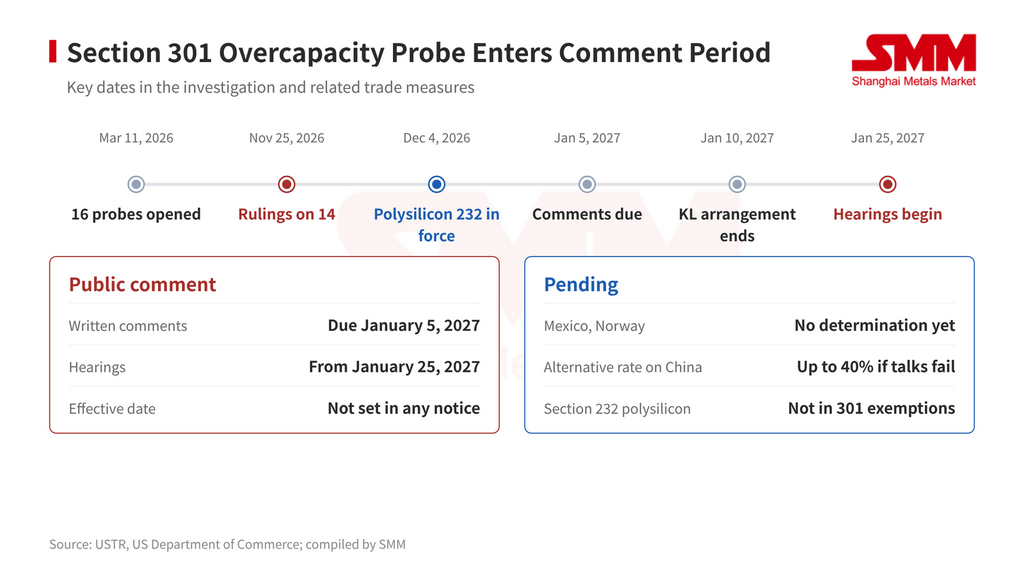
The Office of the United States Trade Representative (USTR) published its findings on November 25 regarding Section 301 investigations into "structural excess capacity" across 14 economies. The agency concluded that the industrial policies of these nations are unreasonable and impose a burden on American commerce, leading to proposed tariffs on all goods not included in specific exemption lists. The suggested tariff ceilings vary by jurisdiction: 35% for Vietnam, 25% for India, 20% for China and Singapore, 18% for Bangladesh, Cambodia, Indonesia, Malaysia, and Thailand, and 15% for the EU, Japan, South Korea, Switzerland, and Chinese Taiwan. Determinations for Mexico and Norway remain pending. The proposals are currently open for public input, with written comments accepted until January 5, 2027, and hearings scheduled to commence on January 25.
SMM assesses that for the solar industry, the specific designation of the sector is less critical than the exemptions embedded within the tariff codes, which carry more immediate operational weight. The USTR identified solar as a sector of concern in its reports concerning China, India, and Cambodia. However, the exemption annexes covering China, India, and five Southeast Asian economies do not include solar cells or modules. Furthermore, lithium-ion batteries and static converters are exempted solely for aircraft applications. Should the proposals be enacted in their current form, solar modules originating from Southeast Asia and India and destined for the United States would be subject to an additional layer of Section 301 tariffs, stacked on top of existing antidumping and countervailing duties (AD/CVD) and Section 232 measures on polysilicon.
Tariff Framework: Caps Include Existing Section 301 Tariffs, Vietnam and India Face the Largest Increases
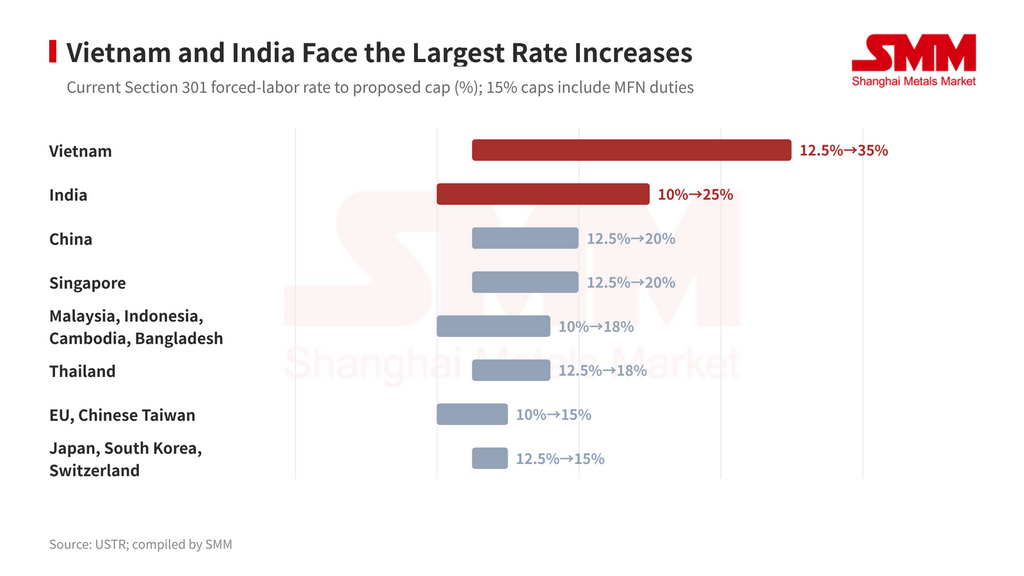
The proposed rates function as all-inclusive caps that subsume the existing Section 301 tariffs on forced labor, rather than serving as additional levies layered on top of current duties. The initial forced-labor tariffs under Section 301 became effective on July 24, with rates set at either 10% or 12.5%. Under the new nominal caps, Vietnam’s tariff rate would escalate from 12.5% to 35%, representing a 22.5 percentage point increase. India’s rate would climb from 10% to 25%, a 15 percentage point jump. Meanwhile, China and Singapore would see their rates move from 12.5% to 20%, an increase of 7.5 percentage points for each. Malaysia, Indonesia, Cambodia, and Bangladesh would face a rise from 10% to 18%, while Thailand’s rate would shift from 12.5% to 18%. The 15% rate applicable to the European Union, Japan, South Korea, Switzerland, and Chinese Taiwan incorporates most-favored-nation (MFN) duties, reflecting increases in the range of 2.5 to 5 percentage points.
Trade negotiations and bilateral agreements retain the potential to alter the final tariff structure. Under the current framework, Vietnam, India and Singapore could see their respective rates reduced to 20%, 17% and 10% if they execute reciprocal trade pacts with the United States. Conversely, if consultations fail to meet Washington’s requirements, alternative rates may escalate to 40% for China. South Korea, Chinese Taiwan, Indonesia, Malaysia, Thailand and Cambodia could face rates of 25%, while the European Union, Japan, Switzerland and Bangladesh might see rates of 20%. It is important to note that the 20% rate proposed for China excludes only the Section 301 tariffs imposed for forced labor; the Section 301 tariffs levied on Chinese goods since 2018 would remain in effect and apply in addition to the new rates. In its own proposal, China suggests a maximum rate of 10% for goods listed in Annex A, while consumer products identified in Annex B would be exempt from these measures.
Regarding exemptions, the proposals targeting the 13 economies excluding China all carve out goods currently subject to Section 232 tariffs. This exemption covers steel, aluminum and copper products, automobiles and auto parts, lumber, patented pharmaceuticals and semiconductors. Additionally, these proposals exempt specific raw materials, energy products and minerals through designated annexes. In contrast, the proposal put forward by China does not include a clause exempting goods from Section 232 tariffs.
Solar in Focus: Named as a Sector of Concern in the China, India and Cambodia Reports
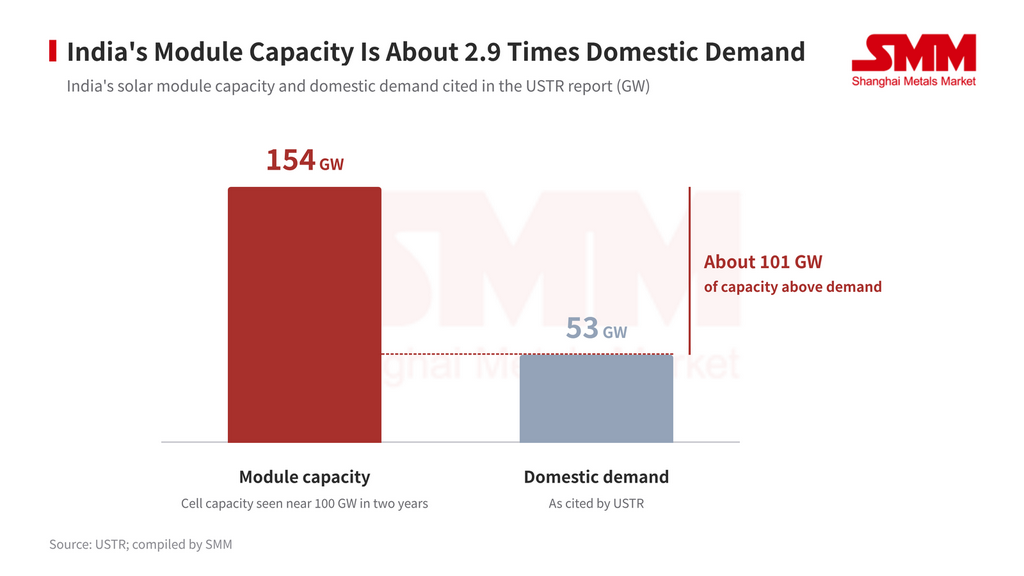
The USTR’s report on India places significant emphasis on the solar sector. It estimates the country’s module manufacturing capacity at approximately 154 GW, a figure that stands at roughly 2.9 times the domestic demand of 53 GW. Furthermore, the agency projects that cell production capacity will expand to around 100 GW within the next two years. Investment in solar energy has surged dramatically, climbing from US$84 million in 2018 to US$10 billion in 2025. The document specifically identifies the production-linked incentive (PLI) scheme for high-efficiency solar modules, which carries a budget of INR 240 billion, alongside local content mandates. It also highlights that India’s annual imports of cells and modules from China averaged approximately US$3.5 billion between 2021 and 2024. Additionally, the report notes that Chinese investment in India’s renewable energy equipment sector surpassed US$400 million during the 2017–2023 period.
Other reports place varying emphasis on specific sectors. The assessment of Cambodia identifies Chinese capital as the primary source of foreign investment, with significant concentration in the garment, solar, and tire industries. In contrast, the report on China categorizes solar, batteries, and wind power among 22 sectors of concern, listing the practice of "encouraging outbound investment to expand capacity abroad" as one of 11 identified issues. While the Indonesia report does not isolate the solar sector, it highlights that US imports of renewable energy electrical products from Indonesia surpassed US$3 billion in 2025, representing approximately one-fifth of total US imports in this category. The report also specifically references Xinyi Glass’s US$11.6 billion investment in a solar glass manufacturing facility located on Rempang.
Analyses of Vietnam, Malaysia, and Thailand do not treat solar as a distinct sector, instead concentrating on Chinese investment flows and transshipment activities. The Vietnam report estimates that transshipment could contribute up to 21.1% to the growth in exports to the United States. Thailand is characterized as a "diversion channel" for China’s excess production capacity. Since the proposed measures apply to all goods, solar modules remain within the tariff scope regardless of whether the solar sector is explicitly named.
Tariff Codes: Neither Modules Nor Storage Batteries Are on the Exemption Lists
Shanghai Metals Market (SMM) reviewed the exemption annexes for seven economies—China, India, Vietnam, Malaysia, Thailand, Indonesia, and Cambodia. The findings are detailed below:
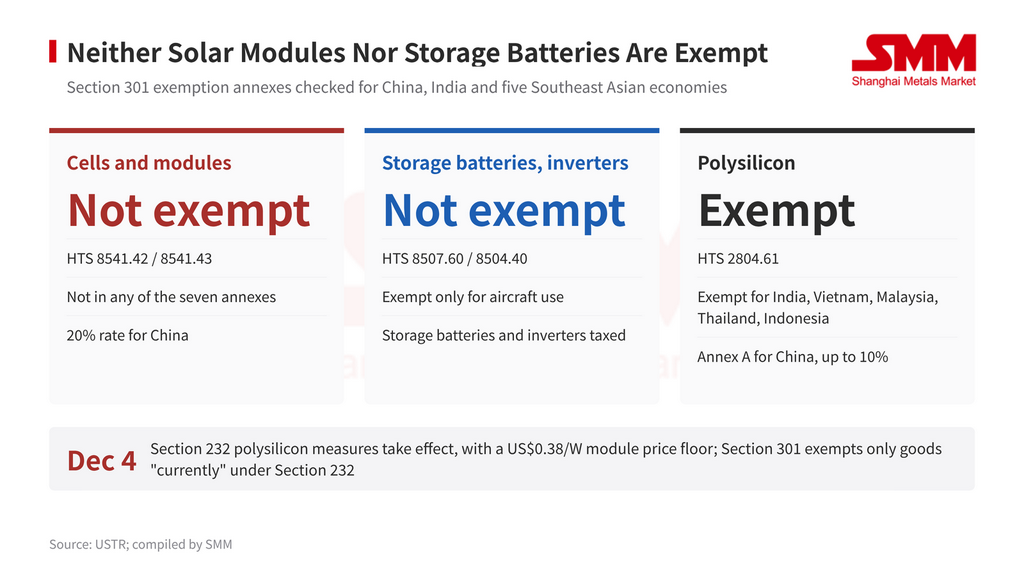
The precise language governing Section 232 exemptions carries significant weight. The proposed exemptions apply strictly to goods currently subject to Section 232 tariffs, a scope that excludes polysilicon and its derivatives. Effective December 4, the Section 232 measures on polysilicon will establish minimum import prices of US$0.38/W for modules and US$0.22/W for cells, alongside a 15% ad valorem tariff on ingots, wafers, cells, and modules. Consequently, under the current regulatory text, these products do not automatically qualify for Section 301 exemptions based solely on the existence of Section 232 measures.
Stacking Effect: Limited Marginal Impact Where AD/CVD Rates Are High, More Direct for Storage Batteries and Inverters
Antidumping and countervailing duties (AD/CVD) on solar products originating from four Southeast Asian countries took effect in 2025. On October 14, the US International Trade Commission (USITC) issued its final determinations in the cases involving India, Indonesia, and Laos. The established antidumping duty rates are 123.04% for India, 94.36% for Indonesia, and 65.43% for Laos. Corresponding countervailing duty rates stand at 126.09% for India, ranging from 73.2% to 173.7% for Indonesia, and between 82.03% and 153.67% for Laos.
SMM assesses that the incremental effect of the proposed Section 301 tariffs is minimal for countries of origin already subject to substantial anti-dumping and countervailing duty (AD/CVD) rates. However, for manufacturers facing lower AD/CVD penalties, as well as for specific product categories such as energy storage batteries and inverters, the new tariffs would directly increase the cost of exporting to the United States. Consequently, production hubs in Laos, the Middle East, and other regions not included in the current list may see their relative cost competitiveness improve further.
Open Questions: Exemption Scope, Trade Negotiations and Timing
The first area of uncertainty concerns the precise scope of exemptions. The proposals invite public comment on which tariff classifications cover essential raw materials and whether the measures could disrupt supply chains. Stakeholders in the solar and energy storage sectors have until January 5 to submit requests for adjustments to tariff-code exemptions.
The second issue involves ongoing trade negotiations. India’s Ministry of Commerce and Industry stated that it is reviewing the notice, reaffirmed that no Indian industry possesses structural excess capacity, and argued that the concerns should be resolved through bilateral trade agreement discussions. Meanwhile, Vietnam’s Ministry of Industry and Trade (MOIT) noted that the plan is still at the proposal stage and confirmed that it will participate in the public hearings and file formal comments.
China’s Ministry of Commerce (MOFCOM) spokesperson, He Yadong, characterized the US Section 301 investigation as a unilateral measure that significantly breaches World Trade Organization regulations on November 26. He stated that Beijing firmly opposes the action and retains the authority to implement necessary countermeasures. The existing US-China agreement reached in Kuala Lumpur is set to lapse on January 10, 2027. Should negotiations fail to meet Washington’s requirements, the alternative tariff rate applicable to Chinese goods could escalate to 40%.
Regarding the timeline, the country-specific notices do not establish an effective date. Vietnam’s Ministry of Industry and Trade (MOIT) anticipates that the United States will finalize its decision between February and March 11, 2027. Meanwhile, determinations concerning Mexico and Norway remain outstanding.
SMM View: Tariff-Code Exemptions Matter More Than Being Named
SMM assesses that the impact of the proposed Section 301 tariffs on the solar sector hinges on two critical factors: whether solar modules and cells are included in the exemption lists, and whether the existing Section 232 measures on polysilicon qualify for the exemption applicable to goods already subject to Section 232. Should the final determinations retain the current regulatory text, solar modules originating from Southeast Asia and India and destined for the United States would be subject to Section 301 tariffs in addition to existing anti-dumping/countervailing duties (AD/CVD) and Section 232 measures. Manufacturers with lower AD/CVD rates, along with producers of storage batteries and inverters, would face more direct financial pressure, potentially prompting US buyers to increase procurement from origins outside the targeted list or from domestic US supply. If Vietnam and India finalize trade agreements prior to the issuance of final determinations, the tariff increases for these countries would be reduced to 7.5 and 7 percentage points, respectively, which would subsequently alter the relative cost positioning of solar modules from Southeast Asia and India in the US market.
SMM will continue to monitor these developments.
Pvola take
The exclusion of solar modules from exemption lists creates immediate supply chain risk for US projects. Developers must evaluate the cumulative burden of Section 301, AD/CVD, and Section 232 duties before finalizing procurement contracts.
Frequently asked questions
What are the proposed Section 301 tariff rates for China and Vietnam under the USTR findings?
The USTR proposes a 20% tariff ceiling for China and a 35% ceiling for Vietnam. These rates apply to goods not included in specific exemption lists, with solar modules and storage batteries notably missing from those exemptions.
How does the USTR proposal affect the US import value of renewable energy products from Indonesia?
US imports of renewable energy electrical products from Indonesia surpassed US$3 billion in 2025. This volume represents approximately one-fifth of total US imports in this category, highlighting the significant trade exposure to potential tariff changes.
What is the deadline for public comments on the USTR's proposed Section 301 tariffs?
Written comments on the proposed tariffs are accepted until January 5, 2027. Hearings are scheduled to commence on January 25, allowing stakeholders to influence the final determinations before they are issued.