Spain Cuts Collective Solar Commitment to One Month in New Decree
The short answer
Spain approved a new royal decree on November 24 that reduces the minimum commitment period for collective self-consumption to one month. This change allows developers and residents to share solar energy with greater flexibility and streamlined administrative processes.
Key facts
- Jurisdiction
- Spain
- Instrument
- Royal Decree amending RD 244/2019
- Status
- Approved by Council of Ministers
- Effective date
- November 24
- Scope
- Collective self-consumption and energy communities
- Rate or target
- One month minimum commitment period
The new collective self-consumption decree makes it easier for neighbors to share solar energy. Key changes include reducing the minimum commitment period to one month and simplifying the procedures for registering installations and adjusting the distribution of generated electricity.
The Council of Ministers approved these measures on November 24, following a proposal from the Ministry for Ecological Transition (MITECO). On the same day, the government also authorized a second royal decree regulating energy communities, aimed at facilitating consumer participation in such projects.
What changes under the new collective self-consumption decree
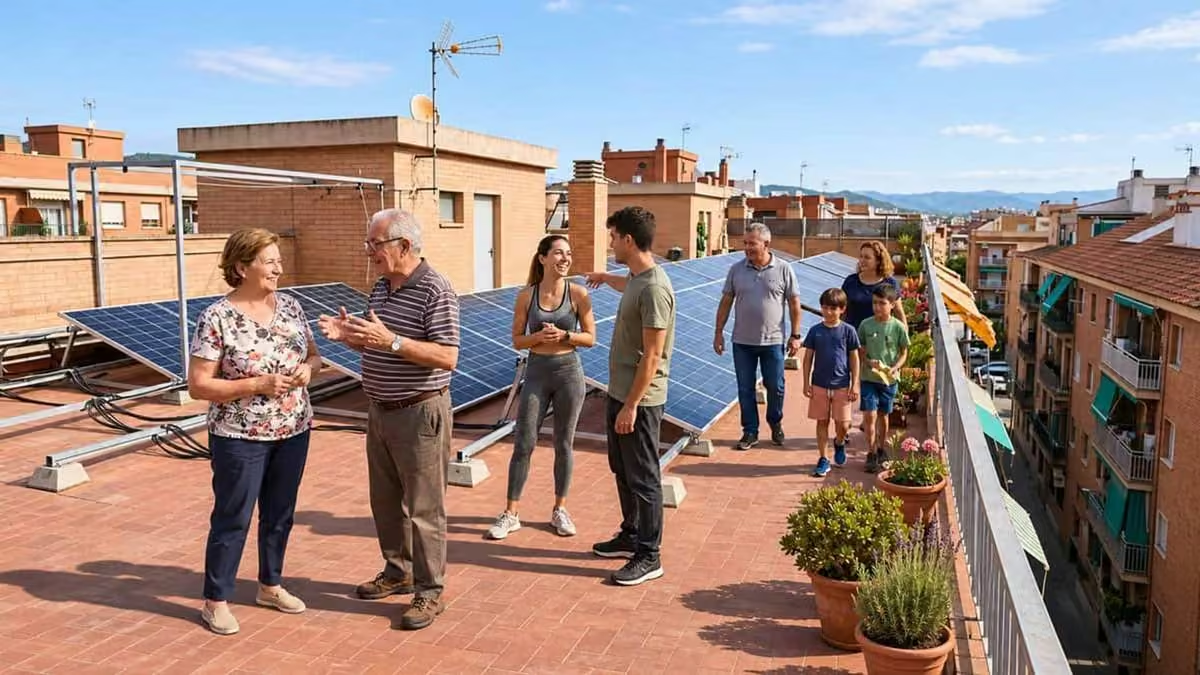
The new decree amends Royal Decree 244/2019, which governs the conditions for electrical self-consumption in Spain. Much of the update seeks to streamline administrative processes for those wishing to share an installation, such as residents in a building equipped with rooftop solar panels.
To streamline the process, the distributor can now process the activation request upon receipt of the first sharing agreement. Should participants later wish to alter the distribution of the generated electricity, the signature of the affected consumers will be sufficient.
Furthermore, the minimum commitment period for collective self-consumption has been reduced to one month, granting greater flexibility to those involved in these installations.
The decree also elaborates on the role of the self-consumption manager, a figure introduced by Royal Decree-Law 7/2026. In the proposal submitted by the Ministry for Ecological Transition, Democratic Participation and Territorial Agenda (MITECO) in October 2025, this manager was tasked with representing participants and handling administrative procedures on their behalf.
These changes arrive amid a surge in self-consumption across Spain. According to MITECO, installed capacity has increased seventeenfold since 2018, reaching 8,256 MW by the end of 2024. The Spanish Union of Renewable Energy (UNEF) places cumulative solar self-consumption at 9.3 GW at the close of 2025, compared to the 19 GW target set by the Integrated National Energy and Climate Plan for 2030. The collective model is expanding particularly rapidly: on Endesa’s network, the number of supplies jumped from 22,000 to over 45,000 between May 2025 and May 2026.
More options for installing solar panels and sharing surplus energy
The new decree broadens the scope for utilizing electricity generated by renewable energy systems. A single consumer will now be permitted to participate in multiple self-consumption models simultaneously, while ownership requirements for the installations have been streamlined to facilitate third-party investment structures.
A significant addition is the introduction of a "shared surplus" category. Under this model, a self-consumer may use the electricity they generate to meet their own demands and share only the excess energy, rather than distributing their entire production.
The draft regulation cited schools, shopping centers, and public buildings with large rooftops as examples, noting that their installations could serve to distribute leftover electricity to other consumers.
The regulation also addresses the integration of batteries and other energy storage systems. It specifies that distributed storage linked to end users will be compatible with all forms of self-consumption. Storage is already becoming a standard feature in homes: according to the Spanish Union of Renewable Energy (UNEF), 61% of new residential self-consumption installations deployed in 2025 included storage capabilities.
What changes for members of energy communities
Alongside the updates to self-consumption rules, the government has approved a separate royal decree that outlines the regulatory framework for renewable energy communities (CER) and citizen energy communities (CCE). The legislation defines the requirements for establishing these entities, the rights and obligations of their members, and a structure designed to facilitate their deployment.
Under the new framework, renewable energy communities will be required to prioritize delivering environmental, economic, or social benefits to their members rather than pursuing financial profit. A notable example of a rural energy community is the EfiDuero Energy project, which unites 77 municipalities across Zamora, Salamanca, and Portugal. This initiative was recognized as Spain’s best energy community in 2025 by EnerAgen.
Governance rules for these communities will prevent any single member or partner from holding more than 40% of the voting power. The regulations also establish proximity criteria linking the communities to their associated energy projects, with specific requirements varying based on the population size of the municipalities where the projects are located.
Citizen energy communities will not be limited to utilizing only renewable energy sources within their immediate vicinity. The decree further outlines the legal requirements for these entities, particularly addressing the regulatory framework applicable when they operate across multiple autonomous communities.
To streamline the formation of these communities and the onboarding of new participants, the new regulatory structure introduces various support mechanisms:
The Institute for Energy Diversification and Saving (IDAE) has already supported 262 energy communities through six iterations of the CE Implementa program.
Key updates on self-consumption and energy communities
The following are the primary measures affecting consumers included in the two royal decrees approved on November 24:
Pending changes to self-consumption regulations
The Ministry for Ecological Transition (MITECO) will submit a new update to the self-consumption regulations for public consultation. Among its objectives is improving consumer protection against delays in the activation of their facilities, achieved by updating the "delay discount." The ministry also proposes limiting the circumstances under which distribution companies can activate self-consumption systems.
For now, the two approved royal decrees must be published in the Official State Gazette (BOE) before they can take effect. The MITECO notes reviewed do not specify a publication date.
Pvola take
The reduction to a one-month commitment period removes a significant barrier for residential and commercial shared solar projects. By simplifying registration and allowing shared surplus models, the decree accelerates the deployment of distributed generation. This regulatory clarity supports the rapid growth in self-consumption capacity observed in recent years.
Frequently asked questions
What is the new minimum commitment period for collective self-consumption in Spain under the approved decree?
The minimum commitment period has been reduced to one month. This change aims to streamline administrative processes for residents sharing rooftop solar installations.
How does the new Spanish decree simplify the activation process for shared solar installations?
Distributors can now process activation requests upon receiving the first sharing agreement. This removes previous procedural hurdles for registering installations and adjusting electricity distribution.
What impact does the new collective self-consumption regulation have on solar installers in Spain?
The regulation lowers administrative barriers for community solar projects by simplifying registration and distribution adjustments. This makes it easier for installers to deploy shared systems in buildings and public facilities.