Tamil Nadu government unveils Battery Energy Storage System policy
Key facts
- Tamil Nadu mandates new solar projects of 1 MW or larger to install BESS with 10% discharge power and 4-hour duration
- The state aims to enable 2.5 GW and 10 GWh of battery storage capacity within three years of the policy launch
- Eligible BESS projects receive a 100% waiver on transmission and wheeling charges for ten years from commissioning
- New renewable energy pooling sub-stations must provide standalone BESS capacity equal to 10% of their sanctioned capacity
All new solar and solar-hybrid projects of 1 MW and above to install BESS with discharge power equivalent to at least 10% of the project’s installed capacity, as well as a 4-hour discharge duration
By BL Chennai Bureau
Share
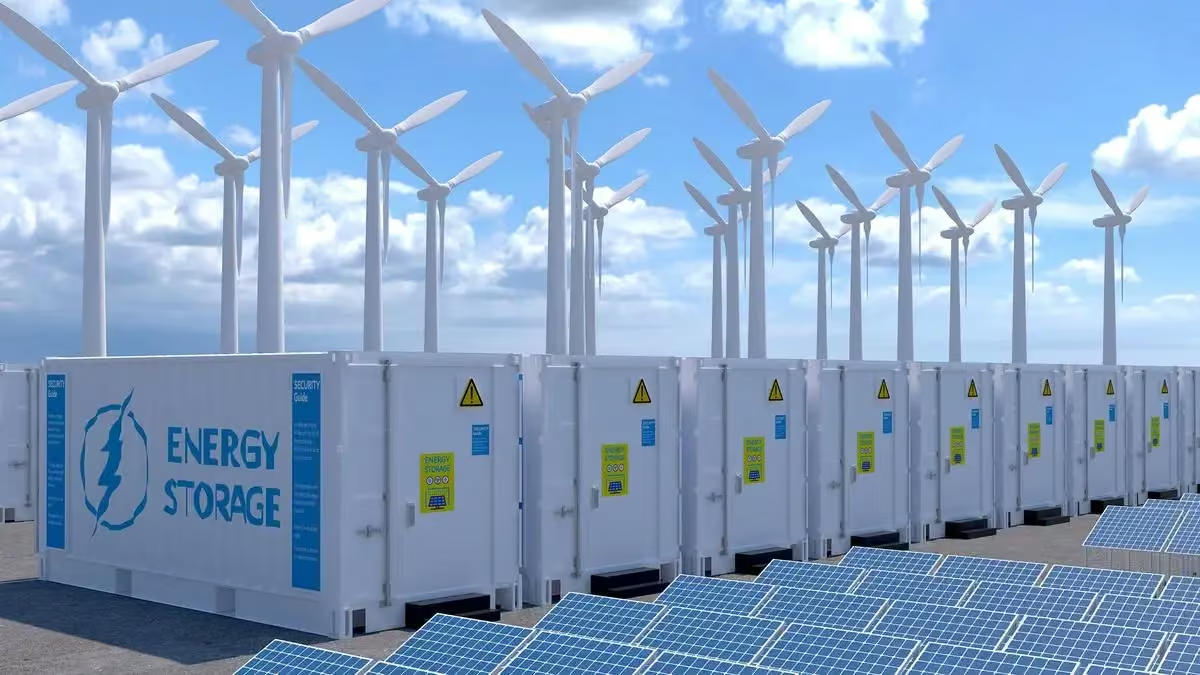
File pic of energy storage system battery containers, combining wind turbine farms, and photovoltaic solar panels. | Photo Credit: Adil bouimama
The Tamil Nadu government on Tuesday officially unveiled a Battery Energy Storage System (BESS) Policy with the goal of enabling at least 2.5 GW/10 GWh of storage capacity within three years.
The policy was launched during an event held at the headquarters of the Tamil Nadu Electricity Board here in the presence of CTR Nirmal Kumar, Tamil Nadu Minister for Energy Resources & Law.
The Tamil Nadu Battery Energy Storage Systems Policy, as first reported by businessline last week, mandates that all new solar and solar-hybrid projects of 1 MW and above will install BESS with discharge power equivalent to at least 10 per cent of the project’s installed capacity as well as with a four-hour discharge duration.
The requirement will apply to projects that either apply for approval on or after the policy’s notification date or are commissioned from April 1, 2027.
Eligible BESS projects approved and commissioned during the policy period will also be considered for a 100 per cent waiver of applicable transmission and wheeling charges for 10 years from commissioning.
New renewable energy pooling sub-stations will also have to provide standalone BESS capacity equivalent to at least 10 per cent of their sanctioned capacity, while existing pooling substations will have to install 5 per cent capacity by FY28 and an additional 5 per cent by FY29.
“Tamil Nadu already has over 25,000 MWs of installed renewable capacity. The future of clean energy will depend upon storing and utilising excess power. Every solar application will now need to provide for at least 10 per cent BESS capacity,” Energy Minister Nirmal Kumar said.
The event also saw the launch of a Renewable Energy Application Portal.
Kumar said the portal will streamline the project application and approval, unlike the earlier manual process. “Earlier, the system was misused with many getting approval, but not beginning construction even two-three years later. With the portal, we will make sure that every application is given a proper deadline,” he said.
Arulkumar Shanmugasundaram, Chief Executive Officer and Managing Director, Swelect Energy Systems said, until now, there was no clear policy framework for implementing battery energy storage systems and the new policy addresses various aspects, including transmission and wheeling charges.
“We are quite pleased with the outcome, particularly because the government consulted industry associations and held multiple rounds of discussions while formulating it,” he said
Pvola take
Developers must now factor significant capital expenditure into project models, as the mandate requires 4-hour storage for all new solar installations above 1 MW. The 10-year waiver on transmission and wheeling charges offers a crucial financial offset, improving the return on investment for storage assets. This regulatory clarity allows investors to proceed with long-term planning, knowing that grid access costs for compliant systems will be eliminated for a decade.
Frequently asked questions
What are the specific BESS requirements for new solar projects in Tamil Nadu under the new policy?
New solar and solar-hybrid projects of 1 MW and above must install BESS with discharge power at least 10% of installed capacity. The system must also have a four-hour discharge duration to comply with the new regulations.
How much storage capacity does the Tamil Nadu BESS policy aim to enable within the next three years?
The policy aims to enable at least 2.5 GW/10 GWh of storage capacity within three years. This target is part of the state's broader strategy to integrate renewable energy and enhance grid stability.
What financial incentives are provided for eligible BESS projects commissioned during the Tamil Nadu policy period?
Eligible BESS projects approved and commissioned during the policy period will receive a 100% waiver of applicable transmission and wheeling charges. This waiver is valid for 10 years from the date of commissioning, reducing operational costs for developers.