China Solar PV News Snippets: 11 PV Companies Receive First Certificates Under China’s Mandatory Module Standards & More
Key facts
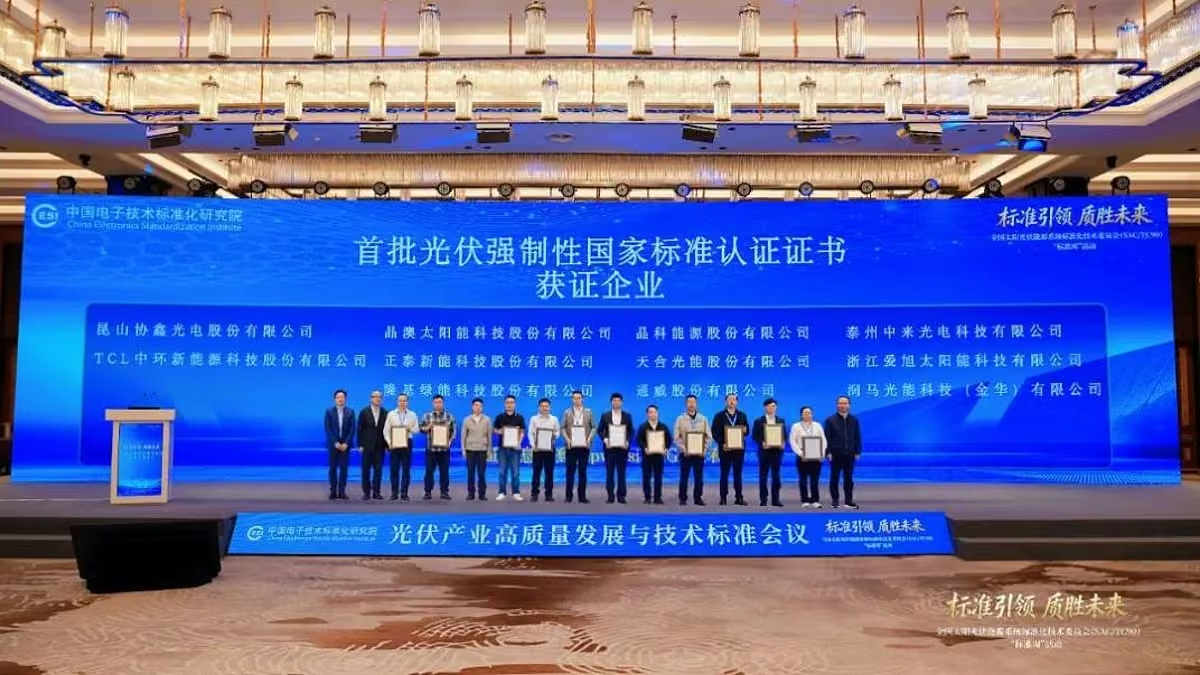
- SAC/TC90 awarded the first mandatory PV module certificates to 11 companies, including JinkoSolar and LONGi, in Yancheng, Jiangsu province
- The new mandatory standards GB 47739-2026 and GB 47740-2026 cover electrical safety, fire protection, and nameplate labeling requirements for PV modules
- China’s first mandatory national standards for PV modules are scheduled to take effect on June 1, 2027, following their publication in May 2026
- Haitian signed a collaboration agreement with Tongwei in March 2026 to develop HJT, TOPCon, and perovskite paste products through December 2030
11 PV Companies Receive First Certificates Under China’s Mandatory PV Module Standards
China’s National Technical Committee on Solar Photovoltaic Systems (SAC/TC90) held a conference in Yancheng, Jiangsu province, where the first certificates under the country’s mandatory national PV module standards were presented to 11 companies: GCL Perovskite, JA, JinkoSolar, Jolywood, TCL Zhonghuan (TCL TZE), Astronergy, Trinasolar, AIKO, LONGi, Tongwei, and Ronma Solar.
The certificates cover two standards: GB 47739-2026 , Safety Requirements for Photovoltaic Modules , and GB 47740-2026 , Requirements for Nameplate Labeling of Photovoltaic Modules . The first addresses electrical safety, mechanical strength, fire protection, harmful-substance control, and hot-spot endurance, while the second covers nameplate information, data retention, and measurement traceability.
Published on May 25, 2026, the two standards are scheduled to take effect on June 1, 2027. They are China’s first mandatory national standards specifically covering PV modules.
Last month, China’s Ministry of Industry and Information Technology (MIIT) proposed tougher standards for solar PV manufacturers, including higher efficiency requirements for solar cells and modules (see China Proposes Tighter Solar PV Manufacturing Standards ).
China Huadian Launches Framework Tender for 13.2 GW of Inverters
China Huadian has launched a framework tender for an estimated 13.2 GW of string inverters for 2026-2027. The tender comprises three lots: 12 GW of string inverters rated at 300 kW or above; 0.6 GW of 50 kW to 150 kW inverters; and 0.6 GW of inverters rated at 50 kW or below.
The framework agreement will remain valid for one year from its effective date or until procurement reaches 110% of the estimated volume for each lot, whichever comes first.
Haitian Group Plans RMB 800 Mn PV Silver Paste R&D + Manufacturing Project
Haitian Group, a Chinese water and environmental services company, has signed an investment services agreement with the local management committee for a new materials R&D center and manufacturing headquarters in Tianfu New Area, Sichuan province. The project involves a planned investment of RMB 800 million and will include PV silver paste R&D and manufacturing lines, auxiliary-material preparation facilities, warehousing, offices, and an overseas R&D and sales center.
Previously focused on water and environmental services, Haitian Group entered the PV silver paste market in 2025 after acquiring assets related to Heraeus’ PV silver paste business. The company said the new project is intended to expand its new energy materials business and develop its PV silver paste R&D and manufacturing capabilities.
In March 2026, Haitian signed an agreement with Tongwei to collaborate on HJT paste, TOPCon paste, and perovskite paste products through December 31, 2030 (see China Solar PV News Snippets ).
TBEA New Energy Puts its First HEMS into Operation in Hubei
TBEA New Energy, the green energy service provider under TBEA, has commissioned its first self-developed hybrid energy management system (HEMS) at a hybrid energy storage power station in Hubei province. The system coordinates sodium-ion batteries and flywheel energy storage, assigning short-duration, high-frequency power demands primarily to the flywheel system, while the sodium-ion batteries handle sustained charging and discharging.
According to the company, the HEMS responds to power commands in <20 ms, with regulation deviation kept within 1%. Its control strategy combines the flywheel’s fast response and long cycle life with the higher energy density of sodium-ion batteries. This reduces the batteries’ exposure to high-frequency power fluctuations while supporting rapid regulation and sustained energy output, helping to limit battery degradation.
In September, TBEA completed production of its independently developed SFFZ-300000/400 large-capacity double-split winding main transformer (see China Solar PV News Snippets ).
CTG Renewables Plans Xinjiang JV for Taklamakan Desert Energy Base
China Three Gorges Renewables (CTG Renewables) plans to establish a joint venture (JV) in Urumqi with three other affiliates of its parent company, China Three Gorges Corporation: China Yangtze Power, Three Gorges Capital, and China Three Gorges Investment Management. The proposed entity, Three Gorges (Xinjiang) Energy Investment Co., Ltd., will have registered capital of RMB 2.523 billion. The four shareholders will hold stakes of 34%, 33%, 16.5%, and 16.5%, respectively.
The JV is intended to advance the Southern Xinjiang Taklamakan Desert renewable energy base in Ruoqiang County. The project has an estimated investment of RMB 71.848 billion and is planned to include 8.5 GW of solar PV, 4 GW of wind power, 3.96 GW of coal-fired generation, and 5 GWh of energy storage.
CTG Renewables said in September 2026 that it had started construction of the supporting coal-fired power project, while the main renewable energy projects were undergoing administrative procedures ahead of approval. The base is expected to achieve full-capacity grid connection by the end of China’s 15 th Five-Year Plan period in 2030.
In August, CTG Renewables completed a 14-day trial operation assessment of its 100 MW solar thermal project in Haixi Prefecture, Qinghai province (see China Solar PV News Snippets ).
Pvola take
The introduction of mandatory national standards for module safety and labeling creates a significant compliance hurdle for manufacturers entering the Chinese market. Developers and investors must verify that their supply chains can meet these stricter requirements by 2027 to avoid project delays. This regulatory shift prioritizes long-term reliability and traceability, which may increase initial costs but reduces operational risks for large-scale installations.
Frequently asked questions
Which 11 PV companies received the first certificates under China's mandatory national module standards?
GCL Perovskite, JA, JinkoSolar, Jolywood, TCL Zhonghuan, Astronergy, Trinasolar, AIKO, LONGi, Tongwei, and Ronma Solar received the first certificates. These certificates cover safety requirements and nameplate labeling standards issued by the National Technical Committee on Solar Photovoltaic Systems.
What are the effective dates and specific standards covered by the new mandatory PV module certificates?
The standards GB 47739-2026 and GB 47740-2026 are scheduled to take effect on June 1, 2027. They cover electrical safety, mechanical strength, fire protection, and nameplate information requirements for photovoltaic modules.
How will the new mandatory PV module standards impact solar module manufacturers and global supply chains?
Manufacturers must comply with new mandatory requirements for electrical safety, mechanical strength, and nameplate labeling by 2027. This regulatory shift requires companies to update production processes and documentation to meet China's first mandatory national standards for PV modules.