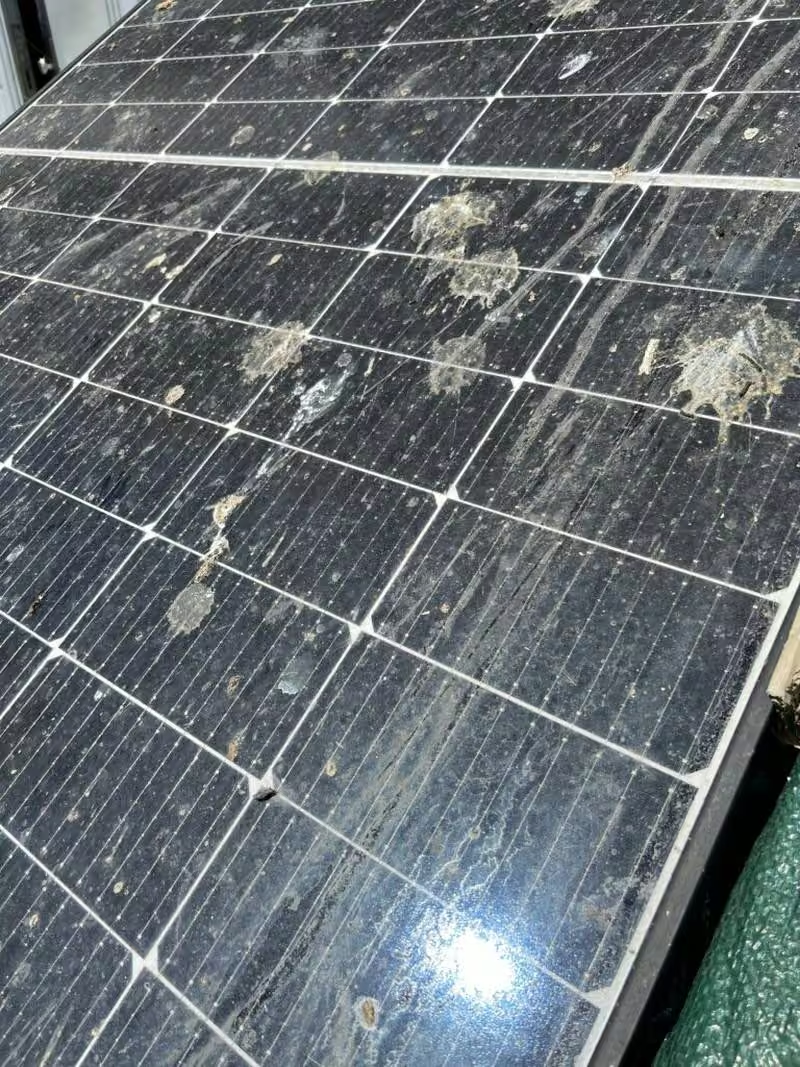
Study reveals that rain alone cannot remove bird droppings from solar panels
The short answer
A year-long experimental study at the University of Split found that rainfall does not remove bird droppings from solar panels, with soiling losses stabilizing at approximately 6%. This challenges standard cleaning models that assume rain restores module performance, requiring operators to adjust maintenance schedules and cost projections for sites near nesting areas.
Key facts
- Technology
- Monocrystalline silicon modules
- Status
- Field study
- Area
- University of Split, Croatia
- Partner
- JA Solar
A year-long experimental study conducted by an international research team assessed the impact of bird droppings on the performance of photovoltaic systems. The findings indicated that soiling losses stabilized after a prolonged period of accumulation and remained at constant levels despite repeated rainfall events.
"Our paper highlights this limitation, but we are not yet able to offer a solution," Leonardo Micheli, the study's corresponding author, told pv magazine. "It is likely that factors such as bird activity and proximity to nesting areas influence soiling accumulation under these conditions, but further research is needed to identify the quantitative variables that could be used to reliably model this type of soiling."
"The study demonstrates that a monitoring method based on clean irradiance measurements can accurately estimate soiling losses caused by bird droppings, without the need to maintain a reference module in a clean state," Micheli added. "However, we also showed that its accuracy depends on calibration. Furthermore, operating conditions may also affect accuracy, and further validation at different sites is required to confirm its general applicability."
"We have demonstrated that rainfall does not necessarily restore modules to clean conditions: significant soiling losses can persist even after repeated episodes of natural cleaning," the researcher stated. "The existence of this phenomenon has already been analyzed in the scientific literature, and our study confirms its relevance in environments affected by bird droppings, as these can be particularly difficult to remove. This challenges the common assumption in models that rain effectively eliminates accumulated soiling and should be taken into account when optimizing cleaning schedules and costs. A rainy period should not be considered proof that photovoltaic modules are free of soiling."
The experimental setup comprised two JA Solar JAM54S30-410/MR monocrystalline silicon modules, installed at ground level at the University of Split in Croatia. One module served as a clean reference, while the other was left exposed to natural soiling accumulation. Both units were mounted on an open structure with identical tilt, azimuthal orientation, and height to ensure comparable environmental and irradiance conditions.
Researchers conducted weekly measurements from July 2024 through July 2025. During each session, they recorded four current-voltage (I-V) curves per module using an EKO Instruments MP-11 tracer, while also measuring module temperature and irradiance. Data collection took place near solar noon under clear skies and stable irradiance conditions, in accordance with the IEC 61724-1 standard.
Researchers determined the soiling ratio by comparing the short-circuit currents of soiled and clean modules. They also tested an alternative method that estimates the output of a clean module using irradiance and temperature data. In addition, the team evaluated three established soiling accumulation models based on particulate matter concentrations and rainfall. Two of these models assumed complete cleaning when daily precipitation exceeded 1 mm, while the third accounted for partial cleaning.
During the monitoring period, the researchers recorded an average soiling ratio of 0.941, corresponding to performance losses of approximately 6%, or an estimated annual loss of 72.1 kWh/kWp. The ratio dropped below 0.90 in November 2024 following a prolonged dry spell, with bird droppings identified as the primary source of contamination. Subsequent rainfall allowed only for a partial recovery of module performance, and the soiling ratio stabilized at values between 0.94 and 0.96.
A second accumulation period, spanning April and May 2025, reduced the ratio to approximately 0.90, resulting in estimated daily energy losses of 0.41 kWh/kW and 0.47 kWh/kW, respectively.
The study found that only manual cleaning fully restored module performance. The analysis further revealed that three conventional soiling accumulation models systematically underestimated losses, as they relied primarily on particulate matter concentrations and assumptions regarding rain-induced cleaning.
The researchers concluded that existing models fail to adequately represent the accumulation and removal of bird droppings, particularly in urban environments. They also recommended that future models incorporate additional soiling measurements, more detailed precipitation characteristics, and saturation effects.
“Overall, the results highlight that the applicability of current soiling modeling methods depends heavily on deposition mechanisms. Clearly, in environments where soiling is not dominated by the gradual accumulation of particles, estimates based on current models may be unreliable,” the researchers stated.
The findings were detailed in the paper “Mind the birds: Assessing the uncertainty in modelling of urban photovoltaic soiling,” published in the journal Solar Energy. The research team included scientists from the University of Split in Croatia and Sapienza University of Rome in Italy.
Pvola take
The finding that soiling persists after rain invalidates the assumption in many yield models that precipitation acts as a natural cleaning agent. Operators in regions with high bird activity must treat rainfall as an insufficient mitigation strategy, as manual cleaning remains the only method to fully restore performance. This necessitates a re-evaluation of cleaning frequency and cost-benefit analyses for ground-mounted systems.
Frequently asked questions
What did the study by the University of Split and Sapienza University of Rome find regarding rain and bird droppings on solar panels?
The study found that rain alone cannot remove bird droppings from solar panels, resulting in stable soiling losses. This indicates that natural cleaning mechanisms are insufficient for maintaining performance in areas with high bird activity.
How did the researchers measure soiling losses in their study of urban photovoltaic systems?
Researchers used a monitoring method based on clean irradiance measurements to estimate soiling losses without a reference module. They recorded current-voltage curves and module temperature data in accordance with the IEC 61724-1 standard.
What are the implications of this study for solar installers managing urban photovoltaic projects?
Installers must account for persistent soiling losses from bird droppings, as rain will not resolve the issue. Accurate performance modeling requires specific calibration and validation, as standard models may be unreliable for this type of soiling.