United States: US Trade Expansion Law Raises Solar Module Prices; Hanwha and OCI Bet on 'Upstream' Strategy
The short answer
Effective December 4, US minimum import prices for solar modules reach $0.38 per watt, raising costs for imported goods by 43.4% since July. This price floor narrows the cost gap with US-made modules, benefiting manufacturers with localized production and non-Chinese supply chains.
Key facts
- Jurisdiction
- United States
- Instrument
- Section 232 measures under the Trade Expansion Act
- Status
- Announced in August, effective December 4
- Effective date
- December 4
- Scope
- Polysilicon, ingots, wafers, cells, and modules
- Rate or target
- $0.38 per watt for modules; $0.22 per watt for cells
Tightening U.S. import regulations on solar power are already driving up local module prices. With imported module costs surging by more than 40%, expectations are rising that Hanwha Solutions and OCI Holdings, which operate U.S. production facilities and maintain non-Chinese material supply chains, will benefit from the shift.
However, the United States remains vulnerable in its production base for core components and raw materials, despite its capacity to manufacture finished modules. Analysts note that securing a stable supply chain is critical to translating price increases into actual profits.
According to the solar industry on the 23rd, a fourth-quarter price survey by Anza, a U.S. solar and energy storage system (ESS) supply chain platform, showed that the median price of U.S. solar modules rose 35.1% from approximately $0.285 per watt in July to $0.385 per watt in October. Imported modules saw a sharper increase of 43.4%, reaching $0.380 per watt.
The surge in prices is driven by Section 232 measures under the Trade Expansion Act, announced by the U.S. government in August.
Effective December 4, minimum import prices will apply to goods entering the United States: $21 per kilogram for polysilicon, $100 per kilogram for ingots and wafers, $0.22 per watt for solar cells, and $0.38 per watt for modules.
The policy sets a price floor for imported goods to prevent low-price competition. A 15% tariff applies to certain products, though for items like those from South Korea, it is added to existing tariffs. Some pre-existing contracts are exempted.
Even before the policy takes effect, the price gap between U.S.-made products and imports is narrowing. Modules using U.S.-made cells rose 7.2% over the same period, while modules combining imported cells with some U.S. components increased by 14.5%.
As imported module prices climb faster, the price difference between the latter and fully imported finished products has shrunk from 7.9 cents per watt to just 1.4 cents. This reduces the relative price burden of locally manufactured products.
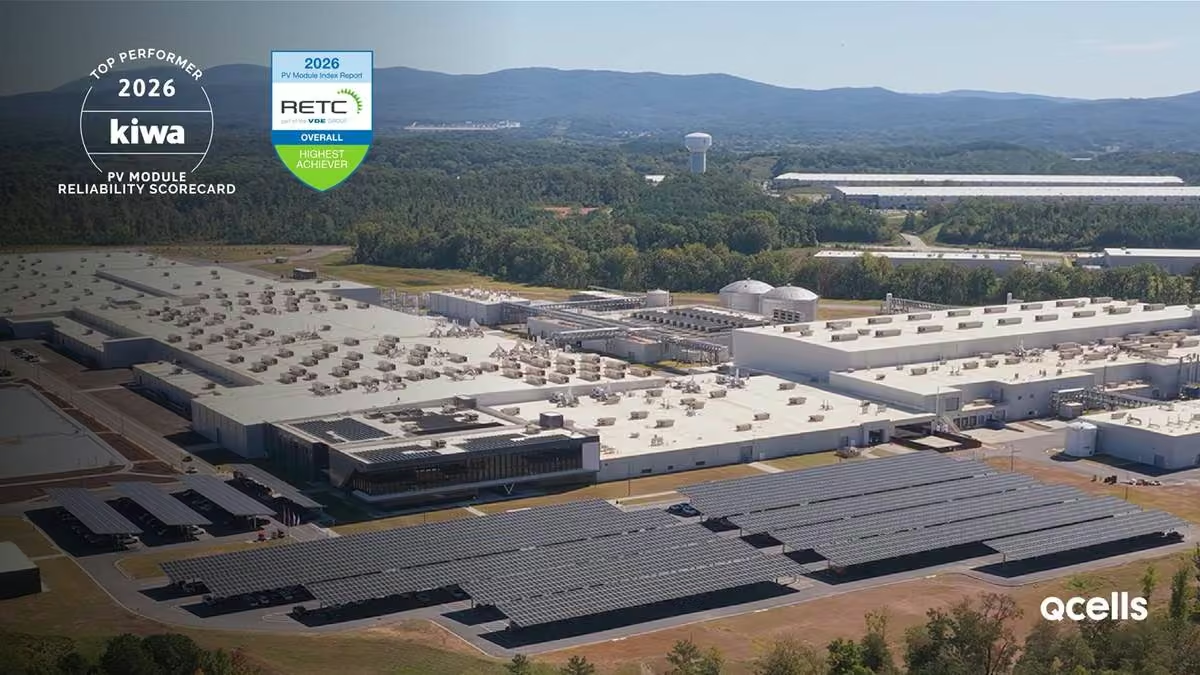
Hanwha Solutions is navigating these shifts through its manufacturing operations in Cartersville and Dalton, Georgia.
The Cartersville site is being developed as a hub for a localized production chain that spans the entire value chain, from raw solar materials to ingots, wafers, cells, and finally modules. Meanwhile, the Dalton facility focuses specifically on module assembly. Cells are the components that convert sunlight into electricity, and modules are the finished products created by assembling multiple cells.
A higher proportion of locally sourced components reduces tariff exposure and enhances eligibility for benefits reserved for U.S.-made products.
During its third-quarter earnings call on the 29th of last month, Hanwha Solutions stated that it had finalized sales contracts for the 2027 production volume of modules from Cartersville that meet U.S. component requirements, and was in the process of contracting for 2028 volumes. The company also cited instances where unit prices in gigawatt-scale contracts had risen by more than 10%.
However, because existing contracts and inventory levels are already in place, there is a lag before market price increases are reflected in revenue. The 105.1 billion won operating profit reported for the renewable energy segment in the third quarter also includes tax credits and profits from power generation operations.
OCI Holdings is prioritizing a non-China supply chain that covers the full spectrum from raw materials to finished modules.
The company produces solar-grade polysilicon at its OCI Terash plant in Malaysia and is advancing a wafer business at NeoSilicon in Vietnam, which processes the polysilicon. Wafers are thin silicon sheets produced in the stage immediately preceding cell manufacturing.
OCI Terash has secured offtakers for production volumes equivalent to its existing annual capacity of 35,000 tons through 2029. Third-quarter sales volumes at the facility increased by 45% compared to the previous quarter.
NeoSilicon has supplied initial wafer shipments to U.S.-bound cell manufacturers from its 2.7 GW annual production facility, with plans to begin shipping long-term contract volumes starting in the first quarter of next year. The company targets an annual production capacity of 11.5 GW by 2029. Additionally, Mission Solar Energy, an affiliate operating a module business in Texas, recorded a recovery in residential sales during the third quarter.
Consequently, the shortage of local upstream supply capacity has emerged as a critical variable. Upstream refers to the stages of manufacturing polysilicon, ingots, wafers, and cells that occur before final product assembly.
According to Rhodium Group, as of the third quarter of this year, the United States had an annual module production capacity of 65 GW, but capacities for cells, wafers, and polysilicon stood at only 20 GW, 3 GW, and 10 GW, respectively. This structure means that even if sufficient module factories are built, the necessary components and raw materials must still be sourced from external suppliers.
Industry sources noted that module prices in the United States have been rising gradually due to measures such as Section 232, and that benefits for domestic module manufacturers are expected to materialize incrementally. The source emphasized that securing upstream production infrastructure and stabilizing supply chains within the U.S. will be critical going forward.
On the other side of the price increase, power developers face mounting cost pressures. A $0.10 per watt increase in module prices translates to an additional $10 million in procurement costs for a 100-megawatt facility. The North American solar power purchase agreement (PPA) price index from intermediary LevelTen Energy also rose 4.9% in the third quarter compared with the previous quarter.
Factors beyond module pricing are also at play. The U.S. Solar Industries Association assessed that short-term installation volumes would see limited disruption thanks to secured materials, but noted that the economic viability of new projects remains a concern.
For domestic firms, the extent of any real benefit will depend not only on price trends but also on supply chain security and the ability to sustain local demand.
Pvola take
The 43.4% surge in imported module prices fundamentally alters the economics of US solar procurement. By eroding the price advantage of low-cost imports, the policy shifts competitive leverage to manufacturers with established US production facilities and diversified, non-Chinese supply chains.
Frequently asked questions
How did Section 232 measures under the U.S. Trade Expansion Act affect solar module prices in the fourth quarter?
Imported solar module prices surged by 43.4% to $0.380 per watt, while the median U.S. price rose 35.1% to $0.385 per watt. This sharp increase is directly attributed to the minimum import price regulations effective December 4.
What is the current median price for U.S. solar modules and how has it changed since July?
The median price for U.S. solar modules is now $0.385 per watt, representing a 35.1% increase from approximately $0.285 per watt in July. This data comes from a fourth-quarter price survey conducted by the supply chain platform Anza.
How are Hanwha Solutions and OCI Holdings positioned to benefit from the rising U.S. solar module prices?
Hanwha Solutions and OCI Holdings are expected to benefit because they operate U.S. production facilities and maintain non-Chinese material supply chains. However, the extent of their profit gains depends on securing a stable supply chain and sustaining local demand.