JR East Installs 5.28 kW Perovskite Film at Shinagawa Station
The short answer
JR East will deploy a 5.28 kW perovskite solar film array at Shinagawa Station starting in fiscal 2027. This pilot installation allows the operator to test lightweight cell performance in a live railway environment, expanding beyond conventional panel limitations.
Key facts
- Area
- 69 square meters
- Technology
- Film-type perovskite solar cells
- Status
- Pilot installation scheduled for fiscal 2027
- Partner
- Sekisui Solar Film
JAPAN: JR East will install film-type perovskite solar cells at Shinagawa Station, a 5.28 kW array of 48 modules on a platform roof due to power lighting from fiscal 2027.
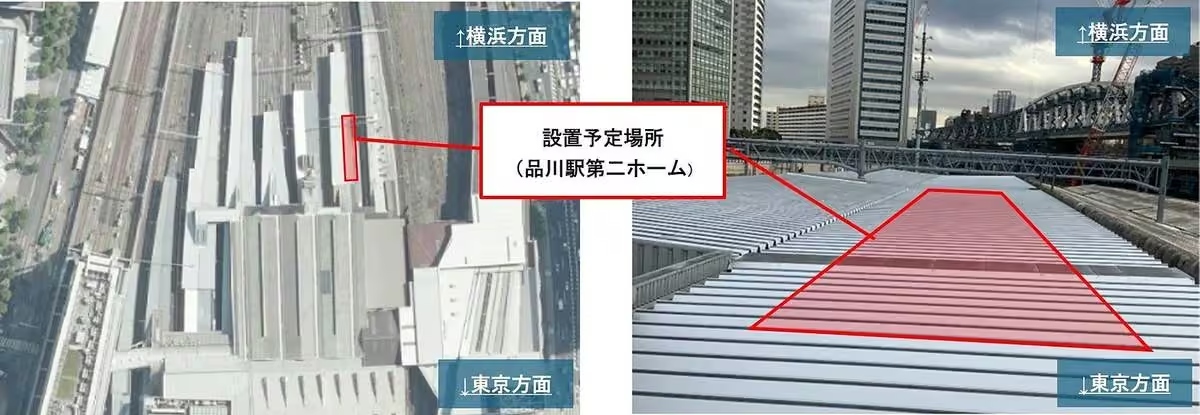
East Japan Railway Company (JR East) will fit the modules to the roof of Platform 2 at Shinagawa Station, which serves Tracks 3 and 4 . The film, made by Sekisui Solar Film, will cover 69 square meters. JR East expects about 5,800 kWh of output a year once use begins in the first half of fiscal 2027, the April–September 2027 period in the company’s calendar.
JR East plans to use the electricity at the station for platform lighting, plus lighting and power outlets in the platform office. JR East calls the project the first full-scale installation of perovskite cells at its railway facilities.
What JR East wants to learn on the Shinagawa roof
JR East plans to measure how the cells generate power in a working railway setting, how practical they are to install and how well they cope with conditions at the site. The results, together with progress in the technology, will feed into a review of other railway assets, station platform roofs among them.
The company has already added solar generation at stations and rolling stock depots under its Zero Carbon Challenge 2050 long-term environmental goal. Conventional panels, however, are heavy and need space. That limits where they can go. Lightweight, flexible film cells are expected to reach places that conventional modules cannot.
The installation was selected under a fiscal 2026 subsidy program for perovskite solar cell deployment, in its equipment installation category. Japan’s Ministry of the Environment, the Ministry of Economy, Trade and Industry (METI) and the Ministry of Land, Infrastructure, Transport and Tourism (MLIT) run the program jointly.
Subsidy conditions for film-type perovskite projects
The Ministry of the Environment’s fiscal 2026 call for equipment installation projects set three main conditions: a mounting surface rated for loads equivalent to 10 kg per square meter or less, at least 5 kW of capacity per facility, and a site close to demand with self-consumption of 50% or more. At 5.28 kW, the Shinagawa array sits just above that minimum. The Agency for Natural Resources and Energy says ¥7 billion is budgeted for the program in fiscal 2026 , including planning support, after five model projects were selected in fiscal 2025. The government’s next-generation solar strategy targets about 20 GW of these cells by 2040.
From a 100 W trial at Hakata to 5.28 kW at Shinagawa
The nearest precedent is at Hakata Station in Fukuoka. Kyushu Railway Company (JR Kyushu), EneCoat Technologies and JGC Corporation began a trial on a Platform 2 roof there on October 21, 2025, which the partners described as Japan’s first on a station platform roof. The test unit is around 100 W, with a 3 kW-class mockup beside it.
JGC’s project report says the work had to fit a short overnight window and was finished in time using modules pre-assembled on pipe frames and fixed to the folded-plate roof. The Shinagawa array has roughly 50 times the capacity of the Hakata test unit and will supply station loads, while Hakata collects output and durability data. JR East has not said how its modules will be mounted or when the work will take place.
Shinagawa will be a working power supply about 50 times the capacity of the Hakata test unit, while Hakata remains a data-gathering trial. Sources: JR East release, November 26, 2026 , and JGC project report on the Hakata trial . The ratio is an editorial calculation (5.28 kW ÷ about 0.1 kW); Hakata capacity is given only as approximate.
Sekisui Solar Film’s 100 MW line
Sekisui Chemical owns 86% of Sekisui Solar Film, founded in January 2025, and the Development Bank of Japan holds the other 14%. In a February 2026 presentation to a government working group , it said its 100 MW line at the former Sharp plant in Sakai, a ¥90 billion investment, was scheduled to start operating from April 2027, with a gigawatt-class line targeted by 2030. In its results presentation of October 30, 2026 , Sekisui Chemical put the start of product supply from the Sakai line in the first half of fiscal 2027, the same period in which JR East plans to begin using power at Shinagawa.
Pvola take
This project shifts perovskite validation from lab metrics to operational reliability in a high-traffic transit hub. By targeting self-consumption for station lighting, JR East addresses the weight constraints that limit conventional PV deployment on existing infrastructure. The 5.28 kW scale provides a critical benchmark for future large-scale railway adoption.
Frequently asked questions
What is the capacity and location of the perovskite solar installation planned by JR East at Shinagawa Station?
JR East plans to install a 5.28 kW array of 48 modules on the roof of Platform 2 at Shinagawa Station. The system will cover 69 square meters and is expected to generate approximately 5,800 kWh annually once operational.
When is the perovskite solar array at Shinagawa Station scheduled to begin generating electricity for platform lighting?
The system is scheduled to begin operation in the first half of fiscal 2027, which corresponds to the April–September 2027 period. JR East intends to use the generated power for platform lighting and office power outlets.
How does the Shinagawa perovskite project align with Sekisui Chemical's manufacturing timeline for its new production line?
Sekisui Chemical expects to begin product supply from its 100 MW Sakai line in the first half of fiscal 2027. This timeline coincides with JR East's plan to start using power from the Shinagawa installation during the same period.