Germany: Battery Storage: Deadline Puts Municipal Utilities Under Time Pressure
Key facts
- Final investment decisions for new battery storage systems in Germany must be completed by the end of 2026 to maintain grid fee exemption
- Project developers must prove to grid operators by March 31, 2027, that final investment decision criteria for fee exemption have been met
- Münster Stadtwerke submitted a coherent measurement concept to the grid operator to document the calculation for their battery storage exemption
- Fluence reports a market split where some projects accelerate to meet deadlines while others slow down due to inability to reach final investment decisions
To remain exempt from grid fees, final investment decisions for new battery storage systems must be made by the end of the year. The first consequences are now emerging.
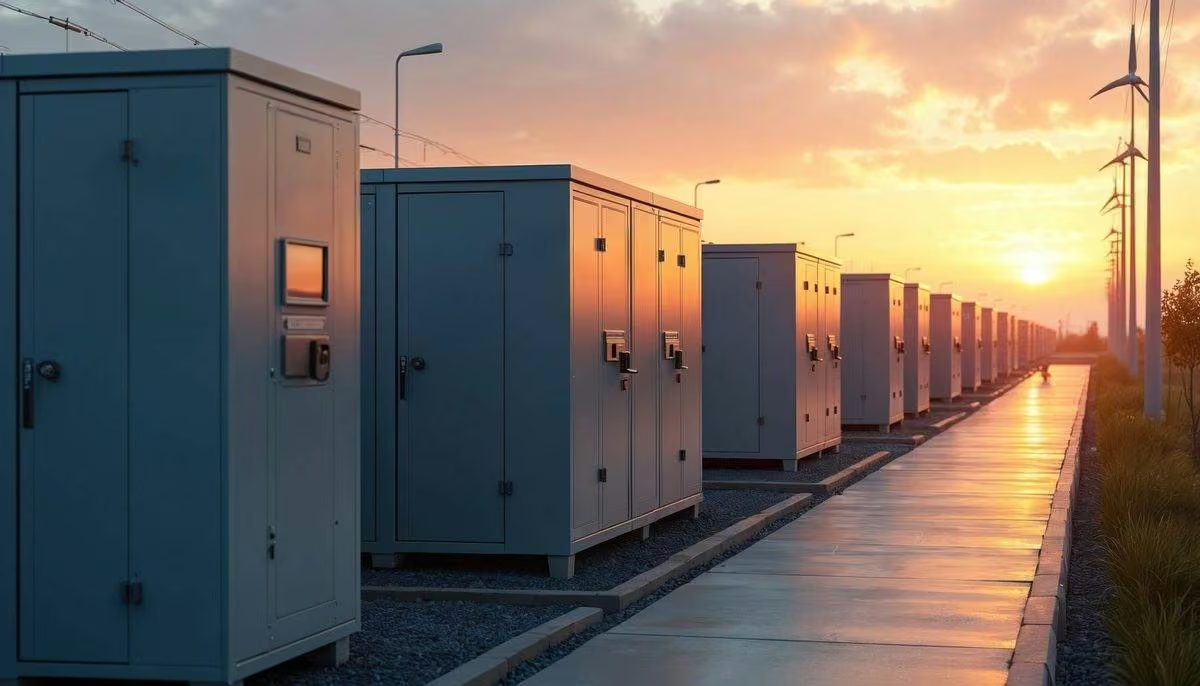
Exemption from grid fees is crucial for the cost calculation of battery storage projects. (AI-generated symbolic image)
For a long time, it was unclear whether battery storage systems would immediately lose their grid fee exemption. In May, the situation was clarified: the protection of legitimate expectations for battery storage systems will remain in place for the time being. However, this exemption is subject to a condition: the final investment decision (FID) must be made by the end of 2026. This requirement has implications for ongoing storage projects, including those of municipal utilities.
"On one hand, there are projects that are pressing the gas pedal," says Julian Jansen, Vice President and Managing Director at Fluence, a battery storage provider. "On the other hand, there are projects that cannot reach an FID by the end of the year and may therefore proceed somewhat more slowly."
Two Speeds in the Market
Fluence is primarily observing one trend: "What we are definitely noticing is a concentration of demand, as all projects that are sufficiently advanced in the development process are currently accelerating their path toward final investment decision (FID)."
According to Jansen, the decision hinges on three prerequisites: "For a final investment decision, I need a building permit, a secure grid connection, and fixed supply contracts – for the storage system as well as for other components. If any of these are missing, I cannot make a final investment decision."
This is currently creating two groups: mature projects are pushing forward with investment decisions. Projects that do not reach FID by the end of the year are slowing down or abandoning the grid fee exemption altogether. Jansen comments: "This separates the wheat from the chaff."
The ZFK inquired with various municipal operators about how the time pressure is affecting their projects. Three central points of conflict have emerged in the process.
Grid connection: A problem for everyone
Grid connection is a bottleneck for all projects, whether privately owned or municipally operated. This is evident, for example, at the Stadtwerke Münster: For a battery storage system, they made the investment decision in spring 2026 and placed the order. The storage system is scheduled to come online in the third quarter of 2027 and is expected to be exempt from grid fees.
For a second project, however, the grid connection approval is still pending. As a result, no components can be ordered this year. The storage system is planned to come online in the first quarter of 2029 and will have to pay grid fees. "The grid connection and communication with the grid operator have been very protracted for one of the two projects," reported the Stadtwerke Münster.
Protracted decision-making: Municipal utilities at a disadvantage
A particular challenge for municipal utilities is the protracted decision-making process of their governing bodies and supervisory boards. In June 2026, Stadtwerke Speyer published the supervisory board’s resolution for a battery storage project. The investment is estimated at approximately 8.5 million euros, and a site has already been secured. The project is scheduled for completion in 2027.
However, prior to the final investment decision, certain corporate and organizational prerequisites must still be met: Additional resolutions by the governing bodies and the involvement of the regulatory authority have not yet taken place. “Since these steps are still pending, we currently assume that the order for the battery storage system cannot be placed within this calendar year,” a Stadtwerke spokesperson said.
Proofs to the grid operator: Unclear rules
A third bottleneck for storage projects is the documentation required for the grid operator. By no later than March 31, 2027, project developers must prove to the respective grid operator that the FID criteria for grid fee exemption have been met.
Münster Stadtwerke reports that they had to submit a coherent measurement concept for the exemption. This allowed the grid operator to document calculation formulas and clearly delineate self-consumption. This process was protracted: "Several coordination meetings with the grid operator were necessary, as the clarity for both parties was not entirely unambiguous," a spokesperson for the Stadtwerke explains.
The Stadtwerke cooperation Trianel is already well advanced in the implementation of the Waltrop battery park. The final investment decision was made in June, and the key components have been ordered. Construction work has been underway since the end of August. Commissioning is scheduled for the second half of 2028.
According to Trianel, the specific documentation required is not yet fully clarified. The company stated that it is in close communication with the relevant grid operator. Nevertheless, Trianel expressed confidence: "We currently assume that the data protection regulations will apply and that the exemption from grid fees will continue to be in effect."
Industry demands clarifications on compliance evidence
The Association of Municipal Utilities (VKU) also views the incompletely clarified proof requirements as an obstacle. The association considers it appropriate for the grid operator to initially review the proofs, provided the criteria are clear and practical.
The VKU holds the Federal Network Agency responsible for setting the standards, "ideally with a comprehensive list of acceptable proofs and a standardized form," a spokesperson explained. "It remains unclear which costs count toward the investment volume and whether a general contractor agreement qualifies as a binding order," the spokesperson added.
Read more about this here: New uncertainty regarding storage exemption
Jansen of Fluence also sees a need for clarification from the regulatory authority: "The current regulatory situation remains uncertain, as only a draft from the Federal Network Agency is available to date." However, he advises his clients to align with the requirements outlined in the draft to ensure that the FID criteria are truly met.
Where municipal utilities are in a strong position
Not all FID criteria are difficult for municipal utilities to meet. They have a clear advantage when it comes to land. The project in Speyer, for example, uses its own site. Financing and components are also not an issue, according to the statements available: Stadtwerke Münster and Trianel have ordered their components or begun construction work.
The exemption from grid fees will be maintained, but only for projects that make a final investment decision by the end of 2026: Those who have already secured grid connection and ordered components remain in the race. For other projects, the exemption is uncertain or will be revoked. It is still unclear how many municipal projects will meet the deadline.
Get unlimited access to all ZFK content!
✓ Full access to all ZFK articles and the digital ePaper ✓ Exclusive analyses, background information, and interviews from the industry ✓ Daily industry briefings with the latest developments
Do you already have a subscription?
You can activate online access to your existing ZFK subscription here.
Spotted an error? Want to share your thoughts? Feel free to contact our editorial team at [email protected].
More on Energy
RWE is testing a hydrogen turbine – Sugar production using biomethane
District heating, battery storage, solar expansion, power grids: ZFK keeps the municipal energy sector up to date on the latest developments.
The EU's exit from Russian gas
In October, only a single Russian LNG cargo was discharged at a European terminal. Russian LNG is already seeking routes to the East, writes Joachim Endress in his column.
Despite a surplus in gas: Why energy consumption is likely to decline in 2026
The experts from the Working Group on Energy Balances cite two main reasons. In particular, one energy carrier is experiencing losses.
Pvola take
The strict 2026 deadline creates a binary risk environment for storage developers, forcing immediate capital allocation to secure fee exemptions. Projects that cannot finalize investment decisions by year-end face significant cost increases, as the loss of grid fee protection directly erodes project economics. This regulatory certainty, while beneficial for long-term planning, accelerates the need for rapid execution and documentation to avoid financial penalties.
Frequently asked questions
What is the deadline for final investment decisions to maintain grid fee exemptions for battery storage in Germany?
The final investment decision must be made by the end of 2026 to remain exempt from grid fees. This requirement creates a split in the market, with some projects accelerating while others slow down due to inability to meet the deadline.
What documentation must project developers provide to grid operators by March 31, 2027, regarding battery storage exemptions?
Developers must prove to the grid operator that the final investment decision criteria for grid fee exemption have been met. This includes submitting a coherent measurement concept, as reported by Münster Stadtwerke, to allow the operator to document the calculation.
How does the grid fee exemption deadline impact the project development timeline for municipal utilities in Germany?
The deadline forces municipal utilities to either accelerate their projects or proceed more slowly if they cannot reach a final investment decision by year-end. This pressure is evident in the market, where some projects are pressing the gas pedal while others face delays.