Wafer Prices Fall as Cost Drag Weakens, Inventory Drawdown Continues; Module Prices Expected to Stabilize

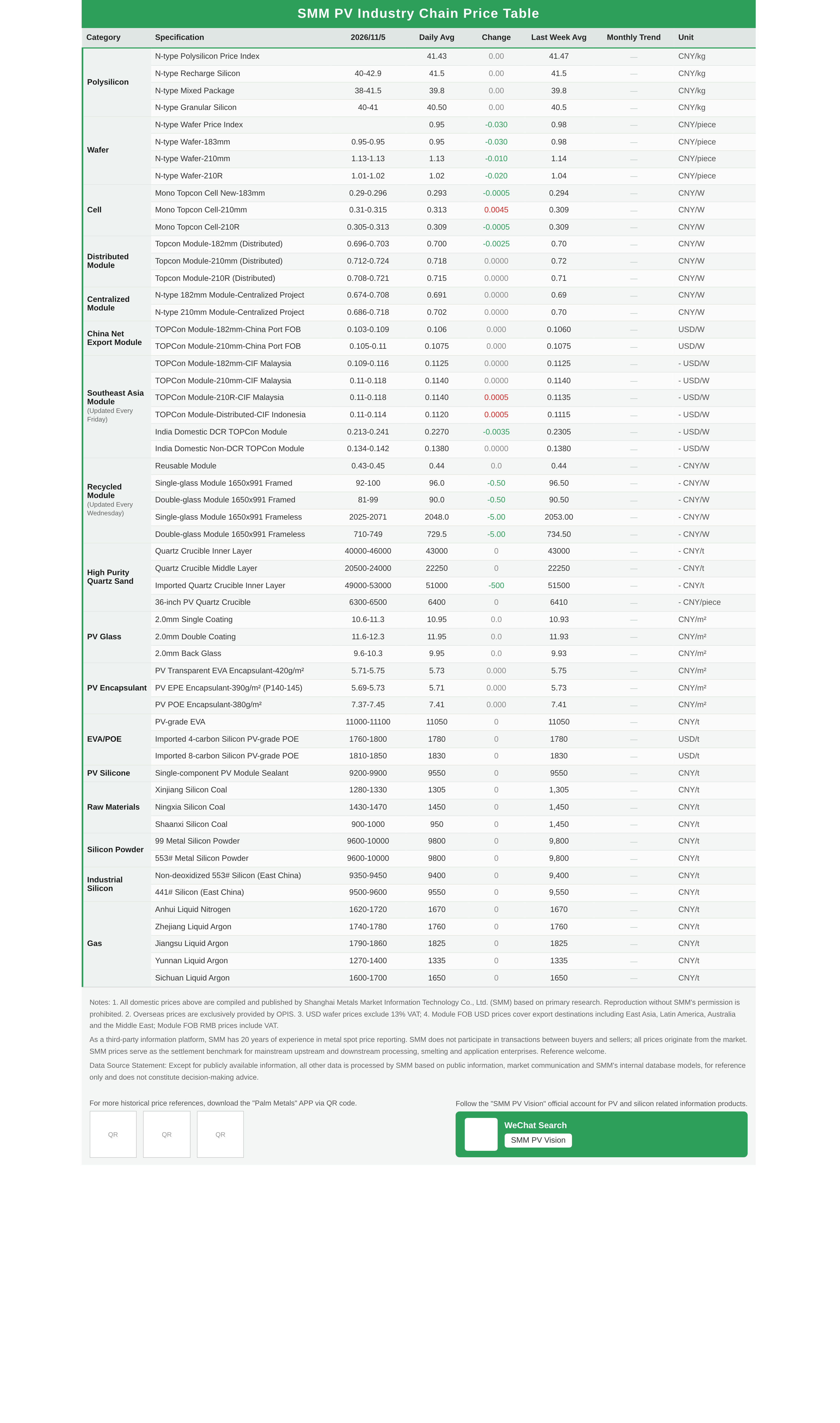
Polysilicon: This week, the polysilicon price index stood at 41.43 yuan/kg, with N-type recharging polysilicon quoted at 40-43 yuan/kg and granular polysilicon at 40-41 yuan/kg. Market quotations remained relatively stable this week, with limited changes. Only a few small transactions were concluded. Futures prices weakened earlier, overall market trading sentiment was subdued, traders showed limited willingness to sell, manufacturers held firm on cost-based quotes, and downstream players mostly stayed on the sidelines, leaving the market broadly stable. China's November production is expected to drop to 85,200 mt, with further production cuts anticipated, which may provide some support to prices. However, more critical factors remain downstream price headroom and the implementation of relevant policies.
Wafer: This week, wafer prices declined again. N-type 183 wafers were priced at 0.949-0.952 yuan/piece, 210R wafers at 1.008-1.022 yuan/piece, and 210mm wafers at 1.126-1.131 yuan/piece. On the supply side, wafer production showed no significant reduction this month, and market inventory remained at a relatively high level, keeping overall supply ample. On the demand side, affected by weakening solar cell purchasing enthusiasm and a pullback in ex-China demand, wafer transactions lacked sufficient support. On the cost side, influenced by subdued sentiment in the futures market, market expectations for future polysilicon prices turned cautious, and cost support loosened somewhat. Wafer prices are expected to remain under downward pressure in the near term, with focus on actual polysilicon transactions, wafer production schedule adjustments, and demand changes for solar cells of different sizes.
Solar cell: This week, solar cell prices diverged: 210N prices rose, 183 saw price cut expectations materialize with prices moving lower, and 210R export orders weakened with the price range revised down. November production continued to see production cuts, though limited in scale, while inventory destocking persisted at a narrowing pace. In terms of prices, 210N performed strongly, with leading manufacturers raising quotations to 0.315 yuan/W and actual transactions concluded at that level. Coupled with a rebound in silver prices over the past two days, both cost and demand provided support. Downstream just-in-time procurement continued, with some enterprises already purchasing at 0.315 yuan/W, while others remained in a wait-and-see stance. In the near term, prices are expected to consolidate on a strong note. The 183 price range was revised down to 0.29-0.296 yuan/W, with price cut expectations materializing amid weak demand. Some leading manufacturers lowered quotations to 0.295 yuan/W, while downstream purchases remained limited and mostly on a wait-and-see basis, leaving prices in the doldrums in the near term. The 210R price range was revised down to 0.305-0.313 yuan/W, with export
Order volumes continued to weaken. Some manufacturers have already reduced new order prices to 0.31 yuan/W, while other mainstream quotations remained unchanged, concentrated in the 0.31–0.32 yuan/W range. In the near term, prices are expected to consolidate on a subdued note, with attention focused on whether Chinese quotations will follow the downward trend. November production is expected to see continued production cuts, albeit on a limited scale, with reductions primarily stemming from integrated enterprises clearing module inventory, lowering scheduled module production, and correspondingly reducing solar cell output. Actual production levels remain to be confirmed as manufacturers finalize their production plans. Inventory continued to decline this week, though the pace of reduction narrowed. Shipments of 210R and 210N modules remained at a normal pace, while demand for 183 modules was weak and destocking progressed slowly. The ongoing inventory drawdown continues to provide support for prices, with attention now shifting to whether price cuts for 183 modules will spread and whether demand can improve.
China Modules: This week, changes in the module market were concentrated at both ends—select specifications saw catch-up price declines while inventory destocking accelerated. On the distributed side, 182mm and HJT modules each fell by 0.0025 yuan/W, while all other specifications held steady and guidance prices remained unchanged. On the centralized side, three-tier quotes were flat for a second consecutive week, with downward pressure further narrowing to select specifications. As of now, the average price of China Topcon modules-182mm (distributed) is 0.6995 yuan/W; Topcon modules-210mm (distributed) average 0.718 yuan/W; Topcon modules-210R (distributed) average 0.7145 yuan/W; Topcon modules-210R high-power (distributed) average 0.754 yuan/W; BC modules-210R (distributed) average 0.763 yuan/W; HJT modules-210mm (distributed) average 0.721 yuan/W. On the centralized side, 182 module prices are 0.691 yuan/W, 210 module prices are 0.702 yuan/W, and 210R module prices are 0.697 yuan/W. Recently, export orders at some top-tier producers have increased, and with November being a concentrated delivery period for centralized projects in China and orders on hand at top-tier producers st
With continued support, module operating rates are expected to remain basically flat compared to October, allowing inventory to be destocked at a reasonable pace. Upstream, 210N solar cell prices continued to rise due to tight spot supply, and the drag from the cost side on modules is weakening. SMM believes that accelerated inventory destocking and a weaker cost drag are forming new support below prices, and module prices are likely to gradually stabilize near current levels in the short term, though the impact of low-efficiency modules on the market still warrants attention. On the inventory side, finished module inventory at producers in China fell sharply to within 25GW, with the single-week destocking volume the largest in nearly two months, also indicating that the pace of centralized project advancement remains relatively fast.
This week, module FOB export prices remained stable across the board, with quotes for standard TOPCon, high-power TOPCon, and BC modules all unchanged, and export guidance prices at major producers also remained unchanged this week. The market exhibited a mix of firm pricing and concessions: some producers expressed intentions to raise prices, but no actual implementation was observed, and higher quotes lacked order support; a few top-tier producers slightly lowered high-end quotes to facilitate deals, while concessions on low-end products still existed. No mainstream large-volume deals were observed during the week, and the transaction center for standard TOPCon remained near $0.106–0.107/W. By technology route, transactions for standard modules remained limited, and some high-efficiency module producers worried that low prices for low-efficiency modules would drag down prices of high-efficiency products. If conventional modules continue to hold prices firm, some enterprises may lower quotes for high-efficiency products to compete for market share, and the premium for high-power TOPCon and BC modules could narrow further. On the cost side, some producers previously insisted on quoting no lower than cost. If silve
As module prices stabilize at low levels, these producers may slightly lower quotes to sell. By market, goods shipped after this week will arrive at European ports at the earliest in late December, coinciding with the Christmas and winter holidays, which may trigger a new round of inventory clearing. Producers have shifted their negotiation focus to deliveries in Q1 next year. Southeast Asia deliveries performed relatively well, but the volume is not enough to offset the decline in European demand. Africa shipments significantly exceeded previous installation-side expectations, making it the main growth market for exports this year. In Australia, the profit margin from distribution to the EPC segment is relatively large, and producers will continue to focus on local distribution channels and tenders for off-grid projects by miners. In the short term, there is still a wave of export orders to markets outside Europe and the US at year-end, but the seasonal cooling of European demand will limit room for quote increases. Module FOB prices are expected to remain in a standoff, with downward pressure on high-efficiency product prices. As of today, PV module export FOB prices are: TOPCon 182mm mo
dules at $0.103-0.109/W, 210mm modules at $0.105-0.110/W, and 210R modules at $0.104-0.110/W; high-power TOPCon 210R modules at $0.109-0.114/W; BC 210R (66/72-cell) modules at $0.110-0.120/W, and BC 54-cell modules at $0.129-0.140/W.
This week, Southeast Asia module CIF prices continued to edge higher, with increases concentrated in low-end quotes: low-end quotes for 210R modules in Malaysia, Thailand, and Vietnam, as well as distributed TOPCon modules in Indonesia, all rose by $0.001/W, while prices for 182mm and 210mm modules and high-end quotes across markets remained flat. Regional delivery pace was relatively ideal, and landed costs continued to support quotes, but transaction volumes were limited. Inventory discounts and low-price order grabbing remained common, and low-priced supply showed no narrowing. As of today, TOPCon module CIF prices in Southeast Asian markets are as follows:
In Malaysia, 182mm module CIF prices are $0.109-0.116/W, 210mm modules at $0.110-0.118/W, and 210R modules at $0.110-0.118/W;
In Thailand, 182mm module CIF prices are $0.108-0.115/W, 210mm modules at $0.109-0.116/W, and 210R modules at $0.109-0.116/W;
In Vietnam, 182mm module CIF prices are $0.106-0.113/W, 210mm modules at $0.107-0.114/W, and 210R modules at $0.107-0.114/W.
By market, Malaysian local PV enterprise Northern Solar announced on November 3 that it secured two PV+ESS power supply contracts under the CRESS framework, supporting two data centers with 100MWac and 89MWac of PV and energy storage respectively, totaling 189MWac. Data center green electricity demand is being converted into concrete projects through CRESS, which is expected to provide growth for Malaysia's subsequent module procurement, but the projects are still in the signing stage, with limited boost to short-term orders. Thailand's household rooftop PV subsidy program opened for registration on October 27, with over 50,000 households registered on the first day. The subsidy applies to 5–10kW household systems, which must complete grid connection before September 30 next year. In response to installers' resistance to the 50,000 baht deposit, Thailand's Ministry of Finance is negotiating with the Small and Medium Enterprise Development Bank to replace the cash deposit with an annual guarantee fee of no more than 500 baht, and has committed to refunding the deposit within 7 days after installation is completed. If the guarantee plan is implemented, participation by small and medi
The proportion of medium-sized installers is expected to increase, and the pace of demand release for household distributed modules in Thailand may accelerate. In the short term, Thailand's household subsidy entering the implementation stage and Malaysia's CRESS projects being signed successively will provide support for regional medium-term demand, while landed costs also provide a floor for quotations. However, Southeast Asia's delivery volume is limited and not enough to offset the decline in the overall export market, and inventory competition within the region will continue. Southeast Asia module CIF prices are expected to remain largely stable at low levels with minor fluctuations, with low-end quotations likely to continue modest recovery, while upside for high-end quotations is limited.
India modules: This week, India DCR and non-DCR module prices diverged. DCR module prices continued to decline, with both high-end and low-end quotations moving down in tandem; non-DCR module prices, after earlier pullbacks, have reached relatively low levels and remained stable this week. As of today, India-made DCR TOPCon module prices were $0.213–0.241/W, and non-DCR TOPCon module prices were $0.134–0.142/W. For DCR modules, year-end local project deliveries provided some demand support, but not enough to absorb high inventory levels. Producers' destocking pressure continued to transmit to transaction prices, with DCR module prices having declined for two consecutive weeks and still facing downward pressure in the short term. For non-DCR modules, after stockpiling demand for the US cooled, non-DCR module prices pulled back earlier, with low-end quotations holding at $0.134/W for three consecutive weeks and no further decline this week. The US has issued affirmative final determinations in both the antidumping and countervailing duty investigations and the injury investigation on Indian PV cells and modules, effectively narrowing the export channel to the US. Producers are shifti
...shifting to other export markets and low-end application scenarios to absorb capacity. Non-DCR module prices are expected to remain largely stable at low levels in the short term, but with external demand lacking growth, rebound momentum is insufficient.
This week, module prices at European warehouses remained broadly stable, but both the high and low ends were under pressure. At the low end, year-end sales promotions and inventory-clearing demand pushed some sub-630W TOPCon inventory to offer larger discounts, squeezing transaction space for standard modules. At the high end, some channels shifted to selling BC products, and high-power TOPCon faced substitution competition, making it difficult to sustain higher premiums. Standard module quotes were only marginally affected by low-end products, mainly thanks to cost support: rising prices of some auxiliary materials such as PV glass, combined with euro exchange rate fluctuations, made suppliers more cautious about locking in prices when taking orders, and some suppliers shortened the validity period of their quotes. On the demand side, end-user procurement pace remained slow, and channels still had limited willingness to actively restock. Year-end cash collection needs and slower winter construction further pushed suppliers to cut prices and clear inventory. In the short term, cost pressure from rising auxiliary material prices provides some support for quotes, but competition from
Low-priced inventory and the substitution effect of BC products have compressed the pricing room for high-power TOPCon, and cost pass-through to transaction prices remains difficult. European warehouse module prices are expected to remain low and rangebound, with inventory products and high-premium products still facing price-cut pressure. As of now, duty-paid ex-warehouse TOPCon module prices in Rotterdam are as follows: distributed 210R (48-cell) modules at EUR 0.1060–0.1147/W, distributed 210R (66/72-cell) modules at EUR 0.1009–0.1112/W; centralized 210R (66/72-cell) modules at EUR 0.0983–0.1085/W, and centralized 210mm (66/72-cell) modules at EUR 0.0985–0.1089/W. Based on average prices by format, warehouse prices in Portugal and Greece are about 2.3%–2.4% higher than in Rotterdam.
End-user: This week, PV modules exhibited a trend of declining prices and increasing transaction volumes. According to SMM statistics, from October 26 to November 1, 2026, Chinese enterprises secured bids for 50 PV module projects, with a weekly weighted average price of 0.69 yuan/W, a decrease of 0.08 yuan/W compared to the previous statistical period. The total awarded procurement capacity reached 6,424.40 MW, an increase of 6,325.17 MW from the previous statistical period.
Based on SMM analysis, the majority of the awarded capacity in the current statistical period fell within the 2,000MW–5,000MW range, accounting for 77.83% of the total disclosed awarded capacity. The breakdown by capacity range is as follows:
The 2,000MW–5,000MW category included 1 project, representing 77.83% of the total capacity, with an average price of 0.665 yuan/W.
According to SMM analysis, the weighted average price in the current statistical period was 0.69 yuan/W, down 0.08 yuan/W WoW. This change was due to fewer awarded projects and lower capacity in the previous statistical period, which did not reflect overall market conditions, while the current statistical period included large-scale framework centralised procurement, with prices better reflecting centralized projects.
In terms of total awarded procurement capacity, the week recorded 6,424.40 MW, an increase of 6,325.17 MW from the previous statistical period.
Regionally, the highest awarded capacity this week was in Beijing, accounting for 77.94% of the total, followed by Shanghai at 15.66%.
In the "China Huadian Corporation Ltd. 2026 Second Batch PV Module Framework Tender - China Huadian Corporation Ltd. 2026 Second Batch PV Module," TCL Zhonghuan New Energy Technology Co., Ltd. won the award for 5,000 MW of PV modules at an average price of 0.665 yuan/W.
In the "Shanghai New Energy 2026-2027 PV Module Framework Agreement (Second Round)," LONGi Solar Technology Co., Ltd. won the award for 1,000 MW of PV modules at an average price of 0.785 yuan/W.
In the "SDIC Power North Bank Economic Development Zone Dongwu Nao Area A Phase II 100 MW Fishery-Solar Hybrid PV Power Station Project PV Module Equipment" tender, Hengdian Group DMEGC Magnetics Co., Ltd. secured the contract for 119.97 MW of PV modules at an average price of 0.748 yuan/W.
PV glass: This week, the increase in PV glass prices widened significantly, with the current round of price hikes first initiated on the quote side. As of November 5, the average price of 3.2mm double-layer coated glass rose to 18.0 yuan/m², and 2.0mm double-layer coated glass rose to 11.95 yuan/m², representing week-on-week increases of 0.25 yuan/m² and 0.40 yuan/m², or 1.4% and 3.5%, respectively. New order quotes for November have risen across the board, supported by continued inventory destocking, sustained production cuts and shutdowns, and firmer fuel costs such as natural gas. However, resistance from the module side remains strong, and actual transactions have not yet fully caught up, leaving a notable gap between quotes and transactions. On the inventory front, glass inventory days fell to around 35 days at the end of October, representing a cumulative destocking of approximately 20% from the mid-year peak. That said, following the rapid increase in quotes, the market is expected to enter a period of intense price negotiation, and the shipment pace may slow down temporarily. SMM believes that November glass prices are expected to consolidate at elevated levels, with a higher likelihood of further increases than declines, though upside potential is limited. The extent to which quotes translate into actual transactions
ons is the key variable to watch.
Film: This week, film pricing ranged from 28,200 to 28,400 yuan/mt. The new round of monthly price negotiations has been settled, with overall pricing slightly lower MoM. On the cost side, upstream PV resin prices are in the doldrums, providing less support for film production costs than earlier. On the demand side, November downstream purchase demand is expected to weaken MoM, with limited buying interest providing little boost to the film market. Film prices are expected to hold steady in the short term, with focus on upstream resin price trends and module production schedules.
EVA: This week, spot prices for photovoltaic-grade EVA ranged from 11,000 to 11,100 yuan per metric ton, with the overall market remaining sluggish. On the cost side, recent pullbacks in oil prices have weakened prior cost support, although raw material prices remain at relatively elevated levels. From a supply perspective, production schedules for photovoltaic-grade EVA in November are expected to contract; however, given weakening downstream demand and the presence of surplus inventory at some enterprises, overall market supply remains ample, making a significant shortage unlikely in the short term. Absent any unexpected geopolitical disruptions, EVA resin prices are expected to remain in a slump in the near term.
POE: This week, China delivered prices for PV-grade POE resin were 12,800-13,000 yuan/mt, edging down WoW. As domestic production facilities gradually release output, domestic supply capability continues to improve and import substitution accelerates, though supply capability still varies by grade. On the demand side, film enterprises continue to purchase mainly on a need-to basis, and with raw material costs and film formulation adjustments, actual POE resin absorption capacity is limited, leaving demand support relatively insufficient. On the cost side, raw material prices provide some support, but the ability to pass costs downstream is limited. POE prices are expected to consolidate on a subdued note in the short term.
High-purity quartz sand: This week, high-purity quartz sand prices remained stable overall, and the softening observed in the previous two weeks did not extend further. Inner-layer sand was priced at 40,000-46,000 yuan/mt, middle-layer sand at 20,500-24,000 yuan/mt, outer-layer sand at 12,000-18,000 yuan/mt, and imported sand spot orders at 49,000-53,000 yuan/mt, all unchanged week-on-week. The only changes occurred on the crucible side: the upper end of the price range for 33-inch crucibles fell by 100 yuan to 5,300-5,500 yuan/piece, and the upper end for 36-inch crucibles also dropped by 100 yuan to 6,300-6,500 yuan/piece, while the lower ends of both did not set new lows. More noteworthy is the shift in supply expectations: November China quartz sand production is expected to begin falling sharply, with oversupply pressure prompting most enterprises to cut or halt production. Meanwhile, sand enterprise inventories are still rising and selling is becoming more difficult, though current storage cycles are relatively lenient and still within tolerable limits for sand enterprises. With production cuts tightening supply on one side and rising inventories increasing selling pressure on the other, the sand market's contradiction is shifting from the price level t
o the inventory level. Given that sand prices are already near cost lines and the upper end of crucible prices is still edging down slowly, SMM expects short-term quotes to likely remain rangebound, with actual transaction flexibility likely to remain greater than quoted levels. The extent of November production cuts will be key to determining whether sand prices can truly consolidate at lows.
Module recycling: Last week, China's PV module recycling market spot prices pulled back slightly.
Early small-format framed modules fell by around 0.5 yuan/unit, with single-glass first-hand prices landing in the 96-110 yuan/unit range, while unframed modules dropped by up to 5 yuan/mt, with single-glass first-hand prices landing in the 2,025-2,071 yuan/unit range. In addition to early small-size modules, large-size prices also trended lower, with framed module prices down by around 0.25-0.5 yuan/unit and unframed modules down by around 3.5-5 yuan/mt.
This price pullback was influenced by the decline in spot prices of key recycled metals. Last week, spot silver prices drifted lower, while aluminum prices continued to consolidate at elevated levels. According to SMM, the #1 silver spot price fell from 13,058 yuan/kg on October 28 to 11,794 yuan/kg on November 4; A00 aluminum prices continued to consolidate at high levels, fluctuating from 23,830 yuan/mt on October 28 to 23,350 yuan/mt on November 4.

Frequently asked questions
What were the specific price ranges for N-type 183 and 210mm wafers in the latest market report?
N-type 183 wafers were priced at 0.949-0.952 yuan per piece, while 210mm wafers were quoted at 1.126-1.131 yuan per piece. These figures indicate a continued decline in wafer prices despite stable polysilicon costs.
How did the polysilicon price index perform this week, and what was the expected November production volume in China?
The polysilicon price index stood at 41.43 yuan/kg with limited changes in market quotations. China's November production is expected to drop to 85,200 metric tons, with further production cuts anticipated to support prices.
What factors are influencing the stability of module prices and the behavior of downstream buyers in the solar market?
Module prices are expected to stabilize at low levels with minor fluctuations, as downstream players mostly stayed on the sidelines. Manufacturers held firm on cost-based quotes, and limited trading activity kept the market broadly stable.