Even the Sun Has Become Expensive in Tunisia: Who Is Blocking the Reduction of Solar Equipment Prices?
Key facts
- Tunisia's peak electricity demand reached 6,000 megawatts during the summer of 2026, causing significant strain and outages across several regions
- Parliamentarians rejected a government proposal to reduce customs duties on solar panels during the debate on the 2026 Finance Law
- The issue of reducing solar equipment tariffs has resurfaced in the draft 2027 Finance Law, with committee members trending toward rejection
- The debate over Articles 49 and 50 of the 2027 draft budget law extends beyond tariffs to broader energy security and grid stability concerns
The electricity crisis that Tunisia experienced during the summer of 2026 was not merely a set of figures recorded by energy consumption indicators, but a genuine test of the power grid’s capacity to meet rising demand, amid soaring temperatures and growing residential and industrial consumption. The country faced significant strain on its electrical network, accompanied by outages in several regions, with peak electricity demand reaching 6,000 megawatts.
This experience should have prompted a fundamental review of energy policy, accelerated investment in renewable energy, and facilitated the acquisition of equipment that allows households and businesses to generate part of their own electricity and store any surplus. However, what is unfolding within the Finance and Budget Committee of the Assembly of the People’s Representatives raises questions about the alignment between these priorities and the legislative options on the table.
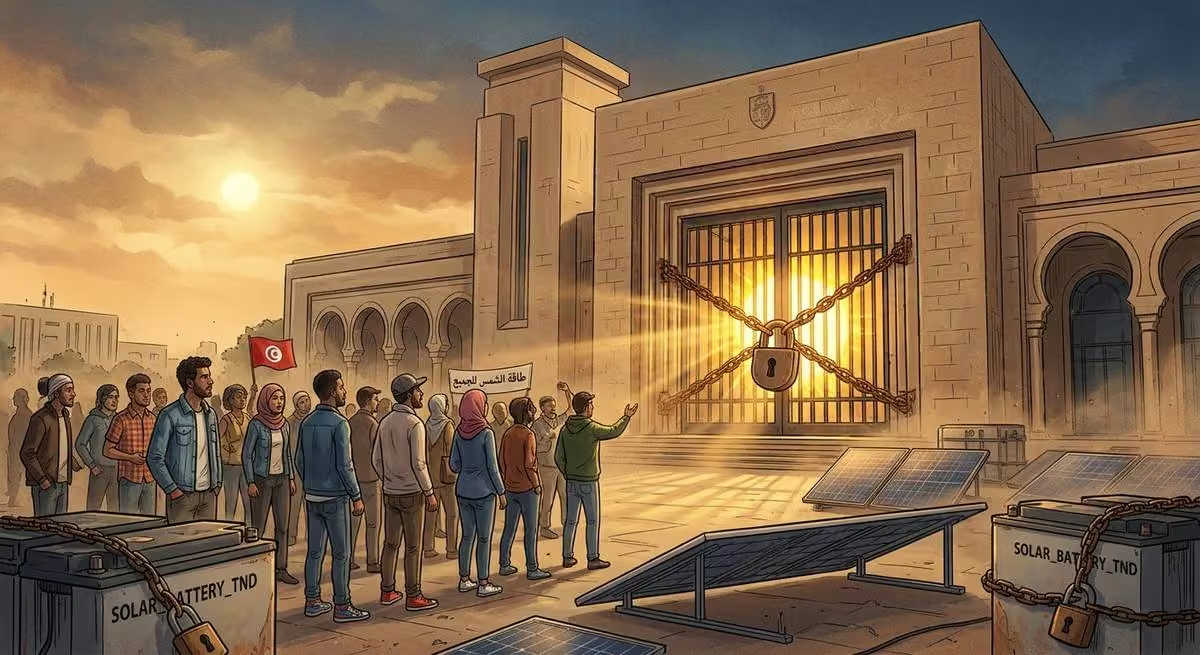
After parliamentarians, during the debate on the 2026 Finance Law, rejected a government proposal to reduce customs duties on solar panels, the issue has resurfaced in the draft 2027 Finance Law, amid a trend among several committee members to reject new measures proposed by the government to lower the cost of investing in solar energy.
This time, it is not just a limited tax adjustment, but a package of measures that is supposed to make solar energy equipment less costly and more competitive.
Article 49 of the 2027 draft Finance Law proposes exempting batteries dedicated to electricity storage from customs duties, value-added tax, and the professional tax paid to the Competitiveness Development Fund. Article 50, on the other hand, stipulates reducing the customs duty on the import of solar collectors from 30 percent to 10 percent.
Consequently, the government once again faces the difficulty of passing tax reductions it deems necessary to encourage investment in this sector, while some deputies insist on the need to protect the local industry and limit the import of such equipment.
The summer crisis exposed the scale of the problem
What makes this discussion even more significant is the context in which it takes place. Tunisia no longer views the solar energy file as an environmental option or a future project, but rather as one of the possible solutions to alleviate the increasing pressure on the electricity production system.
During the hearing on the 2027 budget of the Ministry of Industry, Mines and Energy, Minister Salah Zouari spoke about the goal of reducing electricity demand from approximately 6,000 megawatts to 5,700 megawatts, saving 300 megawatts, through consumption rationalization and changing certain habits, in addition to encouraging industrial enterprises to shift part of their operations to nighttime hours.
He also revealed a trend toward integrating an additional 300 megawatts of renewable energy and establishing a battery-based electricity storage system with a capacity of 300 megawatts.
Here, the importance of both batteries and solar collectors becomes apparent. Electricity production during sunny hours alone is not sufficient to address supply imbalances, unless storage capabilities are available to allow the use of generated energy at other times, particularly during peak periods.
From the 2024 decision to the 2027 challenge
To understand the background of the current controversy, it is necessary to return to the decision made by the parliament in 2024, when it approved, through Article 40 of the Finance Law, an increase in customs duties on the import of solar collectors from 10 to 30 percent, with the decision set to take effect starting January 2025.
When the government proposed in the 2026 Finance Law to reduce this rate from 30 to 15 percent, Article 47 failed to pass the parliamentary debate, and the provision was ultimately dropped despite the Finance Minister’s insistence on the proposal.
Today, the scene repeats itself, with the difference that the government is now proposing a return to a 10 percent rate, alongside exempting batteries from a series of fees and duties.
Between the two attempts, the expected progress in the energy transition has not materialized. Data circulating about the sector speak of approximately 600 megawatts of installed capacity, including around 200 megawatts on residential rooftops and 110 megawatts in the industrial sector, while other projects remain stalled.
The issue of tenders also poses additional difficulties, as circulating figures indicate the existence of approximately 1,200 megawatts of troubled projects, including 300 megawatts at risk of non-completion due to administrative procedure delays and investors’ threats to halt their projects.
Protecting the local industry or imposing additional costs on consumers?
On the other hand, those opposing the proposed reductions rely on the argument of protecting domestic products, arguing that reducing tariffs on imported equipment could weaken Tunisian companies active in the manufacturing of solar collectors and batteries.
This position warrants discussion, but protecting local industry cannot be an isolated objective detached from the other elements of the equation, nor can it become a reason to keep equipment costs high for citizens and industrial enterprises.
The question that arises is: what is the actual contribution of the Tunisian industry to meeting market needs? Does it have the capacity to provide the required quantities and specifications to keep pace with the expected expansion of solar energy projects? Are there studies proving that maintaining current tariffs will lead to the development of local production, or will the result primarily be an increase in investment costs and a delay in the spread of this technology?
Moreover, the debate should not be limited to solar collectors, as electricity storage has become an essential part of the energy transition equation. Consequently, keeping battery costs high could also limit the viability of investing in solar power generation.
The summer of 2026 has revealed that Tunisia’s energy security can no longer afford to postpone decisions or treat renewable energy as a secondary issue. From this perspective, the debate over Articles 49 and 50 of the 2027 draft budget law goes beyond the reduction of customs duties, reaching a broader question about how the country is preparing for the coming years and protecting its citizens and institutions from a recurrence of electricity supply crises.
Pvola take
Legislative hesitation on tariff reductions creates a significant barrier for solar developers and investors in Tunisia. By maintaining high import costs for panels, the state undermines the economic viability of distributed generation projects that could alleviate grid stress. This policy misalignment signals that regulatory risk remains a primary concern for stakeholders seeking to scale renewable energy infrastructure in the region.
Frequently asked questions
Why did the Tunisian parliament reject the proposal to reduce customs duties on solar panels in the 2026 Finance Law?
The Finance and Budget Committee rejected the government's proposal to lower import tariffs on solar equipment. This decision contradicts the need to accelerate renewable energy investment following the severe electricity crisis experienced in the summer of 2026.
What was the specific change to solar collector import duties approved in the 2024 Tunisian Finance Law?
Article 40 of the 2024 Finance Law increased customs duties on imported solar collectors from 10 percent to 30 percent. This regulatory change was set to take effect starting in January 2025, significantly raising the cost of imported solar hardware.
How does the current legislative stance on solar tariffs impact developers and investors in the Tunisian market?
The rejection of tariff reductions creates a higher cost barrier for acquiring solar equipment, which may deter investment in distributed generation projects. This policy environment complicates efforts to reduce reliance on the strained national grid and meet rising residential and industrial demand.