Germany: PV subsidy ends in 2027: Bundestag votes on November 9
Key facts
- The German Bundestag is scheduled to vote on the EEG amendment on November 9, 2026, to phase out fixed feed-in tariffs for new solar installations
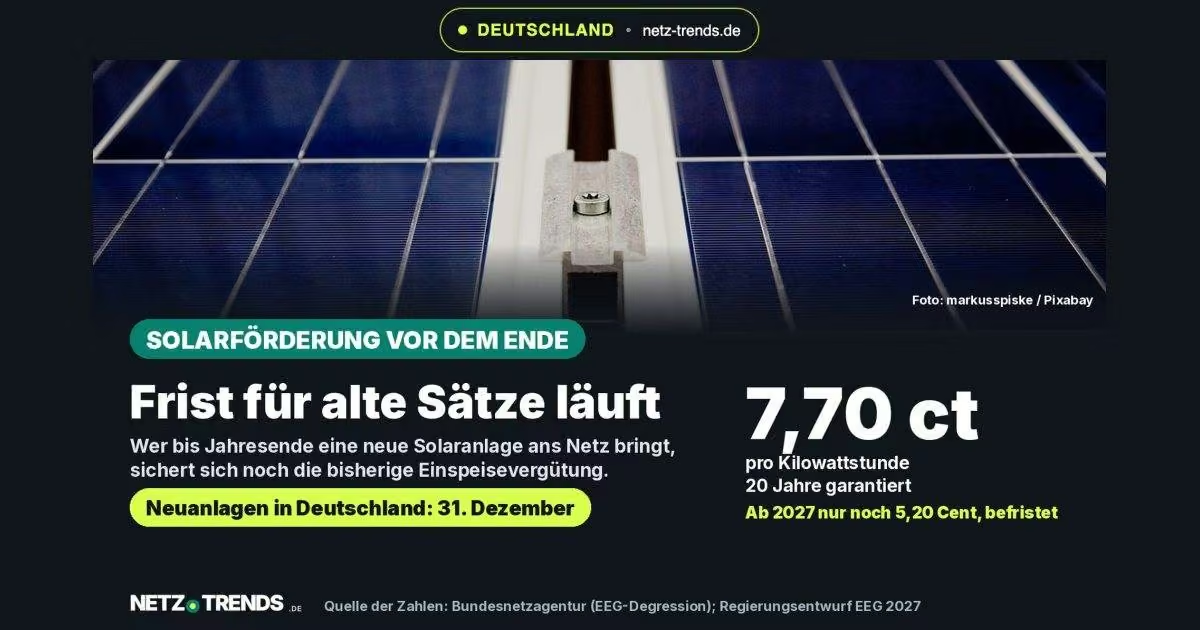
- Homeowners connecting solar systems to the grid by December 31, 2026, can secure a feed-in tariff of 7.70 cents per kilowatt-hour for 20 years
- Starting in 2027, the feed-in tariff for new solar installations will decrease to 5.20 cents per kilowatt-hour, marking a significant reduction in guaranteed revenue
- The draft legislation eliminates permanent subsidies for new rooftop solar systems under 25 kilowatts that connect to the grid without a tender process from 2027 onward
Homeowners who connect their solar systems to the grid by December 31 will secure a feed-in tariff of 7.70 cents per kilowatt-hour for a period of 20 years. Starting in 2027, this rate will decrease to 5.20 cents.
Key points at a glance
The German Bundestag is set to phase out the fixed feed-in tariff for new solar installations later this month. Under the government’s draft legislation, those seeking to lock in the current, significantly higher rates have until the end of the year to do so.
The move is grounded in the Renewable Energy Sources Act (EEG) amendment, which the federal cabinet approved on July 29, 2026. The legislation terminates the fixed feed-in tariff for wind, solar, and biomass facilities, mandating that new installations instead engage in direct marketing of their electricity. Existing installations will continue to receive the subsidies they were originally guaranteed.
The timeline for the law’s enactment had remained uncertain for some time, as the second and third readings in the Bundestag were postponed in October due to disagreements among coalition partners. According to the Federal Association of Renewable Energy (BEE), the vote is now scheduled to take place during the parliamentary session week from November 9 to 13.
The German federal parliament will hold a vote on November 9 regarding the termination of the photovoltaic subsidy program in 2027.
The draft legislation for the Renewable Energy Sources Act (EEG) amendment and the accompanying grid connection package entered its first reading in the German Bundestag on September 24, 2026. A hearing followed in the Committee for Economics and Energy on October 5, during which several experts criticized the proposal, raising specific concerns regarding small-scale photovoltaic systems and the transitional provisions.
The second and third readings, which were anticipated for mid-October, were cancelled due to "significant differences" among the governing parties. The Federal Association of Renewable Energy (BEE) now identifies the parliamentary session week from November 9 to 13 as the most likely timeframe for the vote, with the Bundesrat potentially following on November 20. The association also warns that the remaining time is tight.
"This package drives a paradigm shift in the renewable energy sector. We remain committed to the 80 percent target for 2030 and to the ambitious expansion pathway."
Katherina Reiche (CDU), Federal Minister for Economic Affairs and Energy (BMWE)
During a hearing held in early October, legal scholar Thorsten Müller proposed that the European Commission grant Germany a temporary, short-term state aid approval for the existing Renewable Energy Sources Act (EEG) 2023. This measure would serve as a contingency should the authorization for the EEG 2027 not be secured in time.
The current rate stands at 7.70 cents.
Under the statutory step-down mechanism of the current Renewable Energy Sources Act (EEG), small rooftop systems with a peak capacity of up to 10 kilowatts peak (kWp) will receive a feed-in tariff of 7.7022 cents per kilowatt-hour for partial grid injection starting August 1, 2026, which rounds to 7.70 cents. For systems that feed their entire electricity output into the grid, the rate is 12.2166 cents. According to the Federal Network Agency, these rates apply to installations commissioned by January 31, 2027, and are guaranteed for 20 years from the date of commissioning.
This rate has already been declining in stages under the existing EEG, with the most recent reduction of one percent taking effect on August 1, 2026, irrespective of the upcoming legislative changes. The 2027 EEG amendment is designed to completely replace this ongoing step-down mechanism for new installations once it enters into force.
What is set to change in 2027
Under the government’s draft legislation, the fixed feed-in tariff for new wind, solar, and biomass installations is set to expire. New facilities will be required to sell their electricity directly on the market rather than delivering it to grid operators at a guaranteed rate. To facilitate this transition, the proposal includes a temporary transitional payment.
For solar systems with a capacity of less than 25 kilowatts, which constitute the majority of private rooftop installations, the draft eliminates permanent subsidies entirely. This change applies only to new systems that connect to the grid without a tender process starting in 2027. According to consistent calculations by several solar industry portals based on the draft text, the transitional payment is expected to be approximately 5.20 cents per kilowatt-hour, valid for 36 months from the date of commissioning. For systems under 25 kilowatts, an optional bonus of roughly 1.5 cents for direct marketing is also under discussion, potentially lasting up to 48 months. The federal government has not officially specified these rates in its press release, as the law has not yet been enacted.
The existing protection for installed capacity will remain unchanged: systems that are connected to the grid before the cutoff date will retain the compensation rate in effect at the time of commissioning for their entire operational life, regardless of any subsequent legislative decisions.
Unresolved issues persist through the end of the year
Two deadlines are converging. The first is political: the European Commission’s state aid approval for the current Renewable Energy Sources Act (EEG) 2023 expires on December 31, 2026. The EEG 2027 is scheduled to enter into force on January 1, 2027, a timeline that requires the German Bundestag to pass the legislation in a timely manner and the European Commission to grant state aid approval for the new subsidy scheme without delay. According to the industry association, neither of these conditions is currently guaranteed.
The second deadline is practical. Industry portals indicate that ordering a solar system now entails a lead time of three to six months for material delivery and system registration. Consequently, those aiming to meet the December 31 cutoff should place their orders immediately rather than waiting until the final month of the year.
Model calculation: Rooftop system with 5,000 kilowatt-hours of grid feed-in per year
NETZ-TRENDS’ own calculations, based on Federal Network Agency rates and the transitional payment reported in the government draft, as of November 7, 2026, do not constitute an official forecast. Actual feed-in volumes depend on system size, location, and self-consumption; whether the transitional payment will be enacted at precisely this level remains uncertain.
The difference appears manageable in the first year but grows with each subsequent year: missing the deadline means losing not just a lower rate for three years, but a 20-year guarantee in favor of open market risk.
Checklist: What needs to be done now
The federal government is also scaling back state support for energy transition measures within private homes. As previously reported, financial assistance for new heat pumps will be reduced in several stages starting in February 2027. Individuals planning to implement both types of systems should monitor the deadlines for both programs.
Frequently Asked Questions
The Federal Association of Renewable Energy anticipates that the Bundestag will vote on the matter during the parliamentary session scheduled from November 9 to 13, 2026, with the Bundesrat following on November 20. No officially confirmed date was available at the time of research.
Existing installations will retain the guaranteed compensation rates agreed upon at their commissioning for the full duration of their contracts. The proposed changes apply exclusively to new systems.
For small rooftop installations up to 10 kWp, the rate has been 7.70 cents per kilowatt-hour (partial feed-in) since August 1, 2026, guaranteed for 20 years. The government draft stipulates that this rate will apply to systems commissioned by December 31, 2026.
A gap in coverage is expected at the turn of the year, as the authorization for the Renewable Energy Sources Act 2023 expires on December 31, 2026. An expert suggested during the Bundestag hearing that the European Commission should grant Germany a short-term transitional authorization. No decision on this matter had been made at the time of research.
If you are planning a solar installation and wish to utilize the deadline before the end of the year, please share your experiences in the comments.
Sources and status
Research and data status: November 7, 2026.
Transparency note: AI-assisted tools were used in the research, structuring, and creation of this article. The sources used are listed within the text. Publication occurs only after manual editorial approval.
Pvola take
Developers and investors must accelerate project timelines to secure the higher 7.70 cent tariff before the 2027 deadline, as the subsequent rate drop to 5.20 cents will materially reduce project economics. The shift toward direct marketing and the elimination of permanent subsidies for small systems increases regulatory and market risk, requiring more sophisticated revenue modeling and off-take strategies to maintain financial viability in the German market.
Frequently asked questions
What is the deadline for German homeowners to secure the current solar feed-in tariff before it decreases?
Homeowners must connect their solar systems to the grid by December 31 to secure the current rate. This deadline is set by the upcoming Bundestag vote on the Renewable Energy Sources Act amendment.
How will the feed-in tariff for new German solar installations change starting in 2027 under the new legislation?
The feed-in tariff will decrease from 7.70 cents to 5.20 cents per kilowatt-hour for new systems. This reduction applies to installations connecting to the grid without a tender process from 2027 onward.
What impact does the termination of fixed feed-in tariffs have on new German rooftop solar projects?
New installations will be mandated to engage in direct marketing of their electricity instead of receiving fixed subsidies. This shift eliminates permanent subsidies for new systems under 25 kilowatts connecting to the grid in 2027.