Dependence on imported fuels drives battery storage in the Dominican Republic

Dominican Republic's reliance on imported fuels drives battery energy storage adoption.
In 2025, coal, natural gas, and petroleum derivatives accounted for 81.1% of national electricity generation, in an isolated system lacking interconnections with neighboring countries.
The National Interconnected Power System (SENI) reached a total installed capacity of 7,120.12 MW by the end of 2025, according to Coordinating Organization data.
Annual generation totaled 26,188 GWh, with steam turbines, combined cycles, and internal combustion engines as the primary production sources.
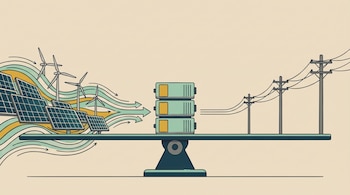
However, renewables are gaining ground. Photovoltaic solar energy already totals 1,580.96 MW of installed capacity, and wind energy 482.15 MW. Together, these technologies account for 29% of the electrical grid, although they contributed 13.5% of generation in 2025. Their growth presents a new challenge: managing production variability and avoiding waste of clean energy when supply exceeds network capacity or instantaneous demand.
At certain times, especially during the afternoons, non-conventional renewable generation can exceed 50% of instantaneous demand.
This situation raises demands on grid frequency and voltage control, two critical variables for maintaining system stability. In a country without regional interconnection, options to balance imbalances are more limited and costly.
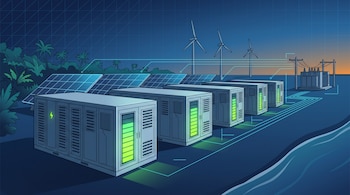
In that context, batteries are emerging as a tool to reduce reliance on imported fuels, better utilize solar and wind energy, and strengthen energy supply security. The Electricity Superintendence (SIE) estimates that a frequency regulation storage system could reduce up to 50% of the cost of that service compared to conventional methods.
Between 2pm 2023 and 2025, the country advanced in establishing a specific regulatory framework for SAEB. The strategy did not await comprehensive reform of Law General of Electricity 125-01, a process that continues via legislative channels, but rather was developed through decrees, resolutions, and technical procedures.
The dependence on imported fuels drives battery storage adoption in the Dominican Republic.
Decree 523-23 paved the way for incorporating battery storage provisions into the electricity law’s implementing regulations. Subsequently, Resolution SIE-136-24-MEM enabled batteries to participate in primary, secondary, and frequency response auxiliary services. This was further supported by regulations authorizing installations, establishing technical requirements, and updating grid connection rules for inverters.
The model separates three dimensions: project authorization, system service conditions, and economic compensation. Batteries can inject or withdraw energy, participate in frequency regulation, and support renewable plant operations, under the supervision of the Coordination Body and the Energy Control Center.
One of the main drivers of investment has been the requirement that all new renewable projects of 20 MW or more incorporate storage equivalent to 50% of their capacity. This measure, established by the National Energy Commission, aims to ensure that solar and wind expansion also contributes to SENI stability.
The reliance on imported fuels drives battery storage in the Dominican Republic.
The progress is already reflected in concrete projects. The first competitive renewable energy tender with storage, EDES-LP-NGR-01-2025, received bids for more than 1,800 MW to meet a demand of up to 600 MW. The process awarded 325,69 MW of new renewable capacity and will incorporate more than 150 MW and 600 MWh of co-located storage.
Additionally, existing renewable contracts will include 138.1 MW of batteries with a four-hour duration, with commissioning expected between March and July 2027. Meanwhile, the Dominican Electric Transmission Company is evaluating the installation of three blocks of 200 MW and 400 MWh at key points in the grid.
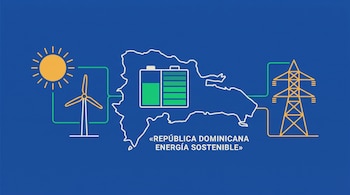
The Dominican Republic’s commitment turns storage into an energy policy component: not only to integrate renewables, but also to reduce exposure to external fuels, lower operational costs, and strengthen the resilience of an island electricity system.
Frequently asked questions
How does the Dominican Republic's heavy reliance on imported fuels influence the strategic adoption of battery energy storage systems?
The country's dependence on imported fuels drives battery storage adoption to reduce external exposure and lower operational costs. This strategy also strengthens the resilience of the isolated island electricity system while integrating renewable energy sources.
What is the current installed capacity for photovoltaic solar and wind energy in the Dominican Republic's National Interconnected Power System?
The installed capacity for photovoltaic solar energy is 1,580.96 MW, while wind energy stands at 482.15 MW. Together, these technologies account for 29% of the electrical grid's total installed capacity.
What specific battery storage project is the Dominican Electric Transmission Company currently evaluating for key grid points?
The company is evaluating the installation of three blocks, each with 200 MW capacity and 400 MWh storage. This initiative aims to manage production variability and avoid wasting clean energy when supply exceeds network capacity.