VinEnergo Solar-BESS Powers 3 Factories: 39M kWh [2026]

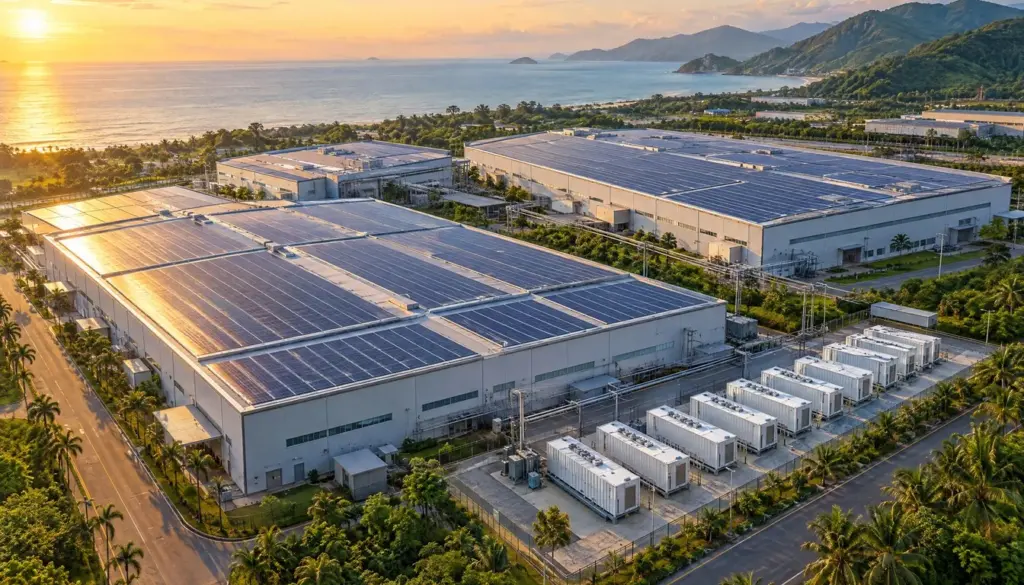
VinEnergo has switched on a rooftop solar and battery energy storage system (BESS) that feeds three factories in Vietnam’s Vung Ang Economic Zone. SolarQuarter reported the commissioning on November 2, 2026, and said the system supplies the VinFast electric vehicle plant, the VinES battery plant and the VG battery manufacturing joint venture in Ha Tinh province. The same report puts annual output at about 39 million kWh.
That makes this a hardware story as much as an energy story. Battery cells are the costliest part of any EV, and the plants that make them draw heavy, steady power. As our tracker of global EV battery market share shows, the cell race is already fierce, and cheap clean power is becoming a lever in it.
This analysis covers what was commissioned, which numbers hold up, how the direct power purchase model works, and what it could mean for EV and battery makers in Southeast Asia. It also flags where the public record disagrees with itself. Every figure below comes from named outlets, and anything that is our own arithmetic is labeled that way.
Add Shattered once in the Google app and our stories show up in your news suggestions.
What VinEnergo Commissioned at Vung Ang
VinEnergo Energy Joint Stock Company built a rooftop solar array paired with battery storage inside the Vung Ang Economic Zone in Ha Tinh, a central Vietnamese province. SolarQuarter says the system now supplies green electricity to the VinFast EV manufacturing plant, the VinES battery manufacturing facility and the VG battery joint venture. The operators named in that report are the Future Production, Investment and Development Joint Stock Company, which runs the VinFast side, and VinES Ha Tinh Energy Solutions Joint Stock Company.
The report describes the installation as the first operational renewable project under Vietnam’s direct power purchase agreement (DPPA) mechanism. That label matters more than the megawatts. A DPPA lets a generator sell electricity straight to a large consumer instead of routing every kilowatt-hour through the state utility’s pricing. For an industrial park with three big power users in one place, the model fits naturally.
Roofs make sense here for a plain reason. Car and battery plants have enormous flat roofs, the land is already paid for, and the generation sits next to the load. No new transmission corridor is needed. The battery then smooths the gap between when the sun shines and when the lines run.
One timing detail needs care. SolarQuarter dated its commissioning story November 2, 2026. A Vietnamese outlet’s English edition, surfaced in our search, reportedly dated the start of operation to October 28. We treat the system as commissioned in the final days of October or on the first days of November, and we do not pin a single go-live day on it.
The Numbers Reported on Commissioning Day
SolarQuarter lists four headline performance figures. The system should generate roughly 39 million kWh a year, cut carbon dioxide emissions by more than 25,000 tonnes a year, offset the equivalent of over 1.13 million trees annually and save close to VND 3.5 billion a year. The report does not publish a solar capacity in MWp or a storage capacity in MWh, and it names no equipment suppliers.
We can do some simple math on those figures, and we flag it as our own calculation. Spread across 8,760 hours, 39 million kWh equals an average draw of about 4.5 MW. The CO2 figure implies roughly 0.64 kg of avoided emissions per kWh, which fits a grid still leaning on fossil generation. The savings figure implies about VND 90 per kWh, though SolarQuarter does not say how it computed the saving.
Those ratios are useful as sanity checks. They show the three claims hang together, which is not guaranteed in press releases. An average 4.5 MW is a modest slice of what an EV plant plus two battery lines might consume, so the system cuts the bill and the emissions without making the plants energy-independent. Treat it as a hedge, not a replacement for grid supply.
Planned Versus Reported: Why the Figures Differ
The project was announced well before it went live. In August 2025, The Investor, VietnamPlus and Bao Quoc Te all covered the launch of a plan combining 43 MWp of rooftop solar with 45 MWh of battery storage. Those reports projected nearly 50 million kWh a year and more than 33,000 tonnes of avoided CO2.
Set those side by side with the commissioning-day numbers and a gap appears. The 39 million kWh figure sits about 22% below the 50 million kWh plan, and the 25,000-tonne CO2 figure sits about 24% below the 33,000-tonne plan. Those percentages are our arithmetic. They suggest the commissioned scope may be smaller than the original plan, or phased, or measured on a different basis.
The English edition of a Vietnamese outlet, found in our search, reportedly describes the operating system as up to 22 MWp of solar plus 45 MWh of storage. We could not retrieve that page in full, so we flag the number as unconfirmed. If it holds, it would explain the lower generation, since a 22 MWp array cannot produce what a 43 MWp one would. We have not seen an official statement that reconciles the two capacity figures.
How to read conflicting project figures
Large solar projects often change between announcement and energization. Roof space gets re-surveyed, phases get split and early output estimates get trimmed once real irradiance data arrives. Our rule here is the conservative one. When two sources disagree, we quote the lower, later figure for what is running today and the earlier figure only as the plan.
Which Factories Draw the Power
Three industrial users share the system. The first is the VinFast automobile plant, which assembles Vietnam’s homegrown electric vehicles. The second is VinES, which makes battery packs and energy storage products. The third is the V-G High-Tech Energy Solutions battery plant, described in the 2025 launch coverage as a battery manufacturing joint venture.
Clustering the load matters. A DPPA works best when a few creditworthy buyers sit close to the generation, because the contract is simpler and the line losses are tiny. Vung Ang is effectively a purpose-built customer base. It also ties the clean power to a specific product claim, since a battery cell made on solar-backed electricity carries a lower embedded carbon number than one made on the average grid mix.
That embedded carbon figure is rising in importance for exporters. Buyers in Europe increasingly ask for battery carbon footprints, and plants in Asia that can document cleaner power gain a negotiating edge. Neither SolarQuarter nor the Vietnamese outlets say VinFast plans to market its cells that way, so this stays our reading of the incentives and not a reported strategy.
The Investor reported that the project supports Vingroup’s net-zero emissions target for 2040 and aims to turn Vung Ang into a green industrial hub. Nguyen Huong Giang, VinEnergo’s deputy general director, framed it as a showcase of Vietnamese enterprises’ determination and pioneering use of new technology to advance the country’s net-zero goal. We paraphrase her remarks here because they did not reach us through our verified-quotes process.
How a DPPA Works and Why It Matters Here
A direct power purchase agreement is a contract between a generator and a large buyer. In Vietnam, the mechanism was designed to let industrial customers source renewable electricity without buying it all through the utility’s standard tariff. SolarQuarter calls the Vung Ang system the first operational renewable installation under that mechanism, and The Investor said the 2025 plan was the first in Vietnam to combine rooftop solar and BESS under a DPPA.
CleanTechnica, writing in September 2025, called the DPPA model relatively untested locally for combined solar and battery projects. It also noted that selling directly to corporate customers lets a project sidestep some grid bottlenecks. Both points cut the same way. The structure has real appeal, and the track record is thin.
For buyers, the draw is price certainty and a credible sustainability claim. For developers, it is a bankable offtaker. For regulators, a working example shows whether contract terms, grid fees and metering rules hold up under daily use. The first commissioned project becomes the template, and every clause that causes friction gets copied or fixed by the next deal.
What we do not know about the contract
None of the sources we reviewed disclose the tariff, the contract length or the investment cost. CleanTechnica estimated a cost of $35 million to $50 million for the 43 MWp plan, based on industry per-kilowatt rates, and stressed that the actual terms were not disclosed. That is an outside estimate for a plan that may have been scaled down, so we do not use it as a project cost.
Why Pair Rooftop Solar With Battery Storage
Solar alone produces power in a bell curve that peaks near midday. A factory that runs multiple shifts needs power at 3 a.m. too. A battery shifts some of the midday surplus into the evening and overnight hours, and it can also shave the sharp demand spikes that raise bills under peak-based tariffs.
Storage plays a second role that matters in Vietnam, which is grid relief. SolarQuarter says the project contributes to reducing pressure on the national grid. Batteries at the point of use let a plant draw less from the grid during stressed hours. They also keep solar output from being wasted when the local network cannot absorb it.
There is a quality angle for battery plants as well. Cell formation and drying rooms are sensitive to power interruptions. A storage system can ride through short dips, though SolarQuarter does not say this system is configured as backup power, so we do not claim it. The same logic is playing out at other power-hungry sites. Our look at the AI power problem and 800V DC designs shows data centers chasing the same mix of on-site generation, storage and tighter power electronics.
Vietnam’s Grid Context: A Solar Boom Meets Congestion
Vietnam’s solar build-out has been rapid. CleanTechnica reported that installed solar capacity grew from 86 MW in 2018 to nearly 18,000 MW by April 2025. It also reported a government target of 46 to 73 GW of solar by 2030, coal at 45% of electricity generation as of 2021, and a 10.9% rise in energy demand in the first nine months of 2024.
Growth that fast strains wires. CleanTechnica said grid congestion and renewable curtailment persist, particularly in southern provinces, because transmission infrastructure lags behind generation capacity. Curtailment means a working solar farm gets told to switch off because the network cannot take its power. Developers hate it, because every curtailed kilowatt-hour is lost revenue.
Behind-the-meter systems like the Vung Ang one dodge much of that problem. Power generated on a factory roof and used on site never needs to cross a congested line. The battery adds a buffer, so a sunny midday does not force a shutdown. In a market where the wires are the bottleneck, that design advantage may count for more than raw panel efficiency.
The Hardware Angle for EV and Battery Supply Chains
Battery manufacturing is energy-hungry, and electricity is a meaningful slice of cell cost. That is why cleaner, steadier supply is turning into a competitive tool. Makers that lock in long-term power through contracts like a DPPA can plan margins more precisely than those exposed to retail tariffs.
Capacity race news elsewhere shows the same pressure. Group14 recently drew attention for a $169 million raise tied to a 10 GWh plant in Spain , a reminder that new battery material capacity is arriving in several regions at once. Plants in each region will compete on cell price, quality and, increasingly, the carbon footprint of the power behind them.
For VinFast, the picture is mixed. The company is a young carmaker, and EV makers across Asia are fighting for volume. Our report on Xiaomi topping 50,000 EV deliveries in October shows how fast a new entrant can scale when supply chains line up. Cutting energy costs at the plant will not decide that contest, but every point of cost matters when rivals sell at thin margins.
Market Impact: Costs, Carbon and Contract Templates
The cleanest read of the reported savings is that they are real but small. Nearly VND 3.5 billion a year is a rounding error against the revenue of an automotive plant. The value lies elsewhere, in the contract template, the carbon claim and the proof that a DPPA with storage can run in practice.
Investors in Vietnamese industrial real estate will watch this closely. If Vung Ang demonstrates a lower power bill and a cleaner footprint, other zones will pitch the same package to tenants. Foreign manufacturers weighing a Vietnam site often ask about renewable access, and a working example answers that question better than a policy paper.
On the utility side, large industrial buyers moving to direct contracts shift some demand off the standard tariff. Grid companies will want clarity on fees for using their wires and on backup supply. The commissioning gives them a live case to study. It mirrors fights seen in other markets, such as the U.S. debate we covered in power bills, data centers and the midterms , where big loads and household customers argue over who pays for the grid.
Competitive Comparison: Three Ways to Power a Plant
Factories and vehicles chase clean power in different ways, and the contrast helps explain why VinEnergo chose rooftops. Engadget examined the other end of the spectrum, putting solar on the car itself. It found that a 400W roof array yields only about 4 miles of range worth of energy, and that extra panels add weight and drag. Read that piece on the limits of solar roofs on EVs for the vehicle side of the story. A factory roof has the opposite profile, with huge area, no weight limit and no aerodynamics to worry about.
Fast charging sites follow a third path. The Tesla site in our 164-stall Supercharger walkthrough pairs charging with an 11 MW solar installation, according to the title of that report. It shows on-site generation working at the charging end, while Vung Ang shows it at the manufacturing end.
Historical Context: From MoU to Commissioning
The path started in the summer of 2025. SolarQuarter reported on August 18, 2025 that VinEnergo signed a memorandum of understanding to deploy solar and energy storage at VinFast, VinES and V-G plants. Days earlier, on August 9, 2025, Vietnamese outlets covered the launch of the rooftop solar and BESS initiative itself.
CleanTechnica followed in September 2025 with a skeptical angle, asking whether Vietnam’s strained grid could carry the ambition. At that point it found no operational date, and it noted that comparable projects typically take 12 to 18 months. Commissioning arrived roughly 14 to 15 months after the August 2025 launch, which lands inside that range.
That timeline is worth stating plainly. From announcement to first output took about a year and a quarter, with no reported public delay. Developers elsewhere would welcome that pace, though the scope may have shrunk along the way, as the gap in reported numbers suggests.
VinEnergo’s Wider Ambitions
The Vung Ang system is not VinEnergo’s only play. SolarQuarter reports the company is supplying BESS solutions for several major projects of Hanoi Power Corporation and Northern Power Corporation, with a combined capacity above 1.1 GWh. That makes the factory installation a small part of its storage business by capacity.
The same report cites a much larger goal. VinEnergo’s portfolio currently stands at 10 GW, and the company aims to expand to 100 GW within three years, with projects planned in Asia and Europe. We treat that as a stated ambition from a company announcement. A tenfold jump in three years would require financing, equipment supply and permitting on a scale that few developers have ever managed.
Why would a Vingroup-linked energy firm chase such a target? A plausible reading, which is our analysis and not a reported fact, is that captive demand from group companies gives it a base load of customers, while storage skills carry over to utility clients. Whether the strategy works abroad depends on execution that the Vung Ang project only begins to test.
Risks and Open Questions
Five questions remain open. First, what is the real installed capacity, 43 MWp, 22 MWp or something else? Second, what are the tariff and contract length under the DPPA? Third, which suppliers provided the panels, inverters and battery cells? Fourth, how does the system perform over a full year, including Vietnam’s rainy season? Fifth, how will grid operators price the use of their network for such contracts?
There is also a measurement risk in the headline metrics. The tree-equivalent figure is a communications device, not an engineering result, and conversion factors vary. The CO2 number depends on which grid emissions factor the company applied. Readers should lean on the kWh figure, which is the most direct output of the system, and treat the rest as derived claims.
Finally, the press picture is thin. Our verified-quotes search returned nothing, and the single source URL our pipeline vetted for this story was an unrelated Engadget piece on car-roof solar. SolarQuarter, The Investor and VietnamPlus carry the core facts, and we attribute accordingly. A statement from VinEnergo or VinFast with full specs would settle most of these points.
Five Predictions for Rooftop Solar and BESS in Vietnam
These are our forecasts, not reported facts.
The takeaway: the Vung Ang commissioning is a modest system with an outsized signal. It shows a DPPA with storage can move from announcement to operation in roughly 14 months, and it hands Vietnam’s EV and battery makers a cleaner power model to copy. What it does not yet show is the full capacity, price or supplier list. Watch for those disclosures, because they will decide whether this is a template or a one-off.
FAQ
What did VinEnergo commission?
VinEnergo commissioned a rooftop solar system with battery energy storage in the Vung Ang Economic Zone in Ha Tinh, Vietnam. SolarQuarter reported on November 2, 2026 that it supplies the VinFast EV plant, the VinES battery plant and the VG battery joint venture.
How much power will it generate?
SolarQuarter reports about 39 million kWh a year. The August 2025 launch coverage projected nearly 50 million kWh, so the commissioning figure is the lower and later one.
What is a DPPA?
A direct power purchase agreement lets a generator sell electricity directly to a large consumer. SolarQuarter calls this the first operational renewable installation under Vietnam’s DPPA mechanism.
How much CO2 and money does it save?
SolarQuarter cites more than 25,000 tonnes of CO2 avoided a year and nearly VND 3.5 billion in annual savings. It does not explain how either number was calculated.
Why do the capacity numbers differ between reports?
The 2025 launch coverage cited 43 MWp of solar and 45 MWh of storage. A Vietnamese outlet’s English edition reportedly cites up to 22 MWp for the operating system. No official statement we found reconciles the two, so the capacity remains unconfirmed.
Does this make the factories fully solar-powered?
No. By our arithmetic, 39 million kWh a year averages about 4.5 MW, which covers part of the demand of three large plants. The factories still depend on the grid for the rest.
What else is VinEnergo building?
SolarQuarter reports BESS work for Hanoi Power Corporation and Northern Power Corporation totaling more than 1.1 GWh. It also cites a 10 GW portfolio and a goal of 100 GW within three years, with projects planned in Asia and Europe.
Marcus Bell covers applied security: authentication, TLS, phishing, and the everyday decisions that keep accounts and data safe. He focuses on turning advice people usually ignore into steps they will actually follow.
Frequently asked questions
Which three specific manufacturing facilities in Vietnam's Vung Ang Economic Zone are now powered by VinEnergo's new rooftop solar and battery system?
The system feeds the VinFast electric vehicle plant, the VinES battery plant, and the VG battery manufacturing joint venture. These facilities are located in Ha Tinh province and operate within the Vung Ang Economic Zone.
What is the estimated annual energy output of the VinEnergo solar and BESS installation commissioned in November 2026 for these industrial sites?
The installation is projected to generate approximately 39 million kWh annually. This output supports the heavy, steady power demands of the battery and vehicle manufacturing processes at the connected plants.
How does the direct power purchase model for this VinEnergo project impact the competitive landscape for EV battery manufacturers in Southeast Asia?
Cheap clean power serves as a strategic lever in the fierce global race for EV battery market share. By reducing energy costs, the model helps manufacturers maintain competitiveness in a market where battery cells represent the highest production expense.