US$300 million wind, solar and battery hybrid plant unveiled in Zimbabwe
Key facts
- Tatanga Energy and Modaso Energy announced a US$300 million hybrid renewable project in Zimbabwe's Mashonaland Central Province
- The 228MW facility will combine 128MW of wind, 100MWac of solar PV, and a 50MW/100MWh battery storage system
- Standard Bank has been appointed to arrange project debt, with a term sheet already agreed upon for the development
- ZESA Holdings is expected to be the primary power buyer through ZETDC under a planned long-term power purchase agreement
- The project is projected to produce around 550GWh of clean power annually, meeting about 5% of Zimbabwe's total electricity demand
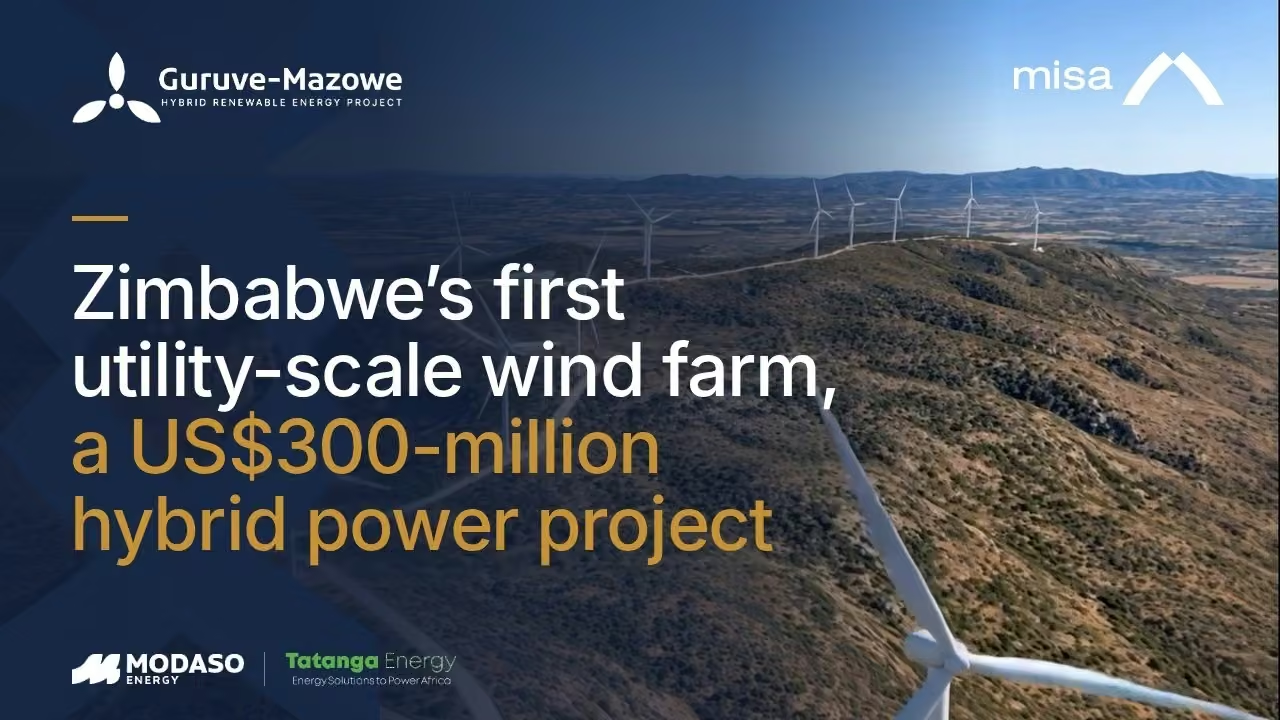
Watch the launch video: MISA Group leads the development of Zimbabwe’s first utility-scale wind farm, a USD 300-million hybrid power project.
Zimbabwean developer Tatanga Energy and Modaso Energy, part of Geneva based MISA Group, have announced plans for a US$300 million hybrid renewable energy project in the Guruve-Mazowe (Chikonyora) area of Mashonaland Central Province.
The 228MW facility will combine 128MW of wind, 100MWac of solar PV and a 50MW/100MWh battery energy storage system, all connected through a single 100MW grid connection. Once operational, it is projected to produce around 550GWh of clean power each year, equal to about 5% of Zimbabwe’s total electricity demand.
The project is described as Zimbabwe’s first utility scale wind farm and the first site in sub-Saharan Africa outside South Africa to integrate wind, solar and battery storage at this scale.
Standard Bank has been appointed to arrange project debt, and a term sheet has been agreed. ZESA Holdings, the national utility, is expected to be the primary power buyer through ZETDC under a planned long term power purchase agreement. Zim GreenCo, part of Africa GreenCo, has signed Heads of Terms for a long term offtake contract and will trade power domestically and regionally through the Southern African Power Pool (SAPP). Financial close is targeted for mid 2027, with commercial operations expected in 2029.
“As a contracted buyer and trader, ZimGreenCo gives Guruve-Mazowe a second route to market alongside ZESA, with access to buyers across the Southern African Power Pool,” says Lion Mashiri , Managing Director for Zimbabwe at Africa GreenCo.
The design places 228MW of generation assets behind a 100MW grid connection, which allows for high utilisation of the grid infrastructure. The battery system is intended to smooth the variability between daytime solar output and night time wind generation, offering a model for managing intermittent renewable energy across the region.
Africa GreenCo’s role is seen as important to the project’s structure. As a creditworthy intermediary and a SAPP member, it can trade surplus power across borders, which reduces default risk and helps attract international investors.
The plant is also expected to ease Zimbabwe’s chronic power shortages, reducing reliance on electricity imports from neighbouring countries and on fossil fuel generation.
Pvola take
This development signals a maturing market for hybrid renewable assets in sub-Saharan Africa, where integrated storage and wind capacity can mitigate grid instability. The involvement of a creditworthy intermediary like Zim GreenCo to manage cross-border trading via the SAPP is a critical structural innovation. By reducing default risk and enabling regional power sales, this model makes the project more bankable for international investors seeking stable returns in emerging markets.
Frequently asked questions
What are the capacity specifications for the wind, solar, and battery components of the Zimbabwe hybrid project?
The project will feature 128MW of wind, 100MWac of solar PV, and a 50MW/100MWh battery energy storage system. These assets will be connected through a single 100MW grid connection point.
How does the involvement of Zim GreenCo and Standard Bank support the financing structure of this renewable energy project?
Standard Bank is arranging project debt, while Zim GreenCo has signed Heads of Terms for a long-term offtake contract. Zim GreenCo acts as a creditworthy intermediary to trade power via the Southern African Power Pool, reducing default risk for investors.
What is the projected annual clean power generation and its impact on Zimbabwe's electricity demand from this hybrid facility?
The facility is projected to produce around 550GWh of clean power annually, which equals about 5% of Zimbabwe’s total electricity demand. This output aims to reduce reliance on fossil fuel generation and electricity imports from neighboring countries.