SMM: Oct sodium-ion battery materials volume rises, prices weak; delivery capacity key differentiator

Entering Q4, the sodium-ion battery industry chain has entered the most critical delivery verification period of the year. SMM data indicates that in October, sodium-ion battery cathode material production increased by 3% month-on-month (MoM) and surged by 260% year-on-year (YoY), while hard carbon anode production declined slightly by 4% MoM but rose by 186% YoY. The high YoY growth confirms that the industry is still on a zero-to-one volume ramp-up trajectory, but the modest MoM performance reveals another reality: the pace of capacity ramp-up is generally slower than market expectations, with a clear time lag between order growth and actual delivery. On the price front, NFPP cathode quotes are diverging, precursor prices are hovering near the cost line, and supply-demand tension for iron phosphate remains elevated. The dual pressure of rising costs and order losses is reshaping the industry’s competitive landscape.
1. Cathode Materials: Production Up 3% MoM, Capacity Release Below Expectations, Orders Accelerating Toward Top-Tier Players
1. Supply Side: Ramp-Up Hindered, Delivery Capacity Supplemented by “Outsourcing + Toll Processing”
In October, sodium-ion battery cathode material production increased 3% month-on-month and surged 260% year-on-year. The overall market operated steadily, but capacity release falling short of expectations was the most prominent contradiction this month. Although 10 kt-scale new lines gradually entered commissioning, compounded by line switchovers and equipment changes, actual output still failed to meet the original ramp-up targets; some enterprises boosted delivery capacity through outsourced processing, and once downstream processes are fully connected after mid-November, monthly capacity is expected to reach the kt level.
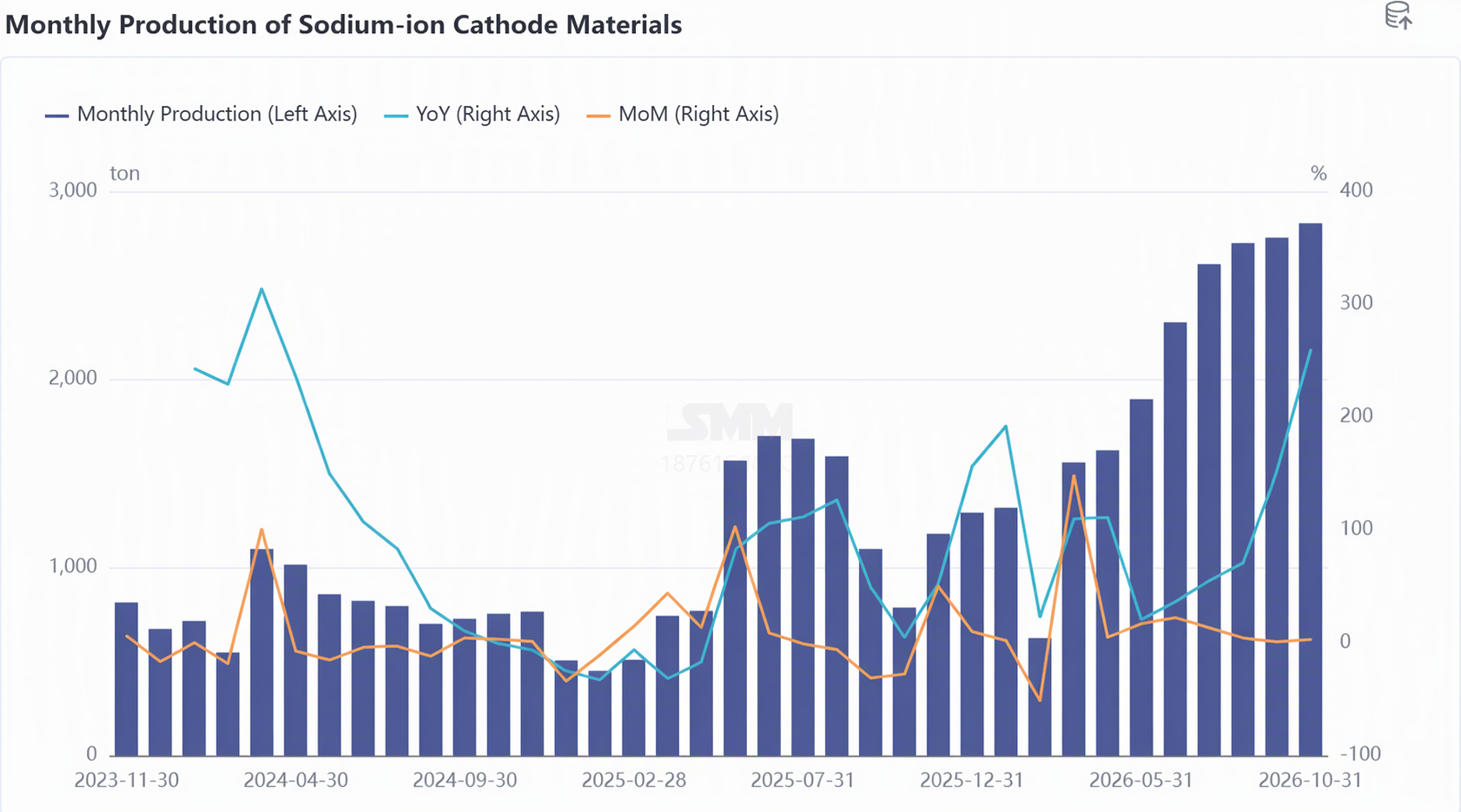
The demand side exhibited significant divergence: in October, some enterprises shipped only a few hundred metric tons, while November orders have expanded to several hundred metric tons and will be delivered in batches, with growth primarily driven by small-scale power and certain energy storage orders. However, it is worth noting that if lithium carbonate prices continue to weaken, December market conditions may fall short of those in November—some clients' new orders are already showing inverted margins, and downstream willingness to place orders has clearly declined. From the perspective of enterprise operations, the trend of orders concentrating among top-tier players is increasingly evident: leading industry players already have orders on hand exceeding 1,000 metric tons, while their own monthly production capacity is only a few hundred metric tons and cannot fully cover demand, necessitating a dual-track approach of "in-house production lines + toll processing" to ensure delivery.
3. Price Side: NFPP Quotes Diverge, Cost Pressure Focuses on Iron Phosphate
In October, NFPP quotes remained relatively stable, with mainstream transactions concentrated at 24,000-27,000 yuan/mt. In the short term, there is clearly no room for price increases, nor room for cuts—prices have entered a stalemate range.
Cost side pressure remains concentrated in the iron phosphate segment. Although phosphoric acid prices have pulled back from 12,000 yuan/mt to around 9,000 yuan/mt, iron phosphate prices remain at around 16,000 yuan/mt due to tight supply-demand conditions, significantly above the reasonable range of 12,000-13,000 yuan/mt. The persistently high raw material costs are driving downstream material enterprises to accelerate the construction of their own iron phosphate production lines or form joint ventures with phosphorus chemical enterprises, advancing industry chain integration. In the precursor segment, mainstream transaction prices are 19,000-20,000 yuan/mt, with large orders as low as 17,000-18,000 yuan/mt, already basically approaching the cost line. Enterprises generally adopt tiered pricing to lock in major clients.
4. Competitive Landscape: Accelerating Tier Differentiation
From the perspective of the competitive landscape, tier differentiation within the industry is accelerating. Top-tier cathode manufacturers with planned capacity at the 10,000-ton level are successively bringing their projects online, steadily expanding their leading edge. Small and medium-sized startups are under pressure due to a tightening financing environment and delays in production line construction, with some enterprises still exhibiting a gap between their publicly stated capacity and actual output. Another noteworthy signal is that NFPP precursor manufacturers generally have low willingness to expand into cathode production, primarily due to concerns about direct competition with their downstream clients—this objectively maintains the competitive boundaries of the existing cathode segment.
Looking ahead, Q4 cathode shipments may exhibit a "high first, low later" trend, with prices remaining weak under the dual pressure of cost support and order losses. Top-tier players with scale capacity, integrated costs, and quality client structures will be the first to benefit, and industry consolidation and concentration are expected to accelerate. November sodium-ion battery cathode production is projected to increase 9% MoM and surge 162% YoY.
II. Hard Carbon Anode: Production Edges Down 4% MoM, Commissioning Window Determines Year-End Output, Stockpiling Willingness Rising
1. Supply Side: Orders in the Hundreds of Metric Tons, Deliveries Yet to Scale Up
In October, the hard carbon anode material market operated steadily overall, with production edging down 4% from September and surging 186% YoY. Although most enterprises received orders at the hundreds of mt level in October, actual deliveries have yet to scale up due to capacity constraints—"orders without goods" is the current reality of this segment.
From enterprise operations, industry capacity had not yet completed expansion in H1, and new self-owned production lines entered a concentrated commissioning period in H2. October-November has become the critical window for fine-tuning and pre-ramp-up, with whether stable production can be achieved in December highly dependent on the commissioning results of these two months.
- Stockpiling camp: Safety inventory has been significantly extended from the previous 3-5 days, with some enterprises already holding inventories at the hundreds of mt level, building reserves ahead of next year's demand release;
- Light inventory camp: Some enterprises maintain only 10-20 mt of minimal stockpiles, reasoning that hard carbon is a versatile material with low resale risk, requiring no heavy inventory to tie up capital.
In terms of technology routes, biomass-based, coal-based, and resin-based approaches are advancing in parallel with no unified standard yet. The consistency of the biomass route is constrained by fluctuations in natural raw materials, remaining the biggest pain point at present; the resin-based route offers better consistency but at a higher cost; moreover, downstream top-tier battery cell manufacturers are still in the sample validation stage for route switching, leaving demand sustainability in question. The outcome of the route competition will directly determine the order allocation landscape in the next round.
Looking ahead: November hard carbon production is expected to increase 6% MoM and surge 197% YoY. As upstream and downstream capacity is released simultaneously and differentiated application scenarios (low-temperature, high C-rate) gradually open up, top-tier players with large-scale delivery capability, cost control, and customer validation advantages are expected to benefit first, while small and mid-sized producers whose capacity claims are disconnected from actual delivery will accelerate their exit from the market.
III. SMM Views and Summary
First, the industry has entered the "orders validating capacity" stage. The high year-on-year growth rates of 260% and 186% indicate that the demand-side narrative for sodium-ion batteries is materializing, but the reality of cathode production ramp-ups falling short of expectations and hard carbon facing a situation of "orders without supply" is equally clear—Q4 will serve as the litmus test for companies' true delivery capabilities, and the gap between advertised capacity and actual production will be priced in by the market.
Second, the pricing system is being squeezed from both ends by costs and inverted margins. The price of iron phosphate at 16,000 yuan per metric ton is significantly higher than the reasonable range of 12,000-13,000 yuan per metric ton, large precursor orders are already near the cost line, and some cathode-side client orders are loss-making with inverted margins—industry chain profits are being squeezed at both ends by upstream raw materials and downstream clients, making integrated layouts (self-built iron phosphate, joint-venture phosphoric acid chemical operations) the common choice among top-tier players.
Third, market exit and consolidation will be the dominant theme from Q4 through next year. With orders concentrating toward top-tier players, a tightening financing environment, and diverging capacity commitment fulfillment, the combined effect of these three factors means companies with scale capacity, integrated cost advantages, and quality client structures will benefit first; conversely, participants with inflated capacity claims and lagging delivery will be rapidly marginalized. November cathode and hard carbon production are expected to increase 9% and 6% MoM respectively, and the industry will accelerate its first round of reshuffling amid coexisting volume growth and price weakness.
Frequently asked questions
What was the year-on-year growth rate for sodium-ion battery cathode material production in October according to SMM data?
Sodium-ion battery cathode material production surged by 260% year-on-year in October. This high growth confirms the industry is still on a zero-to-one volume ramp-up trajectory despite modest month-on-month performance.
How did hard carbon anode production change month-on-month and year-on-month in October, and what does this indicate about delivery capacity?
Hard carbon anode production declined 4% month-on-month but rose 186% year-on-year in October. The modest month-on-month performance reveals that capacity ramp-up is slower than expected, creating a time lag between order growth and actual delivery.
Which specific capabilities will allow top-tier sodium-ion battery cathode players to benefit first during the industry's first round of reshuffling?
Top-tier players with scale capacity, integrated cost advantages, and quality client structures will benefit first. Conversely, participants with inflated capacity claims and lagging delivery will be rapidly marginalized as the industry accelerates its reshuffling amid coexisting volume growth and price weakness.