The Engineering Details That Decide Energy Storage Reliability

At about 6 a.m. on Sept. 18, 2026, workers at the Moss Landing Power Plant in California spotted a flare-up along the north wall of the Moss 300 battery building. The building had burned in January 2025, and the new flare-up came more than 20 months later. Vistra, the plant’s owner, said it believes about 1,200 of the roughly 2,500 battery modules still inside the structure ignited. Those modules had not been de-energized because they sat in a section of the building that was unsafe to enter after structural damage from the first fire. Monterey County issued a shelter-in-place order, and the natural gas plant on the site was temporarily shut down. By late afternoon, county officials reported the fire was inactive.
The episode arrived as the industry can point to a very different set of numbers. The Electric Power Research Institute (EPRI) reports that the battery energy storage system (BESS) failure rate, measured against cumulative deployed capacity, fell 99% between 2018 and 2025. Both facts are true at once, and together they define the challenge for utilities that are leaning harder on storage every year. The technology is getting safer, but reliability is being decided by specific engineering choices: how old a design is, how hard it is operated, what protects the cells from one another, and how well the equipment that ties the system to the grid is built to last.
Storage Becomes a Grid Fixture
The scale of the buildout explains why those details matter. According to the U.S. Energy Information Administration (EIA), utility-scale battery storage capacity in the U.S. grew at an average annual rate of 70% over the last three years, reaching 43.6 GW at the end of 2025. Operators added another 8.3 GW in the first half of 2026, bringing nameplate capacity to nearly 52 GW. Furthermore, they have reported plans to add 54 GW more over the next two and a half years: 14 GW in the second half of this year, 26 GW in 2027, and 14 GW in 2028. On those figures, the fleet would roughly double.
Much of that capacity is paired with solar (Figure 1). The EIA notes that solar photovoltaic plants host the largest battery storage units. The Bellefield Solar and Energy Storage Farm, which serves the California Independent System Operator (CAISO) and began operating in December 2025, couples 500 MW of solar with 500 MW of storage, and plans call for doubling both by November 2026. If that happens, the EIA says, Bellefield will become the largest storage facility in the country. In Florida, the Manatee Solar Energy Center pairs 75 MW of solar with 409 MW of batteries, while Nevada’s Gemini Solar Hybrid combines 690 MW of photovoltaics with 380 MW of storage.
1. Battery storage units are regularly being paired with solar plants and sometimes even wind farms. This rendering shows a renewable generation site with solar arrays, wind turbines, and battery storage cabinets. Courtesy: nVent
The reliability case is easiest to see in the West. The Western Electricity Coordinating Council (WECC), in a December 2025 report prepared with the Federal Energy Regulatory Commission (FERC), the North American Electric Reliability Corp. (NERC), and CAISO, noted that roughly 27 GW of BESS capacity was installed in the Western Interconnection when the report was published. Storage, it said, helps meet system demand “particularly during evening hours when solar generation is ramping down and the demand on the system is still high,” and it contributes to ancillary services that support grid stability.
Data centers are adding a new dimension. Vince Sprenkle, director of the Grid Storage Launchpad at the Pacific Northwest National Laboratory (PNNL), said in a lab feature last year: “We are seeing a dramatic shift in the energy sector due to things like the scaling of data centers. It is changing the dynamic of where we need energy storage.” PNNL said in a January news release that artificial intelligence (AI) data centers can cause sudden spikes and drops in demand, which stored energy can be called on to absorb.
What the Failure Data Shows
EPRI’s BESS Failure Incident Database, which the institute started in 2021 after a cluster of lithium-ion fires in South Korea and an incident in Surprise, Arizona, tracks failures worldwide. The 99% figure includes 33 non-public incidents that EPRI is aware of. The institute attributes the improvement to lessons from early failures being built into newer designs and best practices.
The database has limits that matter to anyone reading it as a reliability measure. EPRI says its focus is on incidents with wider public health and safety impact rather than operational failures, so it is not a measure of everyday availability. It is compiled from media reports and other public documents, and EPRI acknowledges it cannot guarantee that every incident is captured. As of Oct. 11, 2026, the stationary-storage table listed 165 incidents worldwide.
EPRI, working with TWAICE and PNNL, has also classified incidents by root cause (design, manufacturing, integration and construction, operation, or a combination) and by the physical location of the failure, including cells and modules, controls, and balance-of-system equipment. The framework is a reminder that cells are only one place a system can fail.
Moss Landing: Lessons From a Legacy Design
WECC’s report on the January 2025 fire is the clearest public look at how an early large-scale system differs from what is being built today. WECC stressed that the report is not a root cause analysis, and Vistra says the cause of the fire is still unknown. What the report does document is the design and operating context.
Phase 1 of Moss Landing, which reached operation at the end of 2020, was housed in a repurposed turbine building, with racks of nickel manganese cobalt (NMC) cells stacked two high across two stories. Its design predates the first fire-safety standard for storage, NFPA 855. The racks were UL 9540A tested and certified, WECC said, but the facility relied on a water-based thermal runaway mitigation system and overhead sprinklers. During the fire, the decision was made to deactivate the overhead sprinklers because they were proving ineffective. WECC’s recommendations caution that water-based systems can damage energized equipment and potentially worsen a chemical fire.
WECC also pointed to state of charge. A capacity test, which charges a system to its maximum, was under way on two of the Phase 1 arrays when the alarm sounded on one of them at 2:48 p.m. WECC does not say the test caused the fire. It does say that high state of charge raises the energy available to a fault, and it cites a study of 23 South Korean fires before 2019 in which 18, or 78%, occurred when the state of charge exceeded 95%. Many operators, it noted, deliberately hold back a portion of capacity to extend battery life. Its recommendations include setting maximum state-of-charge limits, limiting the frequency of capacity tests, and notifying the local fire department and rehearsing failure scenarios before a test.
Chemistry and layout matter as well. According to WECC, NMC cells can become unstable at about 160C and burn as hot as 800C in thermal runaway, while lithium iron phosphate (LFP) cells remain stable to about 230C and burn at about 620C in thermal runaway. Based on discussions with manufacturers, the report says the industry is trending toward LFP and toward outdoor containerized designs. Those allow spacing between units, and WECC says testing has shown that a loss would be limited to a single container if the battery management and thermal runaway mitigation systems fail. Warehouse-style installations like Moss 300, WECC concluded, “are unlikely to be replicated.”
The report’s most telling observation is about the speed of change. “A system designed in 2020 bears little resemblance to those being deployed today, even for projects of similar scale,” it says. For owners of older systems, WECC recommends evaluating and retrofitting facilities to the extent possible to meet current fire safety standards and establishing appropriate operating margins where facilities can’t fully meet them.
The Rest of the Site: Grounding, Connections, and Speed to Power
Fire protection dominates the post-Moss Landing conversation, but it is not the only way a storage site can fall short. Dave Dong, director of vertical growth at nVent, told POWER that storage sites have drawn greater scrutiny in recent years in response to the Moss Landing event, and that the standards driving that scrutiny mainly address fire mitigation. Equally important, he said, is attention to downstream safety that may not have changed, such as best-practice grounding.
Dong said “under-engineered” may not be the right word for the problem. The issue is longevity. Storage sites are generally expected to run 20 years or more before they are replaced or updated, he said, so engineers must make sure connections last that long in their specific environment. A grounding connection can pass its qualification test and still be the wrong choice for 20 years or more in a particular site’s soil, he said. The connection type and material, he said, have to match the environment.
“Surge protection only works as well as the grounding behind it,” Dong said. The goal is one bonded grounding system across the site so surge current has a low-impedance path into the earth (Figure 2). If the grounds aren’t bonded together, a lightning strike can push surge current through the inverter, and no amount of surge protection can solve for that, he said.
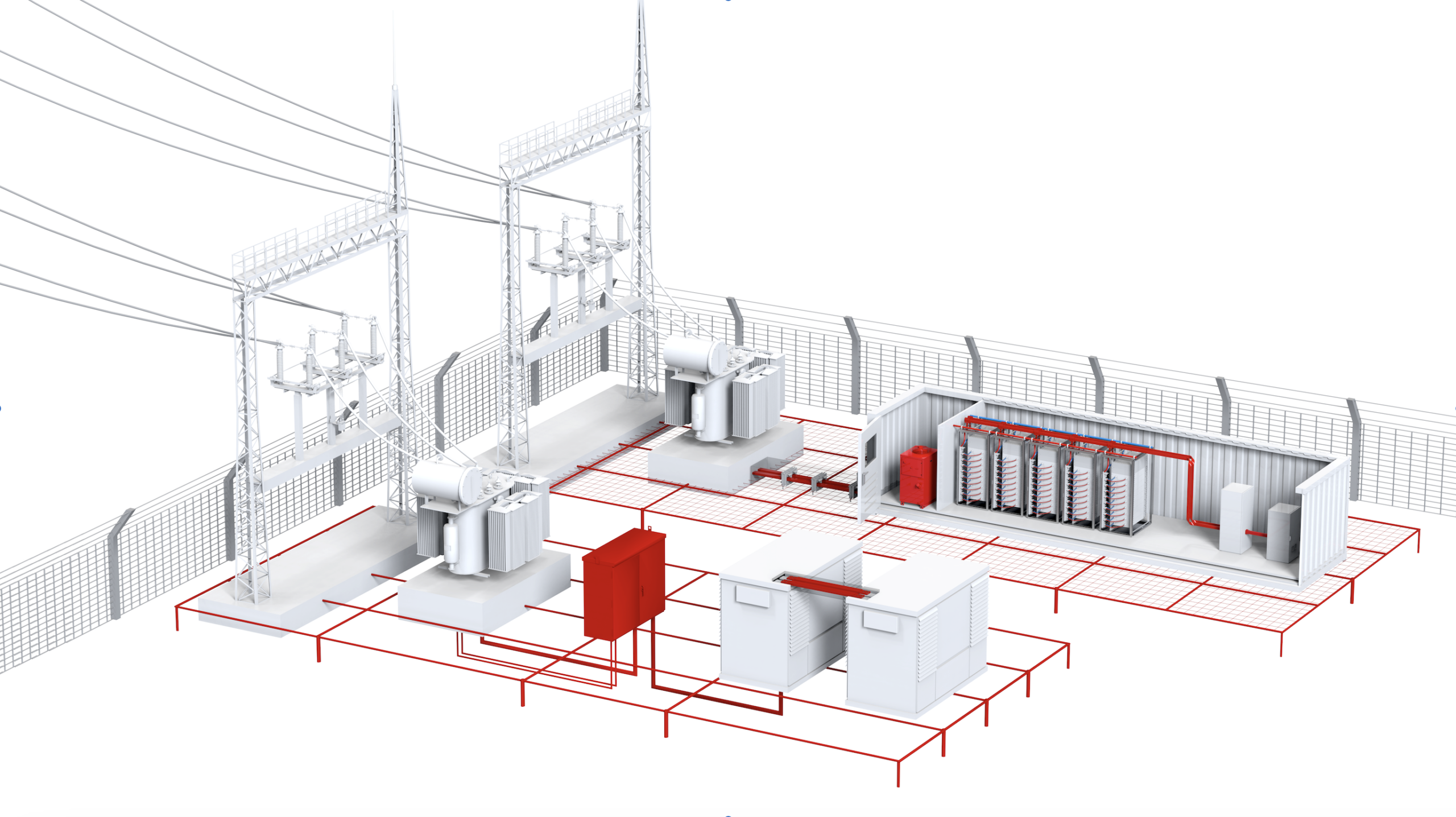
2. A rendering of a battery storage site tied into a substation. The red lines depict a site-wide grounding and bonding system. Courtesy: nVent
nVent supplies lightning protection, grounding and power connections, and ground rods for storage sites, along with enclosures and thermal management. According to company literature, its grounding connections include compression, mechanical, and exothermic options, and its services include grounding system design assistance and site surveys. The company’s outdoor-rated BESS enclosure is designed to support UL 9540, and its side-mount chiller offers 14 kW of cooling capacity across ambient temperatures from –22F to 122F.
Maintenance guidance points the same way. WECC’s list of recommended maintenance tasks for a BESS includes insulation resistance and grounding verification alongside cooling system inspections and battery health monitoring. WECC notes that temperatures below freezing or above 100F can degrade performance for certain chemistries.
Pairing storage with solar does not change much about the connection hardware, Dong said. DC-coupled and AC-coupled systems differ architecturally, but he said that has little effect on the hardware that connects them.
Where the grid is concerned, he said, the pressing gap is somewhere else. “The biggest gap utilities are racing to close right now is speed to power,” Dong said. “For a lot of data center projects, the longest wait isn’t construction. It’s the transformer. Lead times for large power transformers now run two to four years.” Instances of four-year lead times, he said, are driving the adoption of other technologies. “A substation can be built,” he said. “A transformer cannot be rushed.”
Testing Before Deployment
Some of the work that will shape the next generation of storage is happening before systems reach a site. PNNL’s Grid Storage Launchpad in Richland, Washington, which opened in 2024, is a $75 million, 93,000-square-foot facility with 34 laboratories. In December 2025, researchers began the first test of a utility-grade battery there: a vanadium flow battery built by Invinity Energy Systems, which will undergo a year of testing under real-world conditions that includes peak shaving. The lab can also test a battery’s ability to provide frequency regulation.
The facility can test systems up to 100 kW and 400 kWh in six bays, and in January 2026 it began accepting applications from battery companies to have grid-scale systems independently tested (Figure 3). PNNL notes that a storage system must have a capacity of at least 100 kW to connect to the grid. “We want to provide space where companies can bring their mature systems to get critical information for operations, and so that utilities can be confident in their performance,” Sprenkle said.
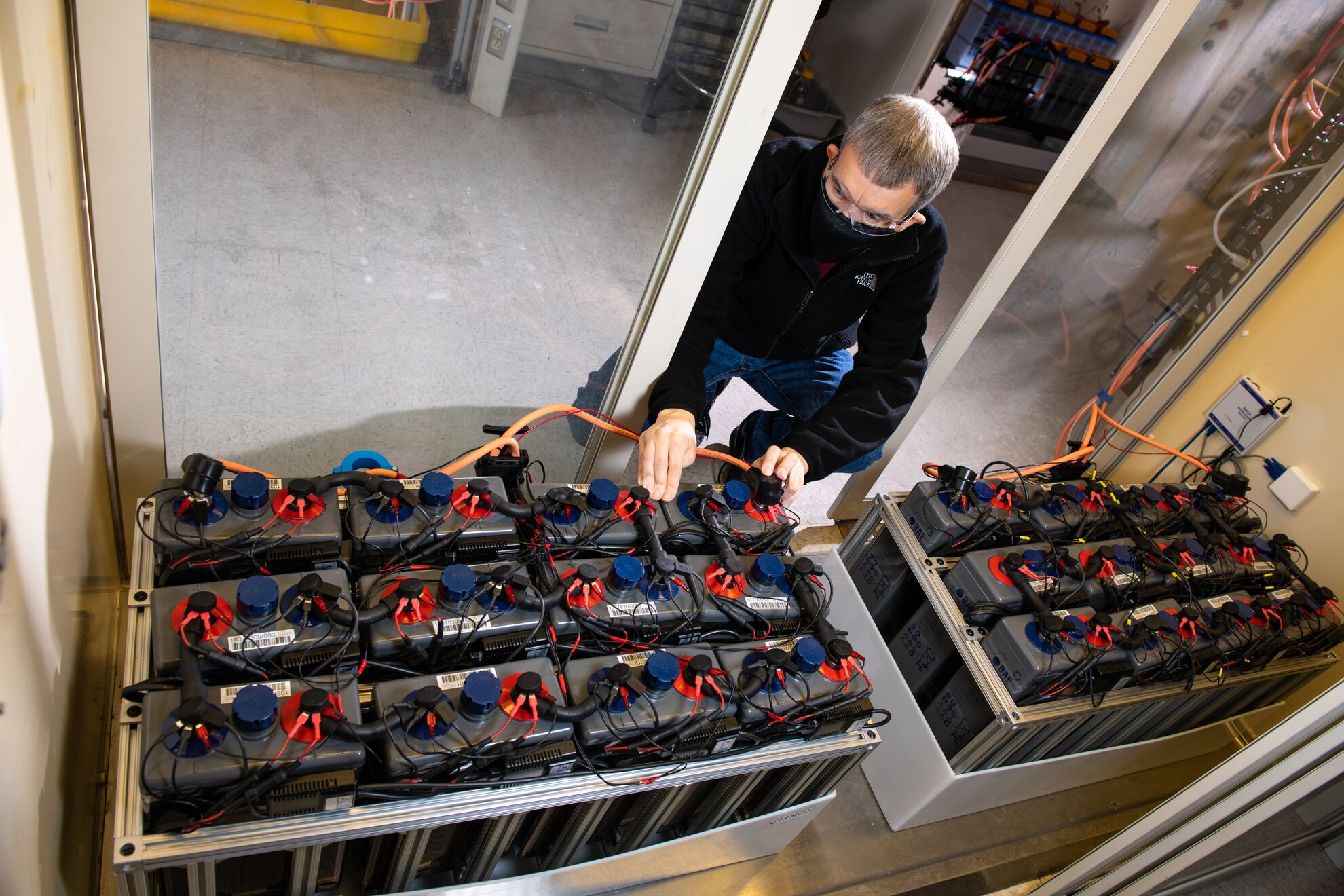
3. At Pacific Northwest National Laboratory (PNNL), researchers can test different battery chemistries at close to real-world conditions. Courtesy: Andrea Starr / PNNL
The laboratory is also studying chemistries beyond lithium-ion. It is working on sodium-ion batteries, which it describes as much more abundant in Earth’s crust than lithium and promising for domestic material security, and on optimizing lead-acid batteries for grid use. Lead-acid batteries, PNNL notes, are widely manufactured and easily recycled.
A Test of Staying Power
The 54 GW operators plan to bring online through 2028 are being built to standards that did not exist when Moss Landing’s Phase 1 was designed, with chemistries and layouts that reflect what the industry has learned since. The older systems will remain on the grid for years, and, as Moss Landing shows, they can remain a liability long after a failure. The question for the next wave of storage is less whether batteries can be made safe than whether everything around them, from the grounding grid to the transformer waiting in the queue, will hold up for the 25 years those sites are meant to last.
Few moments have placed more pressure on the U.S. power sector than the one we’re in now—surging load growth, an evolving generation mix, mounting reliability concerns, rising costs, and a regulatory environment in flux. But those pressures look very different depending on where you sit on the grid.
In this session, executives from several of the industry’s most influential associations share what’s at the top of their members’ agendas, the challenges keeping their members up at night, and the work their organizations are doing to help meet those challenges head-on.
Attendees will leave with a clearer picture of how different segments of the power sector are approaching today’s defining issues, and where their priorities align, diverge, and intersect.
This executive panel brings together leaders from across the power sector for an in-depth discussion of the issues shaping the industry today. The discussion may explore current trends in generation, transmission, and distribution, along with the regulatory environment, supply chain pressures, demand growth, and workforce considerations influencing strategic decisions. The session will offer attendees a direct view into how utilities are adapting their planning, operations, and investment priorities to meet a rapidly evolving landscape.
Women are driving innovation and transformation across the power sector. This panel highlights how diverse leadership strengthens organizational resilience, fosters inclusive practices, and fuels progress in a rapidly evolving industry. Hear from trailblazers as they share strategies for recruiting women into energy roles, advancing careers, and breaking barriers. Whether you're new to the field or a seasoned professional, this session offers insights to empower your journey and build a more inclusive energy future.
Across the country, state policymakers and regulators are taking proactive steps to meet the challenge of load growth. What are the policies, regulatory strategies, and state programs that have worked for responding to growth while keeping costs low for ratepayers?
The U.S power sector is going through profound change. The new administration slowed the pace of regulatory initiatives, courts placed key rules on hold, and multiple environmental standards affecting generation and transmission entered periods of reconsideration. At the same time, demand pressures from data centers, electrification, and broader economic growth continued to mount, leaving utilities and power producers facing critical choices about where to invest in new generation, how quickly to retire aging assets, and how to plan for compliance in a policy environment defined by uncertainty.
Against this backdrop, the session will provide a comprehensive update on the environmental regulations shaping the industry and examine how ongoing litigation could alter the trajectory of rulemaking and permitting timelines into 2026 and beyond. It will also challenge the traditional view of permitting as a purely technical and regulatory exercise governed by statutes, studies, and agency schedules. In practice, permitting is deeply political: community sentiment, local leadership dynamics and organized advocacy cam all determine whether a project advances smoothly or becomes mired in controversy. Building on this dual regulatory and political context, attendees will learn practical approaches for treating permitting as both a compliance requirement and a political pathway.
This panel will focus on AI’s role and application across the utility lifecycle. From generation, control systems, and emission monitoring, AI is playing an ever increasingly important role on security and predictive maintenance.
Frequently asked questions
How many battery modules ignited during the September 2026 flare-up at the Moss Landing Power Plant in California?
Vistra estimates that approximately 1,200 of the roughly 2,500 battery modules inside the structure ignited during the incident. These specific modules had not been de-energized because they were located in a section deemed unsafe to enter after the previous fire.
What percentage decrease did EPRI report for the BESS failure rate between 2018 and 2025 relative to cumulative deployed capacity?
The Electric Power Research Institute reported that the battery energy storage system failure rate fell by 99% during that period. This metric is measured against cumulative deployed capacity, indicating a significant improvement in overall technology safety despite isolated incidents.
What specific engineering practice did experts identify as critical for downstream safety at storage sites beyond standard fire mitigation measures?
Experts emphasized that best-practice grounding is equally important for downstream safety and may not have changed sufficiently. This attention to grounding is crucial as the industry faces greater scrutiny following recent events at major battery storage facilities.