Never before have so many batteries been registered as in October, record after record as the netting scheme approaches its end

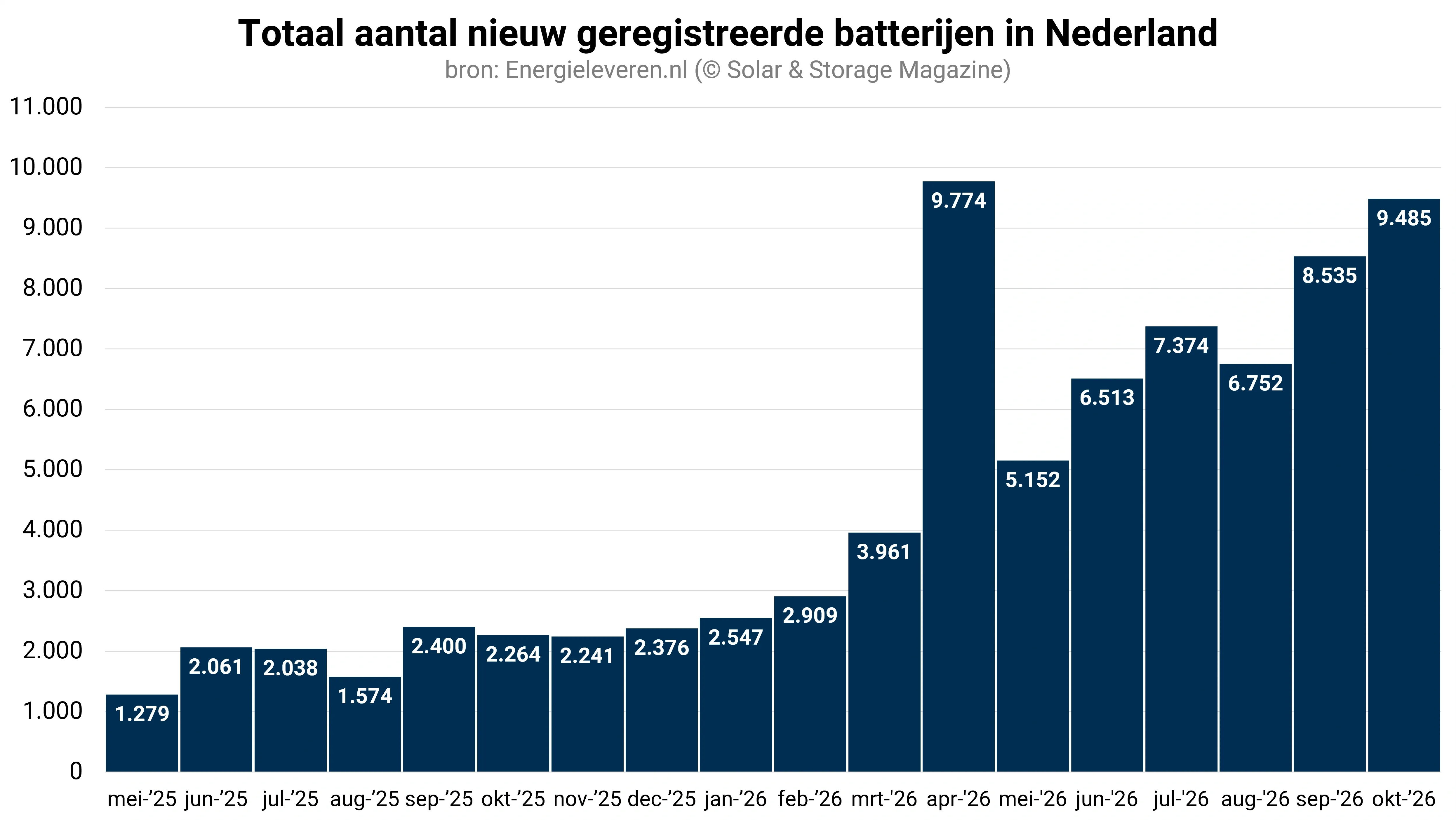
In August, the monthly number of battery registrations fell to 6,752 units due to the traditionally quiet holiday period. The strong rebound in September – with 8,535 registrations and, at that time, a monthly record – confirmed that the market is growing rapidly. The peak month of April, with 9,774 registrations, involved a one-off catch-up of Zonneplan batteries that were retroactively recorded. As the end of the netting scheme on January 1, 2027, approaches, demand for (home) batteries is now accelerating at a high pace.
63,002 new batteries
In the first 10 months of 2026, a total of 63,002 new batteries were registered with regional grid operators, more than three times the 20,596 registrations recorded across all of 2025. Of the 63,002 registrations in 2026, the largest share, 34,166 units, falls within the mid-range segment of 5 to 15 kilowatts; home batteries smaller than 5 kilowatts account for 24,617 registrations, and systems above 15 kilowatts, which are mostly commercial, total 4,219. In practice, actual numbers are higher, as enforcement of the mandatory registration requirement remains absent, and an unknown portion of installations falls outside the statistics.
Small consumers
The vast majority of registrations once again came from small consumers, a category that includes households and small businesses. In October, they registered 9,386 new batteries, more than 10 percent higher than the 8,463 registrations in September. The comparison with the same period last year is self-evident: in October 2025, small consumers registered only 2,240 new batteries, less than a quarter of the current monthly total.
New capacity
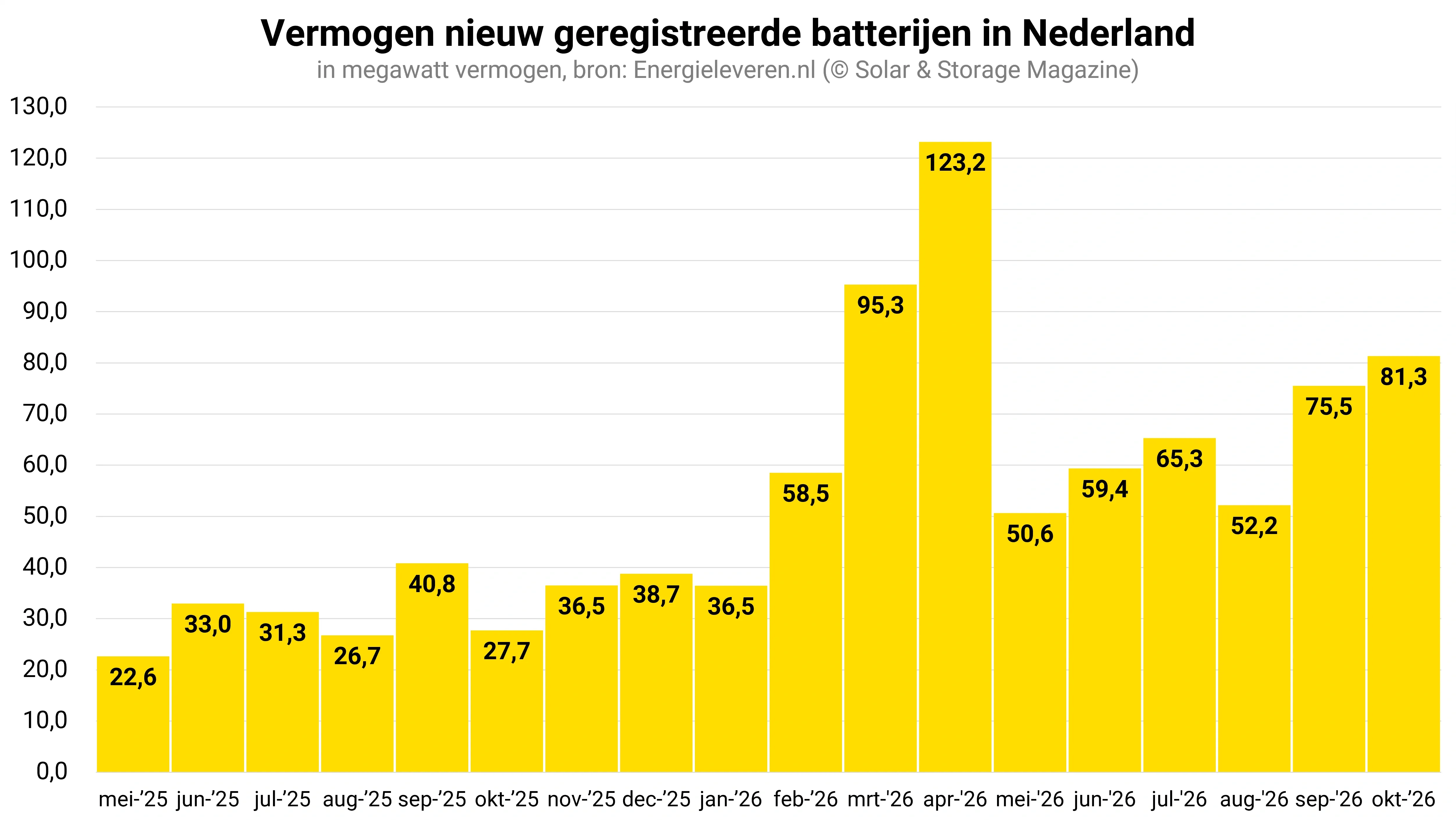
In October, the total newly registered inverter capacity reached 81.3 megawatts, an increase of over 7 percent compared to 75.5 megawatts in September. Compared to October 2025, which recorded 27.7 megawatts, the registered capacity has nearly tripled. The largest absolute contribution came from the mid-range segment of 5 to 15 kilowatts with 40.7 megawatts, followed by the commercial segment above 15 kilowatts with 28.4 megawatts, and the smallest category with 12.3 megawatts.
Year-on-year growth in capacity
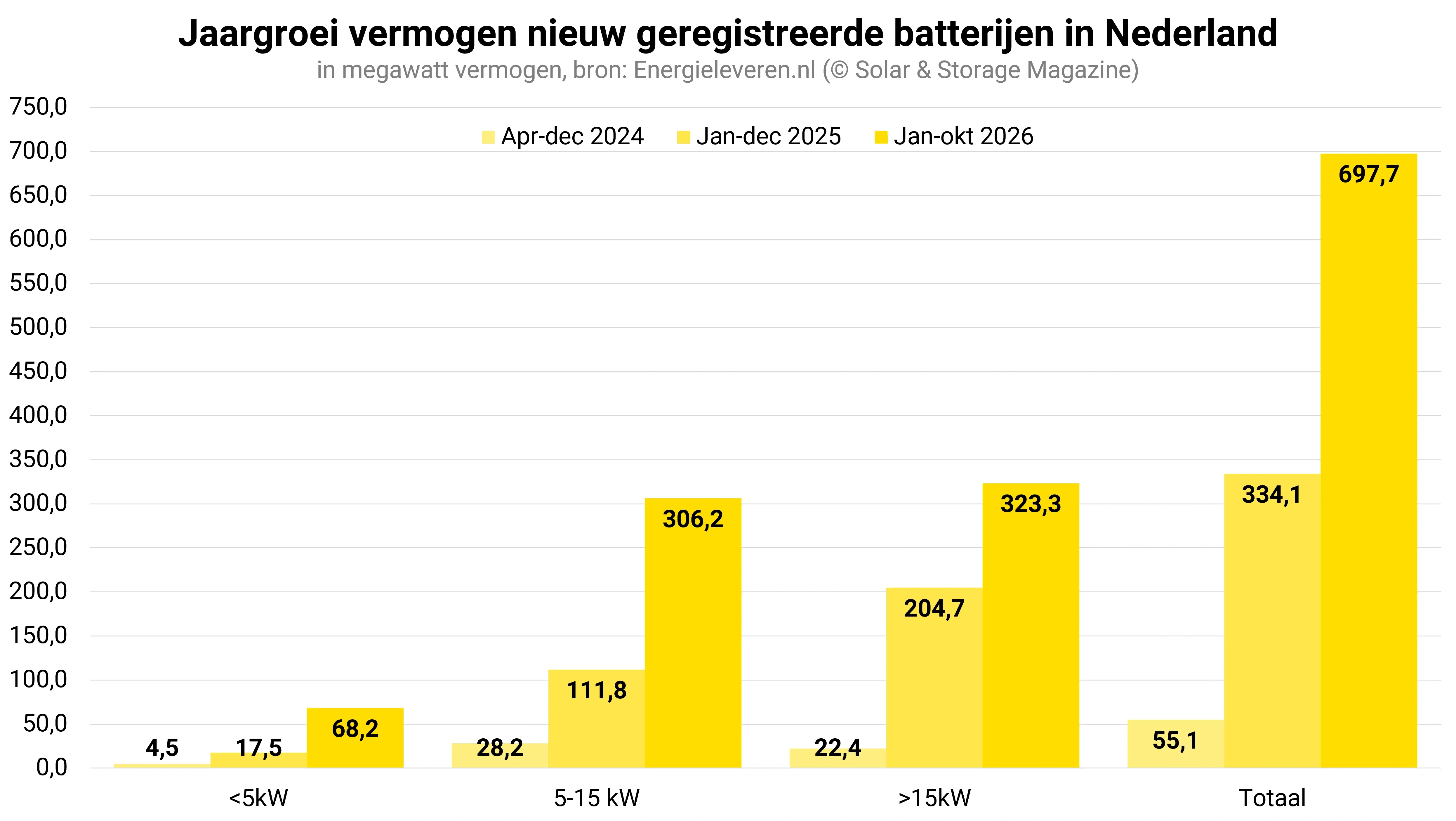
Measured in newly registered inverter capacity, the growth figures are impressive. In the first 10 months of 2026, a total of 697.7 megawatts was registered, more than double the 334.1 megawatts registered over the entirety of 2025. In terms of capacity, the segment above 15 kilowatts leads with 323.3 megawatts, but the mid-range segment of 5 to 15 kilowatts is closing the gap rapidly, reaching 306.2 megawatts. After 9 months, the difference between these segments was still 29.4 megawatts; by the end of October, that margin had narrowed to 17.1 megawatts. The segment below 5 kilowatts stands at 68.2 megawatts.
5 to 15 kilowatt
The mid-range segment of 5 to 15 kilowatt further strengthened its position in October. With 4,655 new registrations, a rise of over 13 percent compared to the 4,105 units in September, this is the largest segment in terms of volume: the 34,166 registrations in the first 10 months account for 54 percent of all registrations this year. Compared to October 2025 – when there were 1,360 batteries – the year-on-year growth is over 242 percent.
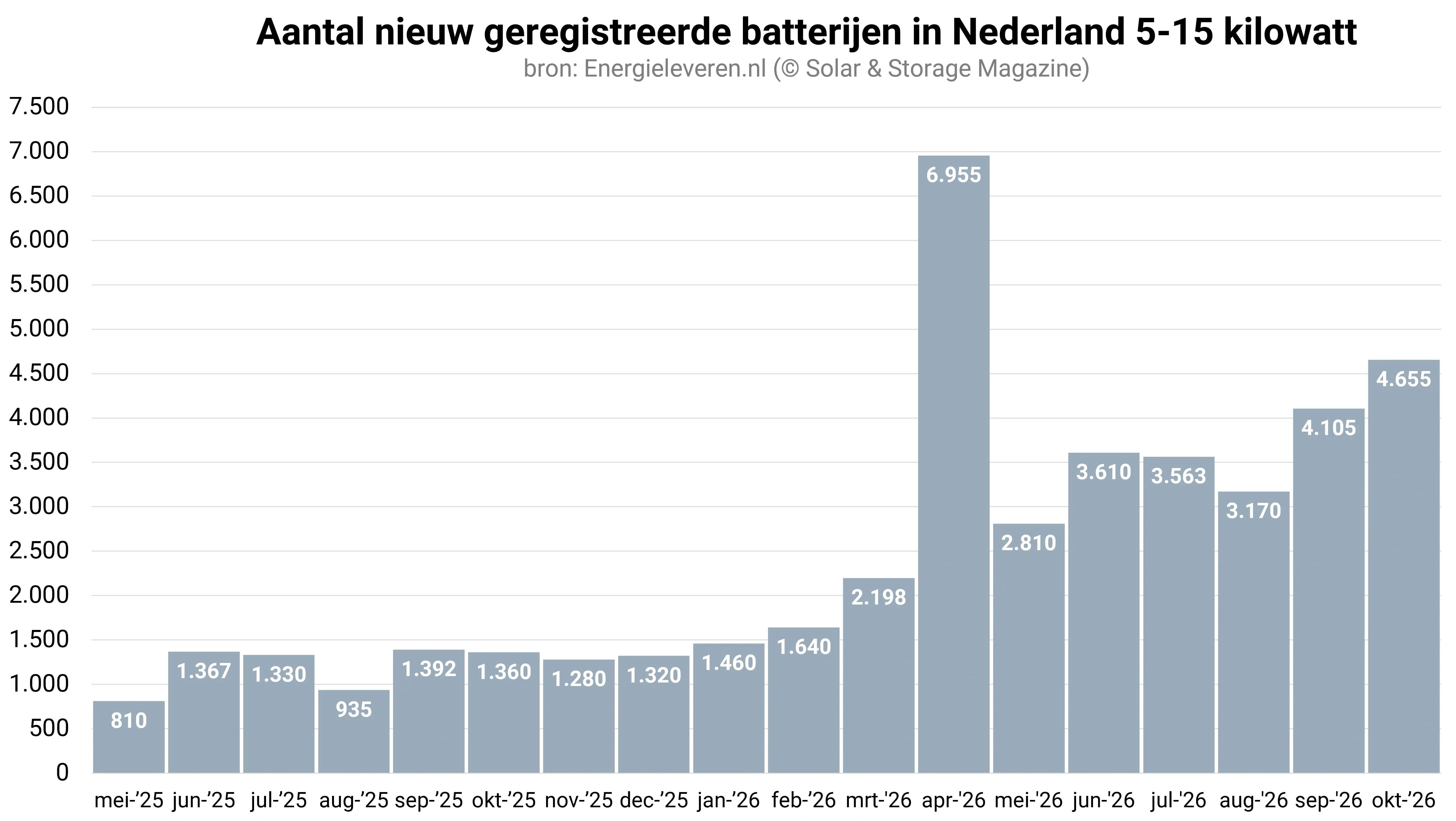
The associated inverter capacity grew from 35.7 megawatts in September to 40.7 megawatts in October – the highest monthly figure this year outside the April peak – and nearly 3.5 times the 12.2 megawatts recorded in October 2025.
Larger than 15 kilowatt
For larger energy storage systems with an inverter capacity exceeding 15 kilowatts, the number of new registrations increased from 521 in September to 649 in October, a rise of nearly 25 percent. Compared with October 2025, when there were 168 registrations, the year-on-year growth exceeds 286 percent. The associated inverter capacity remained nearly stable, moving from 28.7 megawatts in September to 28.4 megawatts in October. The combination of more registrations with a nearly unchanged total capacity indicates a higher share of smaller installations within this segment; the average registered capacity per registered battery fell from over 55 kilowatts in September to nearly 44 kilowatts in October.
Up to 5 kilowatts
In the segment of batteries smaller than 5 kilowatt – almost exclusively consumer home batteries – October set a new monthly record for this segment with 4,181 registrations. The previous record was held by September, with 3,909 registrations. Compared to October 2025 – when there were only 736 registrations – the year-on-year growth is nearly 470 percent.
The associated inverter capacity increased from 11.1 megawatts in September to 12.3 megawatts in October, also a record for this segment and nearly six times the level of October 2025, which recorded 2.1 megawatts.
Capacity versus numbers
In 2024, when grid operators began registering batteries, the mid-range segment of 5 to 15 kilowatts still dominated with 28.2 megawatts. Throughout 2025, the commercial segment above 15 kilowatts took the lead with 204.7 megawatts, nearly double the mid-range segment at 111.8 megawatts. In the first 10 months of 2026, the gap has narrowed significantly: the segment above 15 kilowatts stands at 323.3 megawatts of new capacity, while the mid-range segment is at 306.2 megawatts. Notably, the smallest battery category has also emerged: from 4.5 megawatts in 2024 to 17.5 megawatts in all of 2025, and to 68.2 megawatts in the first 10 months of 2026 – a growth of more than a factor of 15 in 2 years, making the smallest battery category the strongest grower in terms of percentage increase in capacity.
Small and large consumers
For large consumers, systems with an inverter capacity of up to 1 megawatt, 99 new batteries were registered in October. This represents an increase of over 37 percent compared to the 72 registrations in September and is the highest monthly figure since the exceptional 194 registrations in March. Compared to October 2025, which saw only 24 registrations, the year-on-year growth is over 313 percent. This segment remains a fraction of the small consumer market in terms of numbers, but commercial installations are on average significantly larger and contribute relatively more to the registered battery capacity.
On track for 100,000
The cumulative total number of batteries registered with regional grid operators reached 88,716 at the end of October. At the end of September, the figure stood at 79,231. With a monthly registration rate that has fluctuated between 8,500 and over 9,400 registrations in recent months, and no signs of demand declining as January 1 approaches, the 100,000 threshold is expected to be reached in December.
Well over 1 gigawatt
In September, the cumulative registered inverter capacity reached the 1-gigawatt threshold for the first time. By the end of October, the total stood at 1,087.2 megawatts. During October, the 1.1-gigawatt mark was also surpassed. At the current monthly growth rate, the 1.5-gigawatt threshold is expected to be reached as early as spring 2027.
Frequently asked questions
Why did battery registrations in the Netherlands hit a record high in October 2026 as the netting scheme ends?
Demand is accelerating because the netting scheme ends on January 1, 2027, prompting consumers to install storage before the rule change. October saw the highest monthly registrations this year outside the April peak, signaling a rapid market shift toward self-consumption.
How many new batteries were registered with regional grid operators in the first ten months of 2026 compared to all of 2025?
A total of 63,002 new batteries were registered in the first ten months of 2026, which is more than three times the 20,596 recorded in 2025. The mid-range segment of 5 to 15 kilowatts accounted for the largest share of these registrations.
What is the projected timeline for the cumulative registered inverter capacity to reach the 1.5-gigawatt threshold based on current growth rates?
The 1.5-gigawatt threshold is expected to be reached as early as spring 2027, given the current monthly growth rate. The cumulative capacity already surpassed 1.1 gigawatts in October, marking a significant milestone for the Dutch energy storage sector.