Quinbrook Expands Supernode to 3074 MWh LFP BESS in Queensland
The short answer
Quinbrook is expanding its Supernode battery in Queensland to 3074 MWh by late 2027 or early 2028. The project uses a pedestal system to reduce concrete costs and supports growing data center demand in the region.
Key facts
- Capacity
- 780 MW nameplate capacity upon completion of the third stage.
- Energy
- 3074 MWh total energy storage capacity upon completion of the third stage.
- Duration
- 4 hours implied by the 780 MW and 3074 MWh figures.
- Chemistry
- LFP battery units supplied by CATL.
- COD or milestone
- Third stage completion due in the December quarter of 2027 or March quarter of 2028.
- Offtaker or owner
- Quinbrook is the developer and operator of the Supernode project.
- Location
- Brendale, Queensland, Australia, adjacent to the South Pine substation.
A couple of years ago, Australia was “the runt” in terms of investment priorities for infrastructure manager Quinbrook, clearly trailing activities that span North America, the United Kingdom and include even a solar farm on the Pacific Island of Guam.
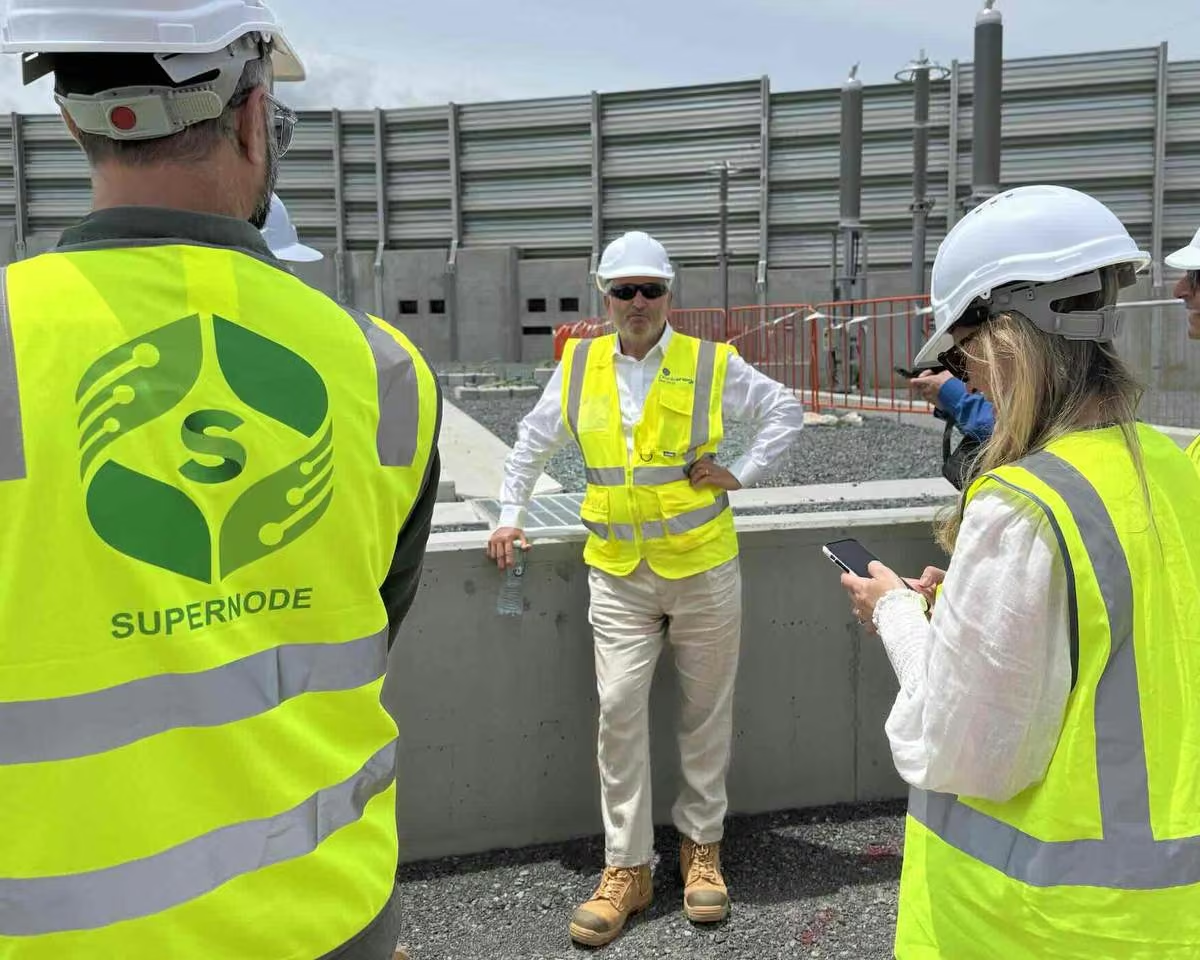
That pecking order, though, has shifted, Quinbrook founder and managing partner David Scaysbrook told journalists during a visit to the company’s Supernode battery in Brisbane, with Australia now taking equal billing with the US and Canada, combined.
One reason for Australia’s improving appeal is the imposition of heavy trade tariffs by the Trump administration, that makes solar panels about three times the price in Australia and batteries about 40% more expensive.
Another is a growing recognition of Australia’s attractiveness as a data centre investment location, underscored by mid-term elections in the US that delivered a strong swing to Democrats and revealed growing unease about artificial intelligence’s spread in that nation.
The announcement by AI giant Anthropic in September to propose a $30 billion data centre on Queensland’s Darling Downs also spurred interest from other tech firms.
“All of a sudden the phone starts to ring,” Scaysbrook says. Queensland, which has lagged New South Wales and Victoria, may soon start to close the data-centre gap.
“The good news is, for Queensland, we can power it…over time, definitely [with] 100% renewables,” he said. “[I]t can be done in a way that doesn’t leech on the grid and impact the ratepayer if it’s done responsibly.”
The Supernode site lies adjacent to the South Pine substation and switchyard, through which as much 80% of Queensland’s power can make its way. Quinbrook has the first two stages of its giant battery system operating, totalling 520 megawatts (MW) and 1858 megawatt-hours (MWh) of capacity, with a third stage of development underway and capacity for a further 520 MW of expansion.
By the completion of the third stage, due in the December quarter of 2027 or the March quarter of 2028, the nameplate capacity will jump to 780 MW and 3074 MWh.
Scaysbrook declines to let on whether Supernode might sign up a data centre partner – as implied by the uptick in interest from the US – or proceed to devote the whole site to a large battery.
“That’s the good news of the story. So that’s all I can say about that today. But more to come,” he said, adding later: “I’d hope by end of Q1 next year, we’ll know where we’re at.”
Investment, so far, is about $1.4 billion, with another $1.2-$1.5 billion possible. For context, London-headquartered Quinbrook, with offices in Houston, New York and Brisbane, has invested about $US6.9 billion ($A10.3 billion) of equity capital in 40 gigawatts (GW) of energy infrastructure assets, according to Scaysbrook’s entry on LinkedIn.
Whatever the firm’s next investment – and they are planning potentially three more supernodes with big batteries in eastern Australia – it’s likely CATL, the giant Chinese storage maker, will play a role.
At the Brendale site, Scaysbrook is keen to show off the “pedestal system” that has each of the 36-tonne battery units in containers placed on small stilts, a technique he says is world-leading.
The “quite outrageous” price of concrete was one motivation, lowering the cost. Construction was also quickened, the elevation allows easier maintenance and reduces the cost of service and the eventual rehabilitation of the site will be easier, he says.
“Quinbrook is now using this technique, that was done here first, all over the world, [for] all our battery projects in the US or the UK,” Scaysbrook said.
James Allan, Quinbrooks’ managing director, says the array of batteries placed back-to-back is also innovative. Initially, the containers “were all identical, and they have doors on the side, and we were going to have to have clearance between each single container”.
After discussions with CATL, the units are now mirror images, with facing doors, a simple idea that reduced the need for clearance and freed up space, Allan said.
Similarly, the batteries on site now have a 20-year warranty, but with technology advancing rapidly, future storage, such as the EnerQB 8-hour battery being developed by CATL and Quinbrook for future stages of the Supernode development will come with a 25-year warranty.
“There’s a common theme coming through renewables – but particularly solar and battery storage – that the industrial might of China has made these technologies not only highly effective, but really quite cheap in the grand scheme of things,” Scaysbrook said.
In addition, the 4 MW-rated storage per container has turned out, over 15 months of trails and now operation, to deliver 4.073 MW each, better than predicted.
“You build to a certain level expecting a certain number of megawatt-hours, but it’s a nice surprise when the quality of the kit is reflected in more megawatt-hours than you paid for,” Scaysbrook said.
Those incremental – and unexpected gains – are welcome, not least because the company has big ambitions to develop a renewables-storage combination that support green industries, particularly in Queensland.
A “Future Made in Australia” plan supports using clean energy to power decarbonised export industries “is good policy [but] execution has been terrible so far”.
“We believe in those fundamentals: the sunshine, the land, the port access,” he said, adding Australia also had the skilled civil, mechanical, and trade skills “that can pull it all together”.
Quinbrook’s local break came after it snapped up a cattle farm north of Brisbane in 2022 that happened to squat next to the South Pine substation, giving the battery site low transmission losses, and a relatively smooth approval process.
The location near a spur off the Queensland coast to a major international telecommunications cable running down the east coast also promotes the site’s data centre “optionality.” (One cable leaves Guam, site of the Quinbrook solar farm that helped plant that idea, as did the Sunshine Coast Counci’s decade-long effort to push for that cable spur to turn Maroochydore into a “smart city” .)
“No one ever did anything with it, and then occurred to us that, as we were getting into the whole data-centre thematic, surely at some point Queensland needs its own data-centre infrastructure,” Scaysbrook said. “If [the state’s] going to be a digital economy, surely we’re not relying on data centres that 1000s of kilometres away.”
The company is now casting its attention in the state further north, particularly in central Queensland where aluminium giant Rio Tinto plans to close its 1680 MW Gladstone power station in March 2029. That creates the need for more renewable energy generation to fill the gap, but also big batteries and even gas-powered synchronous condensers to provide grid stability and security.
“The further you go north, the more fragile the grid becomes,” Scaysbrook said, noting that Gladstone will continue to have big loads from smelters, cement and the LNG export trains. “So when that [Gladstone coal plant] comes out, the grid goes into ‘freak out'”.
“So that created an opportunity for us to, then, start planning battery storage and … replicating Supernode,” he said, referring to Quinbrook’s proposed Gladstone State Development Area (GSDA) Energy Hub Project .
Further north, around Townsville, Quinbrook’s $8 billion Project Green Poly , including a “Supernode North”, lays out an even grander vision to mine high-purity quartz, smelt it and produce polysilicon for the solar panel and semiconductor industry.
“We actually own stakes in all the quartz worth owning in the whole of north Queensland,” Scaysbrook said. “So we can vertically integrate the supply chain all the way from … the quarry, all the way through to the refining and the smelting of that into metallurgical silicon and into polysilicon.”
“[W]e can create a self-sufficient, future-made in Australia supply chain in a value-add way for the basic building blocks that we need for the cheapest form of power generation that we’re going to see in our lifetimes,” he said. “There’s nothing on the horizon that gets cheaper.”
One thing that doesn’t feature on Scaysbrook’s horizon is nuclear energy.
The Nationals – and also One Nation – have touted policies that directly threaten renewable energy and even storage, he said. Still, the issues of cost are hard to ignore.
“The reality is that nothing comes close to solar and battery storage when you put them together,” he said. “So, the best way we can keep power costs down in Australia is to support the development of large-scale solar and battery storage.”
“We are a clean energy investor, but we’re a power investor as well, and we know what new nuclear costs, and we know what new coal costs, we know what new gas costs”
As for nuclear, in particular, “it doesn’t come even remotely close” Scaysbrook said. “It’s not even worth thinking about.”
Pvola take
The shift to a pedestal system addresses concrete cost inflation while enabling faster construction and easier maintenance. This infrastructure innovation is critical for scaling long-duration storage in markets facing high data center loads. Quinbrook’s strategy positions Australia as a competitive alternative to US and Canadian sites for renewable-backed data center power.
Frequently asked questions
Why has Quinbrook elevated Australia to equal investment priority with the US and Canada?
Quinbrook now treats Australia as an equal priority due to high US tariffs and data center demand. US tariffs make solar panels three times more expensive and batteries 40% more expensive in Australia.
What is the storage capacity per container for Quinbrook's Supernode battery project in Brisbane?
The Supernode battery project features 4 MW of storage capacity per container. This configuration has been tested over 15 months to ensure reliability and performance in the Australian grid.
How do US trade tariffs impact the cost of solar and battery equipment in Australia?
US trade tariffs have made solar panels about three times more expensive in Australia. Batteries are also approximately 40% more expensive due to these trade measures, influencing investment decisions.