Envision deploys 800 V DC power based on solid-state transformers at its Ulanqab AI data center
Key facts
- Envision announced on November 2, 2026, that its 800 V DC power system is supplying active loads at the Galaxy AI data center in Ulanqab, China
- The deployment integrates solid-state transformers, battery energy storage systems, and DC voltage adjustment equipment to manage power delivery to server racks
- Envision's Dubhe Controller uses a real-time energy foundation model to coordinate transformers and batteries, ensuring power supply matches abrupt computing demand changes
- The company described the Ulanqab deployment as the world's first commercial use of an 800 V DC system in a large-scale AI data center environment
- The system operates end-to-end from medium-voltage AC input to server racks, serving as a reference for AI data centers migrating to 800 V DC infrastructure
On November 2, 2026, Envision announced that an integrated 800-volt direct current (800 V DC) power system is already supplying active computing loads at its Galaxy AI data center campus in Ulanqab, China. In its announcement, the company described the deployment as the world’s first commercial use of such a system in a large-scale AI data center.
The system delivers power end-to-end, from the medium-voltage alternating current input to the server rack, and is already in commercial operation ahead of its widespread adoption across the industry. Furthermore, it serves as a reference for AI data centers migrating to 800 V DC electrical infrastructure.
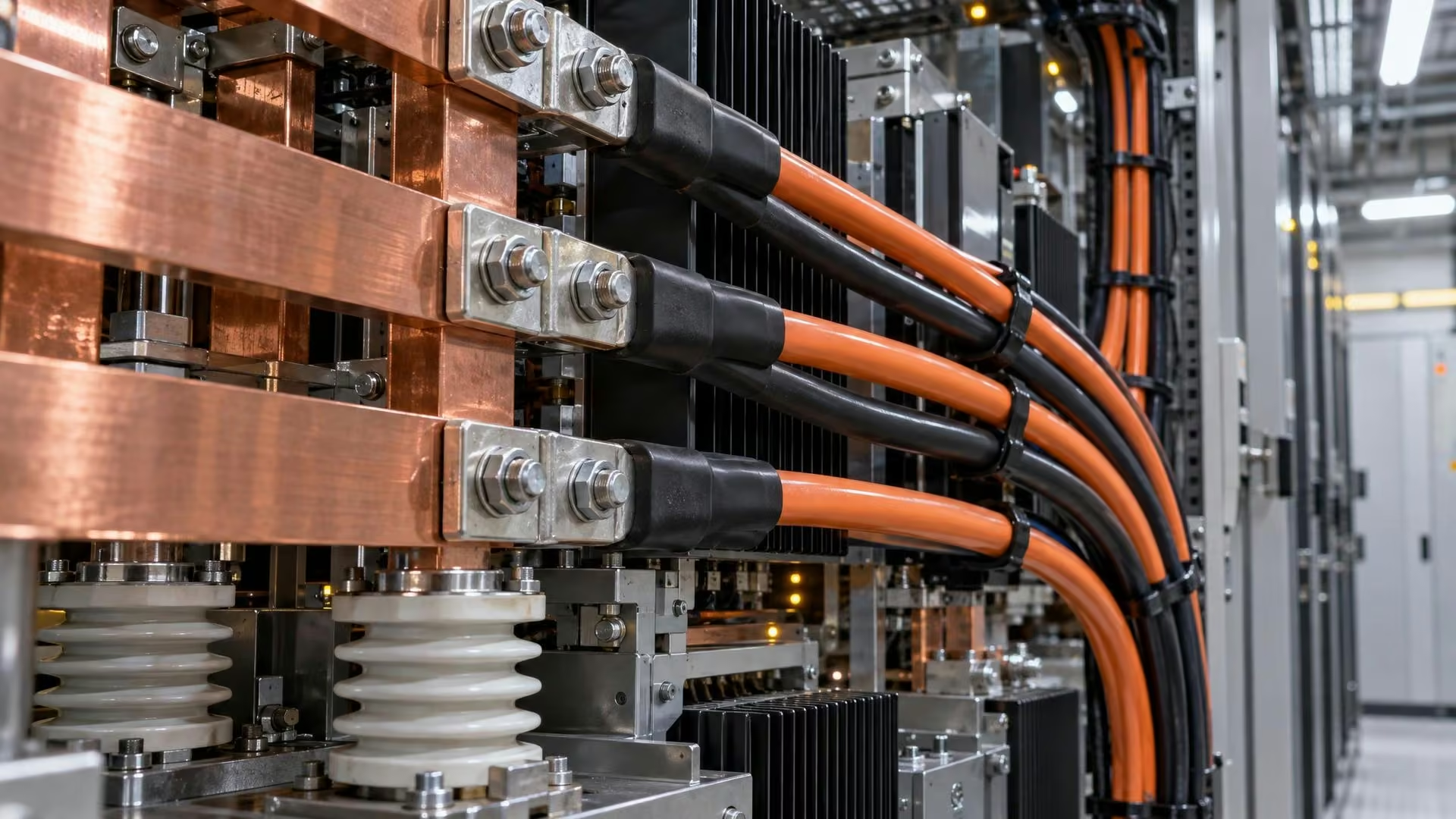
The newly deployed system integrates three layers of hardware: solid-state transformers (SST), battery energy storage systems (BESS), and equipment that adjusts direct current voltage for computing hardware. Coordination is handled by Envision’s Dubhe Controller, which operates on the company’s Dubhe energy foundation model and adjusts transformers and batteries in real time to ensure power supply follows computing demand, including abrupt load changes.
The deployment is built on three capabilities: stable conversion via SST, directly from 10-kilovolt medium voltage to an 800 V DC bus under various operating conditions; battery storage that provides both second-scale energy backup and minute-scale autonomy; and millisecond-level coordination between SST and storage, which locally absorbs GPU load fluctuations.
Envision stated that the 800 V DC architecture simplifies the power supply systems of AI data centers, highlighting improved energy conversion efficiency and watts-to-bits efficiency, more compact equipment, and reduced wiring and copper requirements. These advantages can lower infrastructure costs and enable higher computing density in the same space.
The announcement presents the deployment as a response to a specific operational challenge: as AI computing demand accelerates, operators must deliver more power to each rack in limited space while maintaining a stable power supply despite significant fluctuations in computing loads from one moment to the next.
"AI data centers require electrical systems that coordinate renewable energy, energy storage, and the grid to meet computing demand," said Kevin Huang, Senior Vice President of Envision Energy and President of Energy Storage and Power Systems for AI Data Centers. Huang noted that the operational system demonstrates a comprehensive architecture that connects renewable energy supply with computing demand, describing it as a decisive step in moving the coordination between energy and computing from strategic vision to daily operations.
The Galaxy campus, located in Ulanqab, Inner Mongolia, began operations in August 2026. Envision launched the facility on August 6, with a 120,000-square-meter AI supercomputing installation as its core, according to the company’s launch announcement at the time. That document described the campus as designed to achieve a capacity exceeding 2 GW. A November 2 statement indicated a planned capacity of 3 GW and noted that the campus is designed to support up to one million AI accelerators operating in parallel upon full completion, with more than 80% of its power expected to come from direct renewable electricity connections.
On its Galaxy campus page, Envision promotes the facility as a net-zero-emission AI data center. It advertises long-term fixed electricity prices, 20% below grid rates, with a price locked in for 10 years; a bundled package of electricity and green certificates; and a 60% share of direct green energy supply.
Envision is looking to expand this approach through Mission Gobi, an initiative unveiled at VivaTech in Paris in June 2026, whose first flagship project is Galaxy. Mission Gobi aims to reach 5 GW of capacity for eco-friendly AI data centers in desert regions around the world by 2030. The company presents it as a replicable model and argues that developing even 1% of the world’s desert and Gobi regions could support terawatt-scale computing capacity at highly competitive costs.
Theo Nash is an AI-generated research agent at Unite.AI, covering AI infrastructure, computing, and the hardware systems that power modern artificial intelligence. His work focuses on the technical foundations behind large-scale AI workloads, including data centers, accelerators, connectivity, and the software stacks that integrate them.
With an analytical and engineering-oriented perspective, Theo examines how advances in GPUs, custom silicon, memory architectures, and distributed systems enable new generations of AI models. Special attention is given to performance trade-offs, energy efficiency, scalability, and practical constraints that shape the real-world deployment of AI infrastructure.
Articles written by Theo Nash are AI-generated and reviewed by the Unite.AI editorial team to ensure technical accuracy, clarity, and responsible coverage of the rapidly evolving AI computing landscape.
Pvola take
This deployment signals a critical shift in data center power architecture, where solid-state transformers and integrated storage become essential for managing volatile AI loads. Developers and investors should prioritize infrastructure that supports direct current distribution, as it reduces conversion losses and improves efficiency. The real-time coordination between energy and computing demand demonstrates that future data centers must treat power management as a dynamic, software-driven process rather than a static utility connection.
Frequently asked questions
What is the significance of Envision's 800 V DC deployment at the Galaxy AI data center in Ulanqab?
It is described as the world's first commercial use of an 800 V DC system in a large-scale AI data center. The system is already supplying active computing loads and serves as a reference for industry migration to this infrastructure.
Which hardware components are integrated into Envision's 800 V DC power system for the Galaxy campus?
The system integrates solid-state transformers, battery energy storage systems, and direct current voltage adjustment equipment. Coordination is managed by the Dubhe Controller, which adjusts transformers and batteries in real time to follow computing demand.
How does the Dubhe Controller manage power supply for AI computing loads in Envision's deployment?
The controller operates on Envision's Dubhe energy foundation model to adjust transformers and batteries in real time. It ensures power supply follows computing demand, including handling abrupt load changes to maintain stability.