China: Orders Exceed Targets but Profits Lag, as Energy Storage Drags Down Siyuan Electric's Q3 Margins

The increasing share of energy storage products with lower gross margins in total revenue has dragged down the group’s weighted average gross margin.
Jiemian News Intern Reporter I By Zhu Qinghua
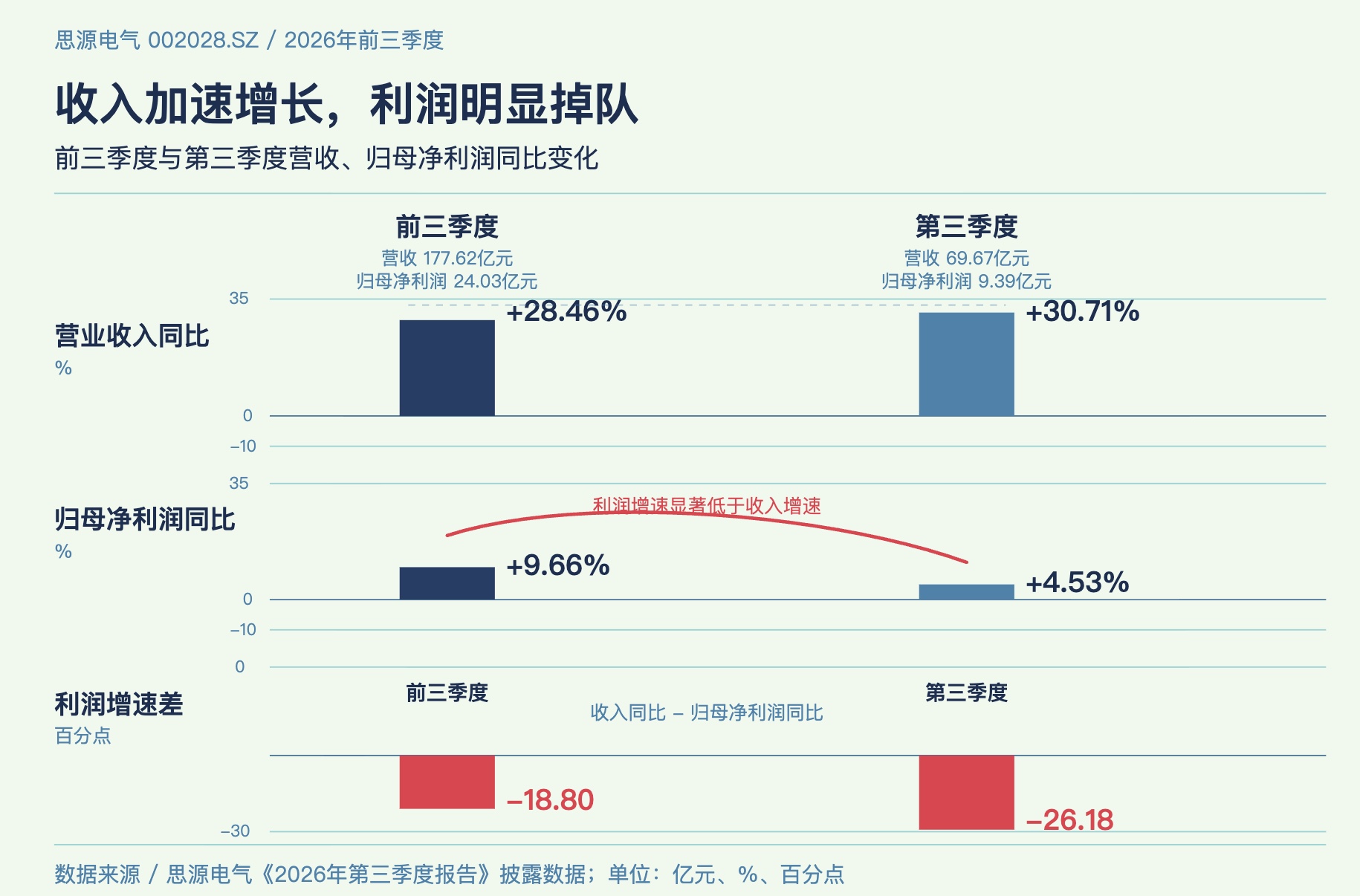
Sieyuan Electric (002028.SZ) released its third-quarter report, which showed a mismatch between the growth rates of revenue and net profit.
In the first three quarters of this year, the company achieved revenue of 17.762 billion yuan, a year-on-year increase of 28.46%; among which, third-quarter revenue was 6.967 billion yuan, up 30.71% year-on-year.
In contrast, the net profit attributable to the parent company for the first three quarters was 2.403 billion yuan, a mere 9.66% year-on-year increase; the net profit attributable to the parent company for the third quarter was 939 million yuan, with a year-on-year growth of only 4.53%.
The company stated at its earnings briefing on October 24 that, according to incomplete statistics, the year-on-year growth rate of new orders in the first nine months of this year has already exceeded the 30% full-year target set at the beginning of the year. As of the end of the third quarter, contract liabilities stood at 4.409 billion yuan, a 48.11% increase from the end of the previous year, primarily driven by an increase in customer prepayments. During the same period, inventory rose by 57.94% compared to the end of the previous year, which the company attributed to expanded business volume, advance stockpiling, and an increase in goods shipped.
In the first three quarters, Sieyuan Electric’s operating costs increased by 31.68% year-on-year, outpacing the revenue growth rate by 3.22 percentage points.
At the earnings briefing, Sieyuan Electric noted that its gross margin was 30.62%, down 1.7 percentage points from the same period last year. The company attributed this primarily to changes in its sales mix, as the share of energy storage products, which carry a lower gross margin, increased within total revenue, thereby dragging down the company’s weighted average gross margin.
Founded in 1993 and listed on the Shenzhen Stock Exchange in 2004, Sieyuan Electric’s core business covers switchgear, transformers, protection and automation systems, power electronics, energy storage systems and components, and engineering turnkey projects.
According to its semi-annual report, the company’s revenue from energy storage systems and components in the first half of this year reached 1.391 billion yuan, a year-on-year increase of 231.25%. This segment’s share of the group’s total revenue rose from 4.94% in the same period last year to 12.89%, yet its gross margin was only 10.5%.
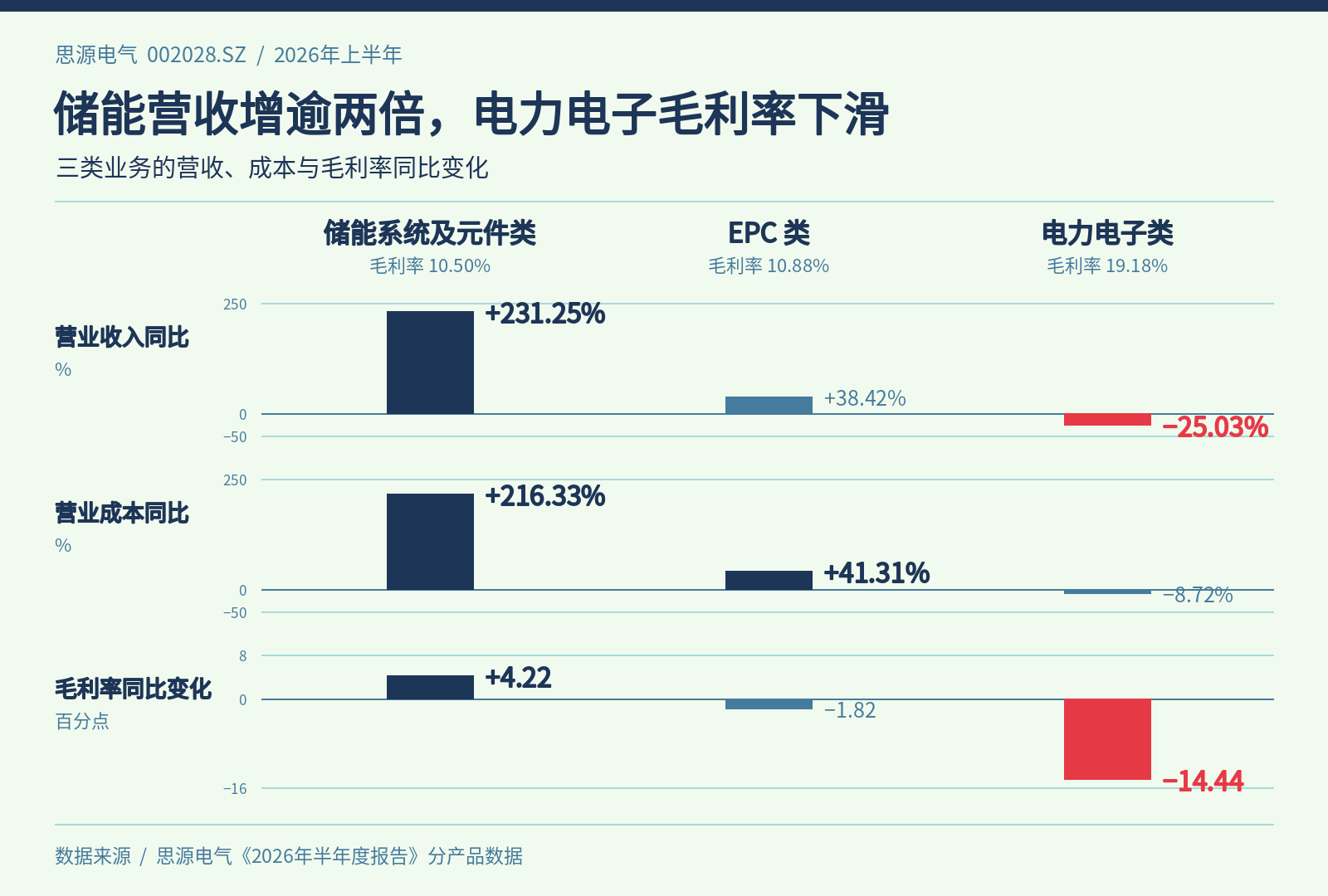
Compared with the same period last year, the gross margins of the core businesses in switchgear and transformers were 39.06% and 36.36%, respectively. Together, they contributed approximately 61% of revenue in the first half of the year, remaining the foundation of the company’s profitability.
Cells are the primary cost component in battery energy storage systems. In common lithium iron phosphate (LFP) storage cells, the cathode material uses lithium carbonate as one of its lithium sources. Rising lithium carbonate prices push up cathode material costs, which may then be passed on to cell pricing. If equipment suppliers cannot simultaneously raise project prices, gross margins will be squeezed.
According to the same set of Shanghai Metals spot prices published by China Nonferrous Metals Network, battery-grade lithium carbonate briefly exceeded 200,600 yuan per ton on May 13. The center of gravity for spot prices shifted downward in July, rebounded briefly in August and September, and then declined again.
Although prices had fallen by the end of the quarter, the average spot price for the first three quarters, as compiled by SMM, was still approximately 157,700 yuan per ton, a year-on-year increase of 121.18%.
At its earnings briefing, Sieyuan Electric stated that the decline in lithium carbonate prices in the third quarter eased pressure on cell costs. Combined with a higher share of revenue from overseas energy storage projects and the launch of products better aligned with market demand, the gross margin of station-level energy storage products improved.
In the first three quarters, the consolidated income statement recorded a loss of 60.076 million yuan from changes in fair value, a year-on-year increase of more than 11 times. The company attributed this change primarily to fluctuations in the fair value of external equity investments.
The semi-annual report showed that in the first half of the year, other non-current financial assets had already recognized a fair value loss of 62.2057 million yuan. The decrease in book value was mainly related to Jiangsu Xinyun Electronics and Shanghai Luxin Electronics.
The company stated that the operating conditions of the two investee companies had changed significantly, and they were revalued based on the company’s share of net assets and estimated recoverable amounts, respectively. By the end of the third quarter, the book balance of other non-current financial assets had decreased by 42.23% compared with the end of the previous year, remaining flat compared with the end of the first half.
Beyond valuation losses on equity investments, the timing of revenue recognition for overseas business also contributed to the divergence between revenue and profit.
Part of the inventory increase at the end of the third quarter consisted of overseas equipment that had been shipped but not yet recognized as revenue, primarily transformers and switchgear.
In the first half of this year, Sieyuan Electric’s overseas revenue was 3.183 billion yuan, accounting for 29.49% of total revenue. The company noted that, according to incomplete statistics, the share of overseas revenue in the first three quarters was slightly higher than in the first half.
In addition, foreign exchange losses and impairment losses also affected net profit. Sieyuan Electric’s financial expenses for the first three quarters were 144 million yuan, compared with -35 million yuan in the same period last year. A research report by Sinolink Minsheng Securities indicated that this was primarily driven by exchange gains and losses resulting from currency fluctuations.
In the first three quarters, the company recognized 38 million yuan in asset impairment losses and 149 million yuan in credit impairment losses, both of which increased compared with the same period last year.
Li Haoyang, an analyst at Hualong Securities Research Institute, stated in a third-quarter report commentary published on October 27 that Sieyuan Electric’s new orders continued to grow rapidly, with even more positive performance overseas. The construction of production capacity for high-end products is expected to support the company’s future order acquisition. The report also highlighted risks such as lower-than-expected grid investment, intensified industry competition, and exchange rate volatility.
Frequently asked questions
Why did Sieyuan Electric's Q3 net profit growth lag significantly behind its revenue increase despite exceeding order targets?
The mismatch resulted from a rising share of low-margin energy storage products in total revenue. This shift dragged down the group’s weighted average gross margin, causing profit growth to trail revenue expansion.
What were Sieyuan Electric's specific revenue and net profit figures for the first three quarters of 2024?
Revenue reached 17.762 billion yuan, up 28.46% year-on-year, while net profit was 2.403 billion yuan, a mere 9.66% increase. Third-quarter revenue hit 6.967 billion yuan, but net profit grew only 4.53% to 939 million yuan.
How does the decline in lithium carbonate prices impact Sieyuan Electric's future gross margins and project pricing strategies?
Falling lithium carbonate prices squeeze gross margins as project prices adjust downward. Although spot prices rebounded briefly in August and September, the overall downward trend continues to pressure profitability for energy storage projects.